
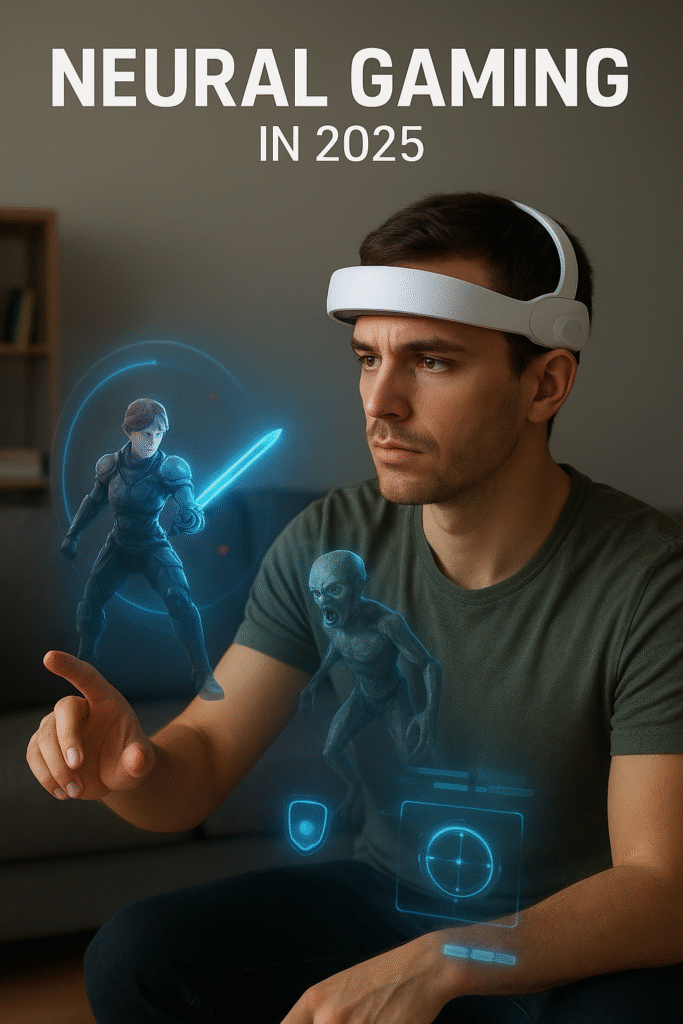
In 2025, gaming isn’t just about controllers, keyboards, or touchscreens — it’s about the mind itself.
Neural gaming — powered by brain-computer interfaces (BCIs) — is emerging as the next big leap in interactive entertainment. It’s transforming how players control, feel, and even experience virtual worlds.
For the first time ever, gamers can play using thoughts, emotions, and brain signals — no hands required.
🧠 What Exactly Is Neural Gaming?
Neural gaming is the fusion of neuroscience and gaming technology, where a BCI (Brain-Computer Interface) reads brain activity and translates it into in-game actions.
Tiny sensors capture electrical signals from your brain, sending them to the console or PC, which then interprets them in real-time.
For example:
- Think “jump”, and your character leaps.
- Concentrate harder, and your aim becomes sharper.
- Calm your mind, and your avatar regenerates health.
It’s pure sci-fi — made real.
⚙️ The Tech Behind It
Several companies are driving this revolution:
- Neuralink and OpenBCI are creating non-invasive brain sensors that read brainwaves through lightweight headbands.
- NextMind (acquired by Snap Inc.) developed neural input devices that integrate with AR/VR headsets.
- Valve, the company behind Steam, has been experimenting with brain-data integration for VR gaming.
Using EEG (electroencephalography) technology, these devices map neural activity patterns to in-game controls — merging biology and gaming seamlessly.
🎮 Gaming Without Limits
Imagine this: you’re deep inside a first-person shooter. You don’t press a trigger — you just think about firing, and it happens instantly.
No lag. No buttons. Just mind-to-game connection.
Neural gaming allows:
- Hands-free gameplay for accessibility — giving people with disabilities a way to fully enjoy gaming.
- Emotion-based responses, where your in-game world reacts to how you feel (fear, focus, or frustration).
- Hyper-immersion, where you can sense environmental feedback through neural haptics.
Some prototypes even let you feel in-game sensations, like the vibration of a car engine or the pull of a sword.
🌌 The Rise of Neuro-VR
Combine Virtual Reality (VR) with brain input, and you get Neuro-VR — the most immersive experience imaginable.
Games like MindQuest VR and Synapse Protocol (concept titles) are exploring this frontier.
In these experiences, your thoughts shape the world — puzzles unlock when you focus, or enemies weaken when your concentration spikes.
It’s no longer about playing as a character.
You become the character.
🧩 AI + Neural Data = Personalized Gameplay
AI integration makes neural gaming even smarter.
AI algorithms learn your brain patterns — detecting boredom, stress, or excitement — and adjust gameplay accordingly.
If your focus drops, the AI might slow the pace.
If you’re in flow state, it increases difficulty for greater reward.
This means every session is uniquely tailored to your mental and emotional state.
⚔️ eSports and the Brain
eSports organizations are now testing neural gaming as a performance-enhancement tool.
Players use BCIs to train focus, improve reflexes, and reduce stress.
Tournaments could soon measure neural response times instead of just hand speed.
Imagine eSports athletes competing not by physical skill — but by mental control and concentration.
It’s gaming’s new definition of “mind over matter.”
⚠️ Challenges and Ethical Concerns
Of course, there are real concerns too:
- Data privacy: brainwave data is extremely personal.
- Overstimulation: constant mental focus could lead to fatigue.
- Fairness: should neural training be allowed in competitive play?
Regulations are still catching up — but developers are working to make neural tech safer and more transparent.
🚀 The Future of Neural Gaming
Experts predict that within the next 5–10 years, BCIs will become as common as VR headsets.
By 2030, we might see fully neural-controlled games where players communicate telepathically with AI companions or other gamers in real-time.
Some futurists even believe neural gaming could merge with the metaverse, creating worlds that react to collective brain activity — an internet powered by thought.
🎯 Final Thoughts
Neural gaming isn’t just an upgrade — it’s a redefinition of gaming itself.
From controlling characters with your mind to feeling virtual worlds as if they were real, this is the next evolution of human-computer interaction.
The line between gamer and game is blurring — and soon, you won’t just play the game…
You’ll be the game.