

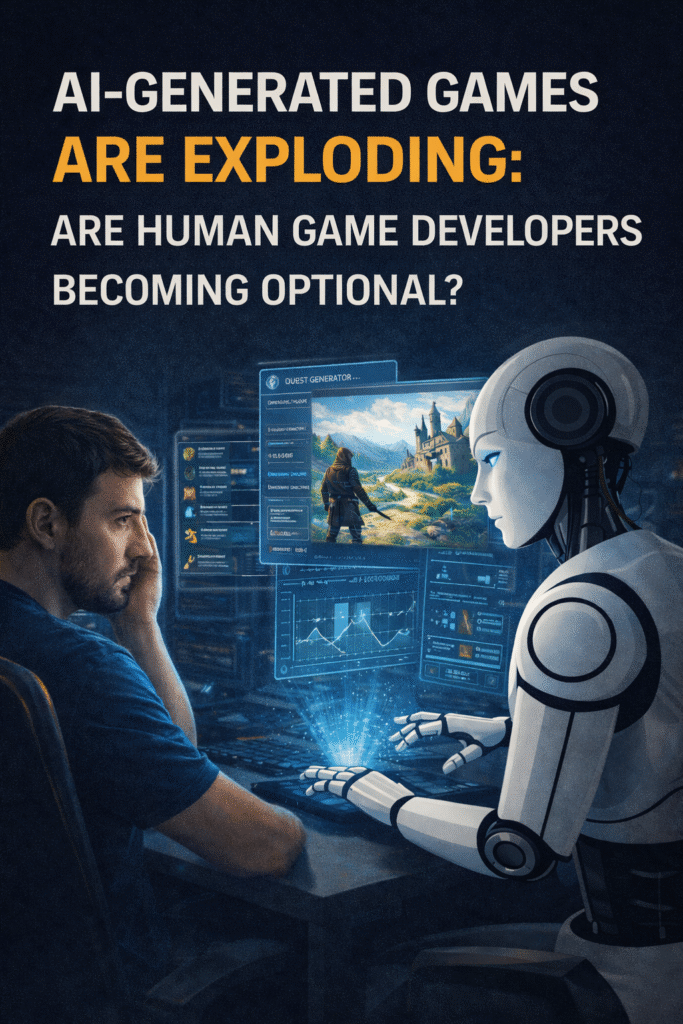
In 2025, a shocking question is spreading across the gaming industry:
What if games no longer need human developers?
Artificial intelligence is no longer just assisting game creation — it is starting to create entire games on its own. From environments and characters to quests, dialogue, music, and even bug fixes, AI is rapidly changing how games are made.
This shift is happening faster than anyone expected — and it could redefine gaming forever.
🤖 What Does “AI-Generated Games” Actually Mean?
AI-generated games are built using systems that can:
Generate game worlds automatically
Create characters, animations, and voice lines
Write storylines and branching dialogues
Design levels based on player behavior
Fix bugs and balance gameplay in real time
Instead of hundreds of developers hand-crafting content, AI models can produce playable experiences in hours — sometimes minutes.
This isn’t theory anymore. It’s already happening.
🧠 Why This Is Suddenly Trending in 2025
For years, AI tools were limited to small tasks. In 2025, three things changed everything.
First, generative AI became powerful enough to understand game logic, not just visuals. AI can now design systems, rules, and progression.
Second, cloud computing removed hardware limits. Massive AI models now run remotely, generating content on demand.
Third, player data gave AI feedback loops. Games learn what players enjoy and instantly generate more of it.
This combination turned AI from a tool into a creator.
🎮 How AI Is Changing Gameplay Itself
AI-generated games don’t feel static.
The world evolves as you play.
Quests are created dynamically.
Enemies adapt to your playstyle.
Stories change based on your choices — not prewritten scripts.
No two players experience the same game the same way.
In multiplayer and mobile gaming, this means endless replayability without massive development costs.
📱 Mobile Gaming Is Leading the AI Revolution
Mobile games benefit the most from AI generation.
Instead of shipping huge updates, developers can:
Stream AI-generated content
Adapt difficulty instantly
Create personalized events
Reduce download sizes dramatically
This is one reason mobile gaming continues to dominate global revenue — AI keeps games fresh without bloated updates.
🏆 What This Means for eSports and Competitive Games
AI isn’t just creating games — it’s shaping competition.
Training modes now adapt to individual weaknesses.
Practice bots behave like real opponents.
Maps evolve to prevent repetitive strategies.
However, this raises questions:
If AI balances gameplay dynamically, is competitive fairness affected?
Can players truly master a game that constantly changes?
eSports organizations are watching closely.
⚠️ The Controversy Nobody Can Ignore
This trend is viral because it’s unsettling.
Developers worry about job security.
Players worry about soulless, formulaic games.
Studios worry about oversaturation.
If AI can create games endlessly, will:
Quality drop?
Originality disappear?
Games lose emotional depth?
The industry is divided — and the debate is growing louder every month.
🔮 What the Future of Gaming Could Look Like
Within a few years, we may see:
AI-generated indie games flooding marketplaces
“Create your own game” powered entirely by AI
Live games that never stop evolving
Players shaping worlds permanently
Smaller studios competing with AAA giants
Game creation could become as accessible as content creation on social media.
🏁 Final Thoughts
AI-generated games are not just a trend.
They represent a fundamental shift in how games are imagined, built, and played.
The future of gaming may not be defined by:
Better graphics
Bigger maps
Higher budgets
But by one question:
Should games be handcrafted… or endlessly generated?
The answer could decide the next decade of gaming.


