
Have you noticed something strange about modern games?
They feel… smarter.
Enemies react better.
Levels feel perfectly balanced.
Difficulty adjusts without you touching settings.
That’s not luck.
It’s technology.
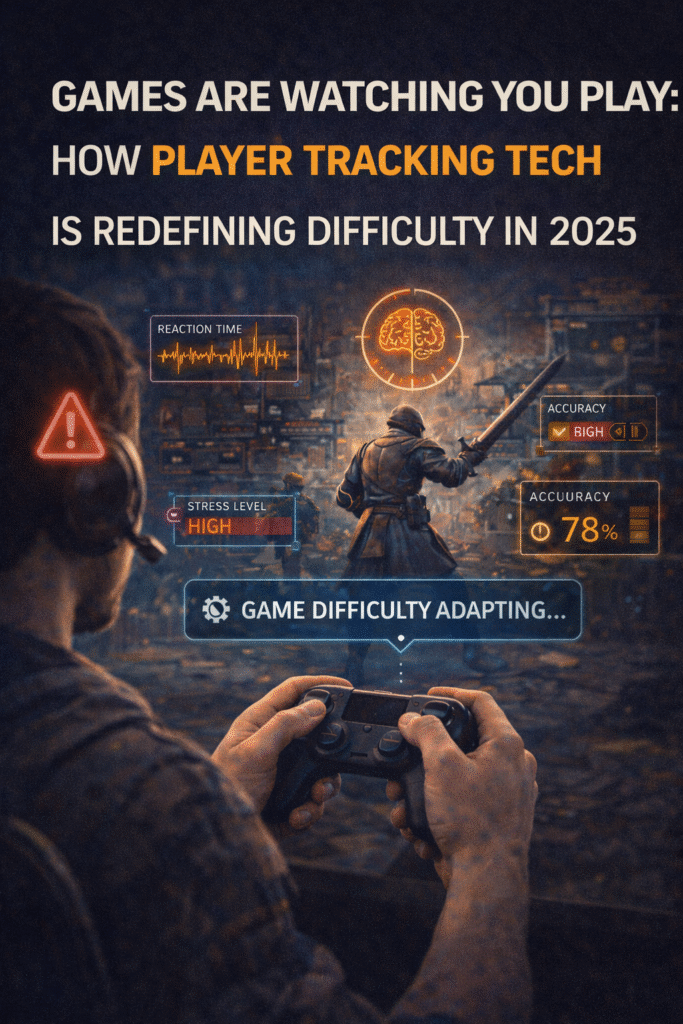
In 2025, games don’t just respond to your input — they study how you play.
👀 What “Player Tracking” Really Means
Player tracking isn’t about spying.
It’s about understanding behavior.
Modern games track:
- reaction time
- accuracy
- movement patterns
- decision speed
- failure points
- stress moments (indirectly)
This data is processed in real time to understand how skilled, cautious, aggressive, or overwhelmed you are.
The game adapts accordingly.
⚙️ Why This Became Possible Only Recently
This trend exploded in 2025 because of three breakthroughs.
First, game engines gained real-time analytics tools capable of processing player data instantly.
Second, AI models became lightweight enough to run during gameplay without hurting performance.
Third, cloud syncing allows long-term learning — the game remembers how you played yesterday, last week, even last month.
Your playstyle becomes a profile.
🎮 Dynamic Difficulty Replaces Traditional Modes
Old systems used:
Easy
Normal
Hard
Modern games don’t rely on that anymore.
Now, difficulty:
- adjusts enemy aggression
- changes spawn rates
- modifies puzzle complexity
- alters timing windows
If you struggle, the game quietly helps.
If you dominate, the game pushes back.
No menus.
No interruptions.
Just seamless adaptation.
📱 Mobile Games Perfected This First
Mobile gaming pioneered player tracking.
Why?
Because retention matters more than skill balance.
Mobile games dynamically:
- reduce difficulty after failures
- increase rewards during frustration
- adjust pacing for short sessions
Now PC and console games are adopting the same techniques — but in more subtle, player-friendly ways.
🏆 eSports and Competitive Modes Use It Differently
In competitive gaming, player tracking doesn’t change difficulty — it changes matchmaking.
Systems analyze:
- consistency
- improvement speed
- decision quality
- playstyle compatibility
This leads to:
- fairer matches
- fewer smurfs
- better team balance
Skill is measured deeper than win–loss ratios.
🔥 Why This Topic Is Going Viral
Gamers are divided — and that’s why it’s trending.
Some players love that games feel smoother and less frustrating.
Others hate the idea of “invisible assistance.”
The big debate:
Should games adapt to players…
or should players adapt to games?
Social media is full of heated discussions around “fake difficulty” vs “smart design.”
⚠️ The Privacy Question No One Can Ignore
Tracking behavior raises concerns.
Players are asking:
- What data is stored?
- How long is it kept?
- Is it shared?
- Can it affect monetization?
Transparency is becoming as important as performance.
🔮 What the Future Holds
Soon, games may:
- predict burnout before it happens
- customize tutorials automatically
- adjust pacing based on mood
- personalize entire campaigns
- adapt stories to your decisions
Games won’t just challenge you.
They’ll understand you.
🏁 Final Thoughts
In 2025, difficulty is no longer fixed.
It’s intelligent.
Games are learning who you are as a player — your habits, strengths, and limits.
The future of gaming isn’t about beating the game.
It’s about how the game reacts when it realizes
you’re about to quit… or about to master it.
And that changes everything.