
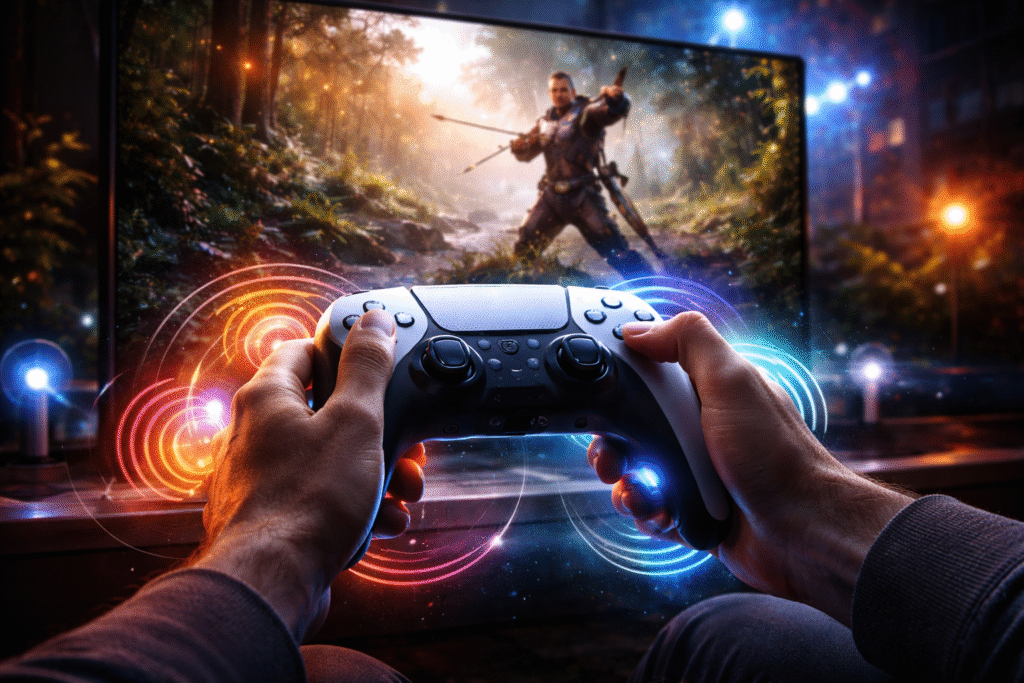
Gaming is no longer just about what you see on the screen — it’s about what you feel. One of the most exciting and viral trends in modern gaming is the rise of haptic feedback and adaptive controllers, technologies that bring a new level of physical immersion to gameplay.
From feeling the tension of a bowstring to the vibration of footsteps, gaming is becoming a fully sensory experience.
🖐️ What Is Haptic Feedback?
Haptic feedback is a technology that uses vibrations and motion to simulate physical sensations.
Instead of simple vibrations, modern haptics can create detailed feedback such as:
- The texture of surfaces
- The impact of explosions
- The resistance of different actions
- Environmental effects like rain or wind
This makes gameplay feel more realistic and engaging.
🎮 The Evolution of Controllers
Gaming controllers have evolved significantly over the years. Today’s controllers are not just input devices — they are advanced tools designed to enhance immersion.
A great example is the PlayStation 5 DualSense Controller, which introduced advanced haptic feedback and adaptive triggers.
These features allow players to feel different levels of resistance depending on in-game actions, such as pulling a trigger or driving on rough terrain.
💻 Impact on PC Gaming
PC gaming is also embracing haptic technology through compatible controllers and accessories.
Gamers can connect advanced controllers to their PCs and experience enhanced feedback in supported games.
This brings console-like immersion to PC gaming while maintaining the flexibility of keyboard and mouse setups.
🎮 Console Gaming Leads the Experience
Console gaming platforms such as:
- PlayStation 5
- Xbox Series X
are at the forefront of haptic innovation.
Developers are designing games specifically to take advantage of these features, creating deeper and more immersive gameplay experiences.
This makes console gaming more interactive and engaging than ever before.
📱 Haptics in Mobile Gaming
Mobile devices already use vibration feedback, but advanced haptics are taking this further.
Modern smartphones are beginning to simulate more detailed sensations, improving gameplay interaction.
This allows mobile gamers to experience a richer and more immersive feel, even on handheld devices.
🏆 Impact on Competitive Gaming
Haptic feedback can also influence competitive gaming by providing players with additional sensory information.
For example:
- Feeling directional impacts
- Sensing environmental changes
- Reacting faster to in-game events
However, in professional eSports, players may choose to limit haptic feedback to avoid distractions and maintain precision.
🚀 The Future of Sensory Gaming
Haptic technology is just the beginning of a more immersive gaming future.
In the coming years, we may see:
- Full-body haptic suits
- Advanced motion feedback systems
- More realistic physical interactions
Gaming is evolving beyond visuals and sound — it’s becoming something players can physically experience.
Haptic feedback and adaptive controllers are turning games into something you don’t just play… but truly feel. 🎮