
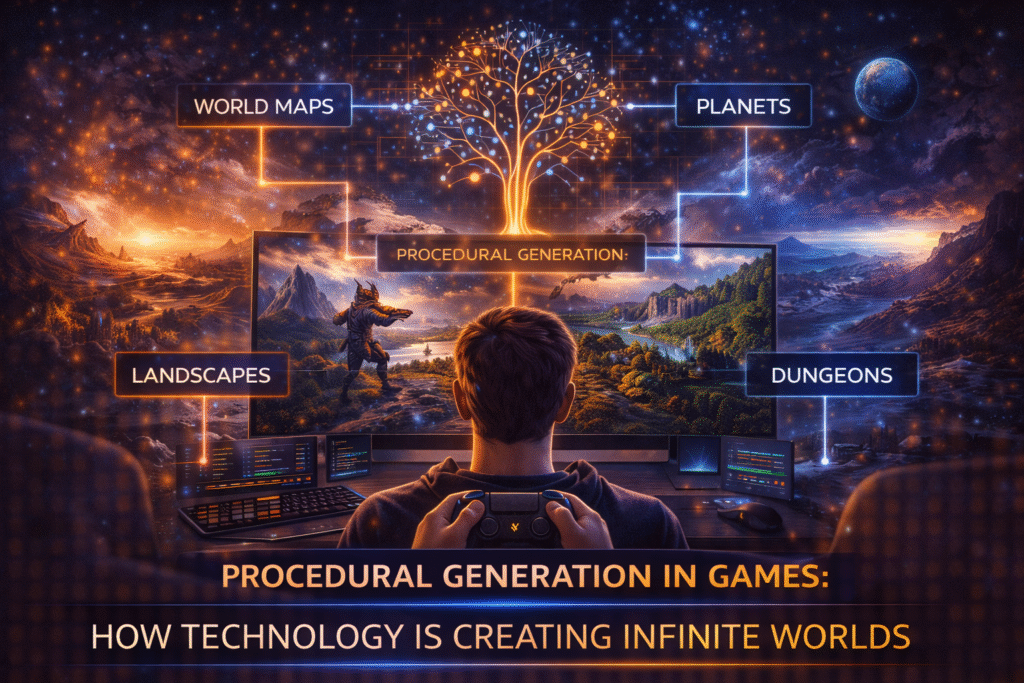
One of the most fascinating technologies transforming modern gaming is procedural generation. Instead of developers manually designing every map, level, or environment, procedural generation allows computers to automatically create massive game worlds using algorithms.
This technology is helping game developers build larger, more diverse, and endlessly replayable games — something that would be nearly impossible with traditional development methods.
🧠 What Is Procedural Generation?
Procedural generation is a technology where game content is created automatically by algorithms instead of being fully handcrafted by developers.
Using mathematical rules and randomness, a game can generate:
- Entire maps
- Landscapes and planets
- Dungeons and missions
- Weather systems
- Enemy placements
Every time the game runs, the world can be slightly different, making each playthrough unique.
💻 Procedural Generation in PC Gaming
PC gaming has been one of the biggest beneficiaries of procedural generation technology. Powerful hardware allows developers to generate extremely large and complex worlds dynamically.
A well-known example is Minecraft, where the entire world is generated procedurally. Players can explore almost endless terrain filled with mountains, caves, forests, and oceans.
Another example is No Man’s Sky, which features billions of procedurally generated planets, each with unique environments and ecosystems.
🎮 Procedural Generation on Consoles
Modern consoles like:
- PlayStation 5
- Xbox Series X
- Nintendo Switch
also support large procedurally generated environments thanks to improved processing power and storage technologies.
Developers use this technology to create larger open worlds while reducing development time and costs.
📱 Procedural Generation in Mobile Gaming
Mobile games are also beginning to use procedural generation to create more engaging gameplay experiences.
Instead of repeating the same levels, mobile games can generate new challenges every time a player starts a session. This keeps gameplay fresh and increases replay value without requiring massive downloads.
Procedural generation is especially useful for endless runner games, roguelikes, and exploration-based titles on mobile devices.
🏆 Impact on Competitive and Multiplayer Games
Procedural generation is also influencing multiplayer and competitive gaming. Randomized maps and environments ensure that players cannot simply memorize every detail of a level.
Instead, they must rely on strategy, skill, and adaptability.
This adds unpredictability to matches and keeps gameplay exciting even after hundreds of hours.
🚀 The Future of Procedural Game Worlds
As artificial intelligence and computing power continue to advance, procedural generation will become even more powerful.
Future games may feature entire galaxies, cities, or ecosystems generated in real time — each completely unique to the player exploring them.
This technology allows developers to create truly massive gaming experiences without the limitations of traditional design.
In the future, gamers may not just explore large worlds — they may explore virtually infinite ones.