
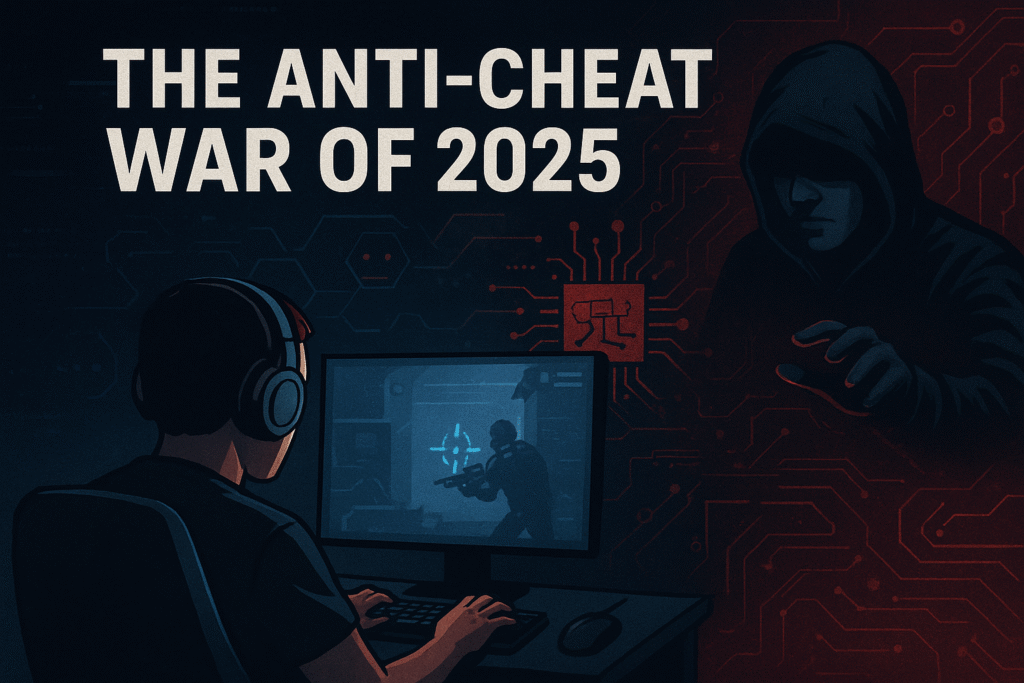
What if cheating wasn’t just a player problem anymore?
What if it became a cybersecurity war?
In 2025, gaming is no longer just about skill, graphics, or fun.
Behind every match you play,
a silent digital battle is happening.
Game developers vs hackers.
AI vs AI.
Code vs code.
Welcome to the Anti-Cheat Arms Race.
And it’s changing gaming forever.
🕵️♂️ Cheating Has Evolved — Faster Than Ever
Cheating today isn’t about simple wall hacks or basic aimbots.
It’s far more advanced.
Modern cheats now use:
AI-powered aim correction
Human-like mouse movement simulation
Screen-reading bots that don’t touch game memory
External hardware cheats like USB and DMA cards
Cloud-based cheat processing
Machine-learning scripts that adapt in real time
Some cheats literally watch the screen like a human.
No injections.
No obvious signatures.
Almost invisible.
This shocked developers.
And forced a radical response.
🧠 Kernel-Level Anti-Cheat: The New Normal
To fight back, studios pushed anti-cheat systems deeper into your operating system.
Much deeper.
Kernel-level anti-cheat now:
Starts when your PC boots
Runs before the game even launches
Monitors system behavior continuously
Detects hidden drivers and memory access
Analyzes low-level input signals
This gives developers unprecedented power.
But it also raises a serious question:
Is my game protecting fair play…
or watching everything I do?
⚔️ AI vs AI: The Real Battle Behind the Screen
The biggest twist of 2025?
Both sides are using artificial intelligence.
Developers use AI to:
Detect abnormal behavior patterns
Identify inhuman reaction times
Flag suspicious aim curves
Analyze decision-making
Track long-term behavior trends
Hackers use AI to:
Mimic human inconsistency
Randomize movement patterns
Learn detection thresholds
Adapt cheats every match
Evade bans automatically
This is no longer cheating vs protection.
This is Artificial Intelligence vs Artificial Intelligence.
🎮 Esports Is Under the Most Pressure
Competitive gaming is where this war hurts the most.
One undetected cheater can:
Destroy tournament integrity
Ruin professional careers
Cost sponsors millions
Break audience trust
As prize pools grow, cheating becomes more tempting — and more sophisticated.
That’s why esports events now rely on:
Hardware inspections
Secure tournament PCs
Private boot systems
Network monitoring
In 2025, trust is as valuable as talent.
🔥 Why Gamers Are Angry in 2025
This topic is going viral because players feel stuck in the middle.
Common complaints include:
Reduced PC performance
Privacy concerns
False bans
Always-on background drivers
System-wide monitoring
Software incompatibility
Some gamers accept this as the price of fair competition.
Others see it as overreach.
The debate is exploding across Reddit, YouTube, and social media.
🔐 The Rise of Hardware-Based Protection
To reduce privacy concerns, companies are exploring new solutions:
Secure gaming CPUs
Trusted execution environments
Encrypted keyboards and mice
Server-side validation
Cloud-based ranked matches
The goal is simple:
Protect fairness
without invading the player’s system.
But the perfect solution doesn’t exist yet.
🚀 What the Future Looks Like
By the end of the decade, gaming may include:
AI-based reputation scores for players
Hardware-certified esports systems
Cloud-only competitive modes
Input authentication for peripherals
Global cross-platform anti-cheat systems
Gaming will become more secure.
But also more controlled.
🏁 Final Thoughts
The anti-cheat war of 2025 proves one thing:
Gaming has become too big, too competitive, and too valuable to stay simple.
Every fair match you play
is protected by invisible layers of technology
fighting threats you never see.
So the next time you queue into a ranked game, remember:
You’re not just playing against other players.
You’re inside a digital battlefield of AI, algorithms, and cybersecurity.
And this war is only getting started.