
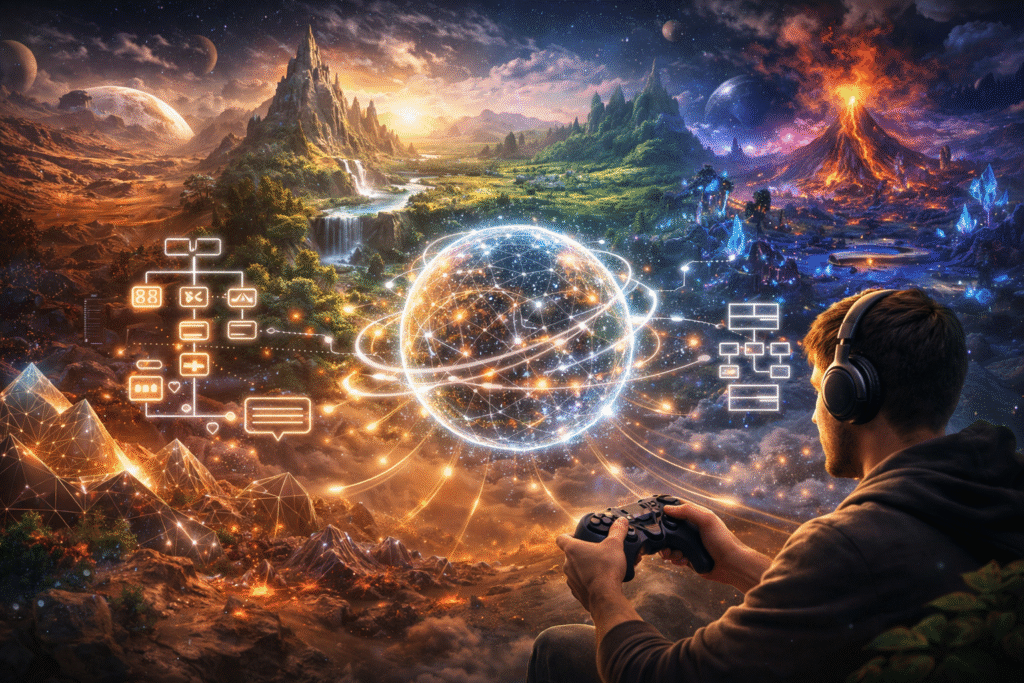
Imagine playing a game where no two players ever experience the same world. No repeated maps, no predictable paths — just endless, unique environments every time you play. This is exactly what procedural generation is bringing to modern gaming.
It’s one of the most exciting and viral trends in game development, powering massive open worlds and replayable experiences across PC, console, and mobile platforms.
🌍 What Is Procedural Generation?
Procedural generation is a technology where game content is created automatically using algorithms instead of being manually designed.
This includes:
- Maps and environments
- Missions and quests
- Items and loot systems
- Enemy placements
- Entire game worlds
Instead of developers building everything by hand, the system generates content dynamically — often in real time.
💻 Procedural Generation in PC Gaming
PC gaming has become the primary playground for large-scale procedural worlds. With powerful hardware, developers can generate vast and complex environments instantly.
Games built using engines like Unreal Engine and Unity can create detailed landscapes, dungeons, and ecosystems that feel alive.
This results in:
- Endless replayability
- Unique player experiences
- Massive open worlds without huge storage requirements
Players never truly “finish” these games because there’s always something new to explore.
🎮 Console Gaming and Infinite Content
Procedural generation is also transforming console gaming on platforms like:
- PlayStation 5
- Xbox Series X
- Nintendo Switch
With improved processing power, consoles can now support dynamically generated worlds that change every time you play.
This keeps players engaged longer without requiring constant manual content updates from developers.
📱 Procedural Worlds in Mobile Gaming
Mobile gaming is adopting procedural generation to create lightweight yet engaging experiences.
Instead of downloading large files, games generate content on the fly, saving storage space while still offering fresh gameplay.
This is especially useful for:
- Endless runner games
- Roguelike experiences
- Survival and sandbox games
It allows mobile games to feel bigger and more dynamic without heavy resource usage.
🏆 Impact on eSports and Competitive Play
Procedural generation is starting to influence competitive gaming by introducing unpredictability.
Dynamic maps and changing environments can test player adaptability, strategy, and decision-making in real time.
However, for professional eSports, fully random systems must be carefully balanced to ensure fairness and consistency.
⚠️ Challenges of Procedural Generation
While the technology is powerful, it comes with its own challenges:
- Risk of repetitive or low-quality content
- Lack of handcrafted storytelling elements
- Difficulty in balancing gameplay
- Technical complexity in design
Developers often combine procedural systems with manual design to maintain quality and creativity.
🚀 The Future of Infinite Gaming Worlds
Procedural generation is pushing gaming toward a future of limitless possibilities.
Soon, games may generate entire universes that evolve based on player actions, creating deeply personalized experiences.
Every player could have a completely unique journey — something no one else has ever seen.
Gaming is no longer just about playing a designed world.
It’s about exploring worlds that are created just for you.
Procedural generation is turning games into infinite experiences — and this trend is only getting bigger. 🎮