

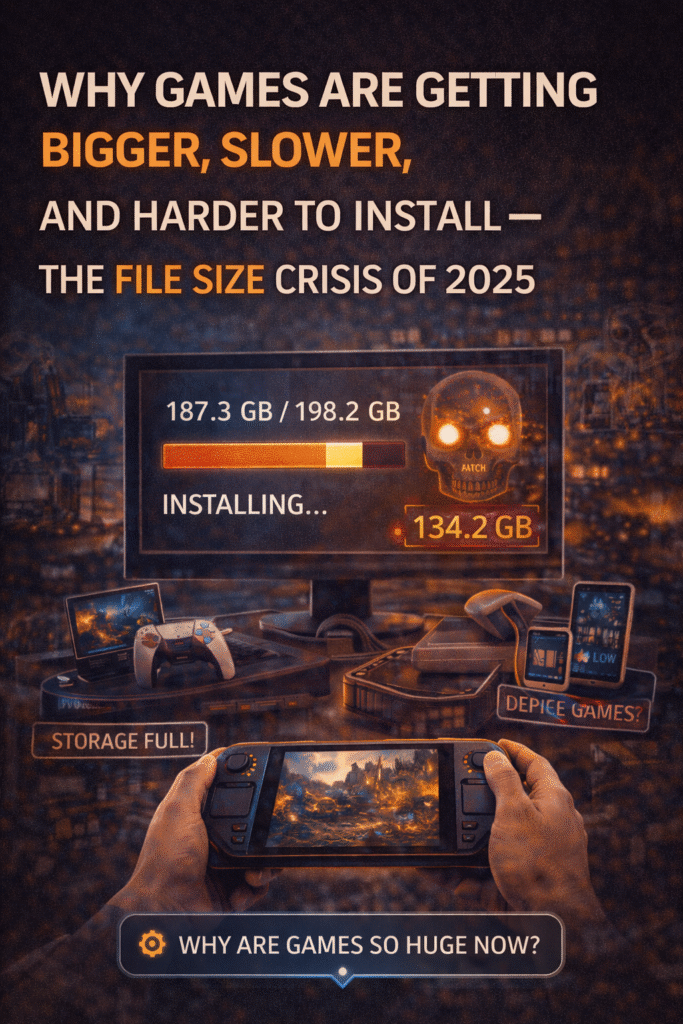
A decade ago, downloading a game meant waiting a few minutes.
In 2025, it can mean:
clearing half your storage
waiting hours for downloads
installing massive day-one patches
Some modern games now cross 150–200 GB — and players everywhere are asking the same question:
Why are games becoming so huge?
This is the story of the gaming industry’s growing file-size crisis — and how technology is both causing it and trying to fix it.
💾 Why Modern Games Take So Much Space
Game size isn’t increasing by accident. Several technologies are pushing storage requirements to extremes.
🖼️ Ultra-High-Resolution Assets
Modern games ship with:
4K and even 8K textures
high-poly character models
cinematic lighting data
photorealistic environments
Even if your screen doesn’t need them, many games still install these assets by default.
The result?
Beautiful visuals — at the cost of massive storage.
🎥 Cinematic Storytelling Is Data-Heavy
Games now rival movies in presentation.
Fully motion-captured cutscenes
multi-language voice acting
high-quality audio files
A single open-world game can contain more recorded dialogue than an entire TV series.
🌍 Open Worlds Keep Expanding
Bigger worlds mean:
more maps
more assets
more AI data
more physics interactions
Every “seamless” open world hides enormous amounts of background data.
📦 Why Patching Makes It Worse
Modern updates don’t always replace files — they often duplicate them.
So after several patches:
install size balloons
storage fragments
load times increase
Players download more… but get less free space.
📱 How This Impacts Mobile and Console Gamers
The problem isn’t limited to PC.
On consoles:
limited SSD space forces players to delete games frequently
external storage becomes almost mandatory
On mobile:
large downloads scare users away
storage limits reduce install rates
updates cause uninstall spikes
Game size is now a retention problem, not just a technical one.
⚔️ Why Developers Struggle to Fix It
Reducing game size isn’t simple.
Developers must balance:
visual quality
loading speed
hardware compatibility
development deadlines
Optimization takes time — and time is expensive.
In competitive markets, visual spectacle often wins over efficiency.
🧠 The Technologies Trying to Save Storage
The industry knows this problem is serious — and solutions are emerging.
🔄 On-Demand Asset Streaming
Instead of installing everything, games load assets only when needed.
This allows:
smaller initial downloads
faster installs
dynamic storage use
🗜️ Advanced Compression Algorithms
New compression techniques reduce file size without hurting quality.
The challenge?
Decompression must stay fast — or gameplay suffers.
☁️ Cloud-Assisted Game Storage
Some data now lives partially in the cloud.
Local storage handles core gameplay
cloud servers stream extras
This hybrid approach is gaining traction.
📉 Smarter Texture Scaling
Games are beginning to install:
only the textures your hardware can display
Lower-end systems no longer need ultra-high-resolution assets wasting space.
🔮 What the Future Looks Like
In the coming years, expect:
customizable install sizes
“install what you play” options
cloud-linked storage by default
smaller but smarter game builds
Game size will stop being a bragging right — and start being a design choice.
🏁 Final Thoughts
The file-size crisis is forcing the gaming industry to rethink priorities.
Bigger doesn’t always mean better.
Smarter design does.
In the future, the best games won’t be the largest —
they’ll be the most efficient.
And gamers everywhere are ready for that change.


