

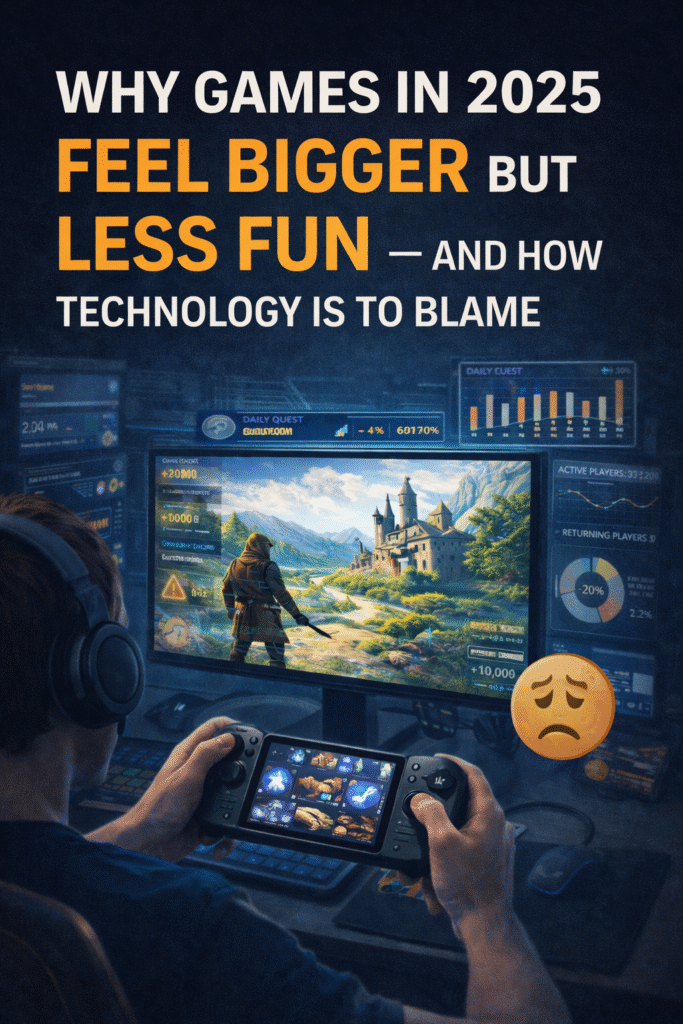
Gamers in 2025 are playing the biggest games ever made.
Bigger worlds.
Better graphics.
More realism.
Higher budgets.
Yet many players are saying something surprising:
“Games look amazing — but they don’t feel fun anymore.”
This isn’t nostalgia.
It’s a technological shift that’s quietly changing how games are built, played, and monetized.
🧠 The Era of Metrics-Driven Game Design
Modern games are no longer designed primarily around creativity.
They’re designed around data.
Every action you take is measured:
how long you play
where you quit
what you click
how often you return
what makes you spend
Advanced analytics platforms now shape game decisions in real time.
If players stop playing after 20 minutes, the game adjusts.
If a mechanic doesn’t increase retention, it gets removed.
If frustration lowers engagement, difficulty changes automatically.
Games aren’t just played anymore.
They are constantly optimized.
📊 Why Games Feel Less Risky and More Repetitive
Technology allows studios to test everything — and that creates a problem.
Risky ideas get cut early.
Unusual mechanics don’t survive testing.
Safe formulas win because they perform better on graphs.
That’s why many games feel:
predictable
over-polished
structurally similar
mechanically familiar
Innovation is replaced by iteration.
Players notice — and they’re talking about it everywhere.
🎯 Live-Service Technology Changed Player Psychology
Live-service systems dominate gaming in 2025.
These systems are powered by:
real-time updates
event-driven content
seasonal passes
daily rewards
engagement algorithms
Games are no longer designed to end.
They’re designed to hold attention forever.
This changes how players feel:
playing becomes obligation
missing days creates pressure
fun turns into routine
progress feels endless
Technology keeps players active — but not always satisfied.
🎮 Graphics Improved Faster Than Gameplay
Ray tracing, ultra-HD textures, motion capture, and realistic physics are pushing visual boundaries.
But gameplay innovation hasn’t kept pace.
Many players feel that:
worlds look alive but feel empty
controls feel familiar across games
missions repeat endlessly
mechanics change very little
Technology focused on spectacle — not interaction.
And players are starting to notice the imbalance.
📱 Mobile Gaming Accelerated This Shift
Mobile gaming perfected the science of engagement.
Retention loops
progress bars
reward timing
dopamine triggers
These techniques migrated into PC and console gaming.
What started as mobile monetization tech is now shaping AAA design.
This crossover is one reason modern games feel engineered rather than crafted.
🔥 Why This Topic Is Going Viral
Gamers aren’t angry because games are bad.
They’re frustrated because games feel designed around them, not for them.
This conversation is trending because it hits a nerve:
players feel manipulated
choice feels artificial
fun feels calculated
creativity feels restricted
Reddit threads, YouTube essays, and social media debates are exploding around this exact issue.
🔮 What the Next Shift Could Look Like
Some studios are pushing back.
We’re starting to see:
smaller focused experiences
shorter but meaningful games
player-driven systems
experimental mechanics
less data-driven creativity
Technology won’t disappear — but balance may return.
The next revolution won’t be about graphics.
It will be about trust between player and game.
🏁 Final Thoughts
Gaming technology has never been more powerful.
But power doesn’t automatically create fun.
In 2025, the most important question isn’t:
“How realistic is the game?”
It’s becoming:
“Does the game respect my time, attention, and curiosity?”
The studios that answer that correctly will define the next era of gaming.


