

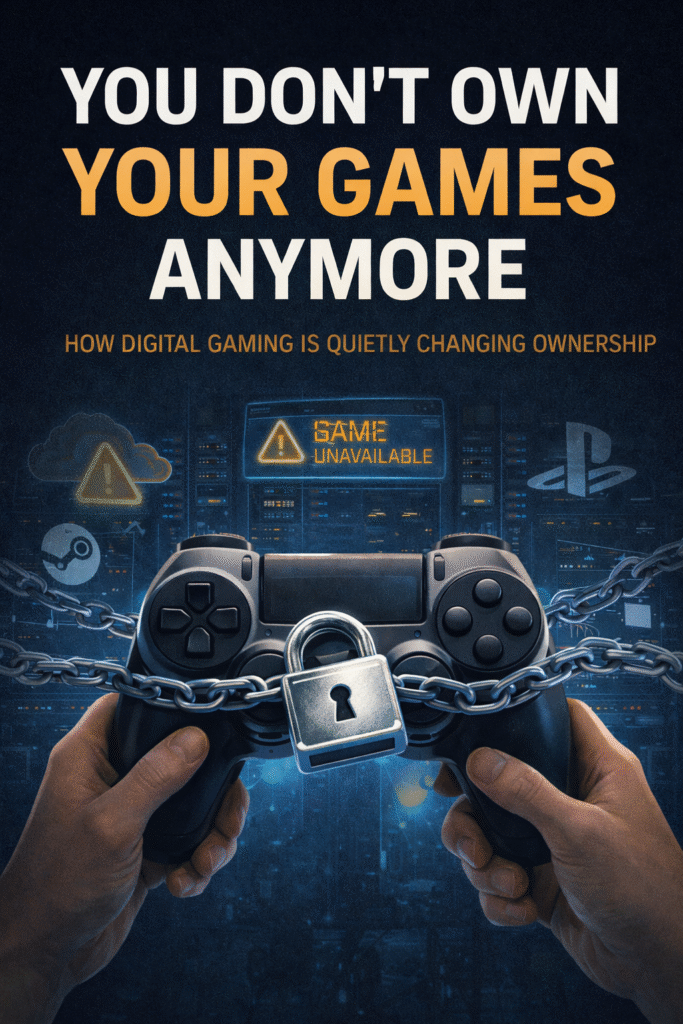
You bought the game.
You downloaded it.
You paid full price.
But in 2025, there’s a harsh truth many gamers are starting to realize:
You don’t actually own your games anymore.
Across PC, consoles, and mobile platforms, the idea of “game ownership” is slowly disappearing — replaced by licenses, subscriptions, and server dependency. And this shift is changing gaming forever.
🧾 From Game Discs to Digital Licenses
In the past, owning a game was simple.
You had a cartridge.
A CD.
A disc.
If the console worked, the game worked.
Today, most games are tied to:
online accounts
digital licenses
platform servers
always-online checks
Even physical discs often act as keys, not full games.
If servers go offline — access can disappear.
🌐 Always-Online Games: Convenience With a Cost
Many modern games require a constant internet connection, even for single-player modes.
This affects:
PC games on Steam and Epic
console titles on PlayStation and Xbox
most mobile games
Why?
Because gameplay, saves, progression, and content are now tied to online servers.
If a publisher shuts down servers, the game may become unplayable — permanently.
📉 When Games Disappear Overnight
In recent years, gamers have seen:
games removed from stores
titles shut down without refunds
servers closed with little warning
content locked behind expired licenses
This is especially common in:
live-service games
mobile games
sports franchises
online-only titles
A game can simply vanish — even if players paid for it.
🎮 Subscription Gaming Is Replacing Ownership
Subscription services are growing rapidly.
Players now access games through:
monthly plans
rotating libraries
temporary availability
While this offers convenience, it also means:
games come and go
no permanent access
no long-term ownership
Your favorite game today may be gone next month.
This model is redefining how players value games.
📱 Mobile Gaming: The Most Fragile Ownership Model
Mobile gaming is the most extreme example.
Many mobile games depend on:
online authentication
server-based progression
time-limited events
If a developer shuts down servers, the game often stops working entirely — even offline.
Millions of mobile games have already disappeared this way.
⚠️ Why Gamers Are Pushing Back
This shift is becoming viral because players are starting to ask hard questions:
Why can a game I paid for be taken away?
Why can’t I play offline anymore?
Why do single-player games need servers?
Why is ownership being replaced by access?
Online discussions, forums, and social media are filled with debates about digital rights in gaming.
🛠️ How Developers Defend the Model
Publishers argue that digital control allows:
faster updates
better anti-cheat
cross-platform saves
live content delivery
reduced piracy
From a business standpoint, it offers stability.
From a player standpoint, it feels restrictive.
🔮 What the Future of Game Ownership Looks Like
In the coming years, we may see:
more subscription-only games
shorter game lifespans
server-dependent single-player titles
digital ownership laws for games
offline modes becoming premium features
Some developers are experimenting with preservation modes, but it’s not mainstream yet.
🏁 Final Thoughts
Gaming technology is advancing faster than ever — but ownership is quietly shrinking.
Games are becoming services.
Access is replacing possession.
Servers now decide what you can play.
The biggest question for gamers in 2025 isn’t about graphics or performance.
It’s:
If a game can be taken away at any time — did you ever really own it?