
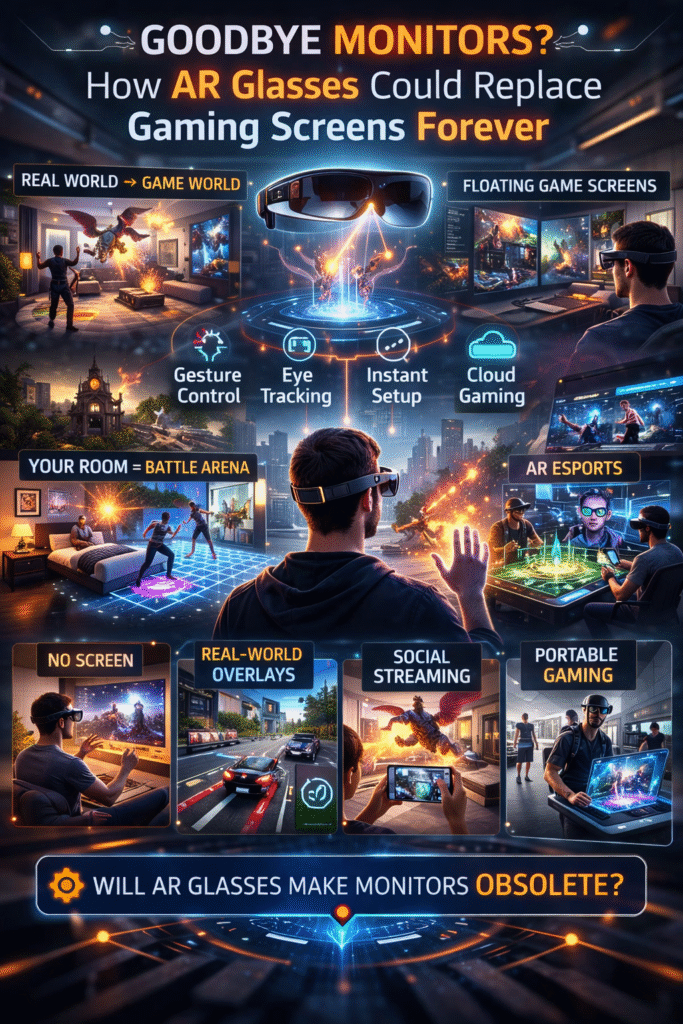
For decades, gaming meant one thing:
A screen in front of you.
TV.
Monitor.
Laptop.
Phone.
But what if the screen disappeared?
What if your entire room became the screen?
That’s exactly what Augmented Reality (AR) glasses are preparing to do.
🚀 Why AR Glasses Are Suddenly Everywhere
Major tech companies are investing heavily in lightweight AR wearables that:
- Project high-resolution visuals directly into your field of view
- Overlay digital objects into your real environment
- Track eye movement and hand gestures
- Connect wirelessly to powerful cloud servers
Unlike VR, AR doesn’t isolate you.
It blends digital and physical worlds together.
And that changes gaming completely.
🎮 Imagine Playing Anywhere
With AR glasses, your gaming setup could be:
- A floating 200-inch screen in your bedroom
- A strategy map projected onto your desk
- A racing cockpit overlay on your living room
- A life-sized boss fight standing in your hallway
No monitor.
No TV.
No physical boundaries.
Your space becomes the game arena.
🧠 The Tech Powering It
Modern AR gaming relies on:
- Spatial mapping sensors
- Eye-tracking systems
- Gesture recognition
- Low-latency wireless streaming
- AI-based environment anchoring
The glasses scan your room in real time and anchor digital objects to surfaces.
That means your desk could permanently “host” your favorite game world.
🔥 Why This Could Go Viral
AR gaming isn’t just immersive.
It’s social-media gold.
Imagine:
- Recording a dragon sitting on your sofa
- Streaming a zombie invasion in your street
- Sharing clips where your entire house transforms into a battlefield
It blurs the line between reality and content creation.
That’s powerful in a short-form video world.
⚡ Competitive Gaming Could Change Too
AR glasses could enable:
- Portable esports arenas anywhere
- Multi-screen virtual setups without hardware
- Real-world mixed tactical games
- Real-time stat overlays floating beside you
Competitive players might replace bulky setups with lightweight wearables.
Travel esports could become easier and more accessible.
🌍 The Accessibility Advantage
AR eliminates physical screen dependency.
This could help:
- Gamers in small spaces
- Players without room for large monitors
- Students or mobile users who game on the move
Gaming becomes more flexible than ever.
⚠️ The Concerns Nobody Talks About
Of course, challenges exist:
- Battery life limitations
- Eye strain risks
- Privacy concerns from constant spatial scanning
- High early pricing
And the biggest question:
Will gamers prefer physical hardware or invisible displays?
🔮 The 5-Year Outlook
In the next few years, we may see:
- AR-exclusive game titles
- Mixed reality battle royales
- Persistent digital worlds tied to real locations
- Personalized HUDs replacing traditional UI
- Entire gaming rooms designed without a single screen
Monitors might become optional.
Not obsolete overnight.
But optional.
🏁 Final Thoughts
Gaming has always moved toward immersion.
Better graphics.
Higher refresh rates.
More realism.
But AR glasses don’t just improve the screen.
They remove it.
When your walls become maps and your desk becomes a battlefield…
Gaming stops being something you look at.
It becomes something that lives around you.
The real question is:
When screens disappear…
Will you ever want them back?