
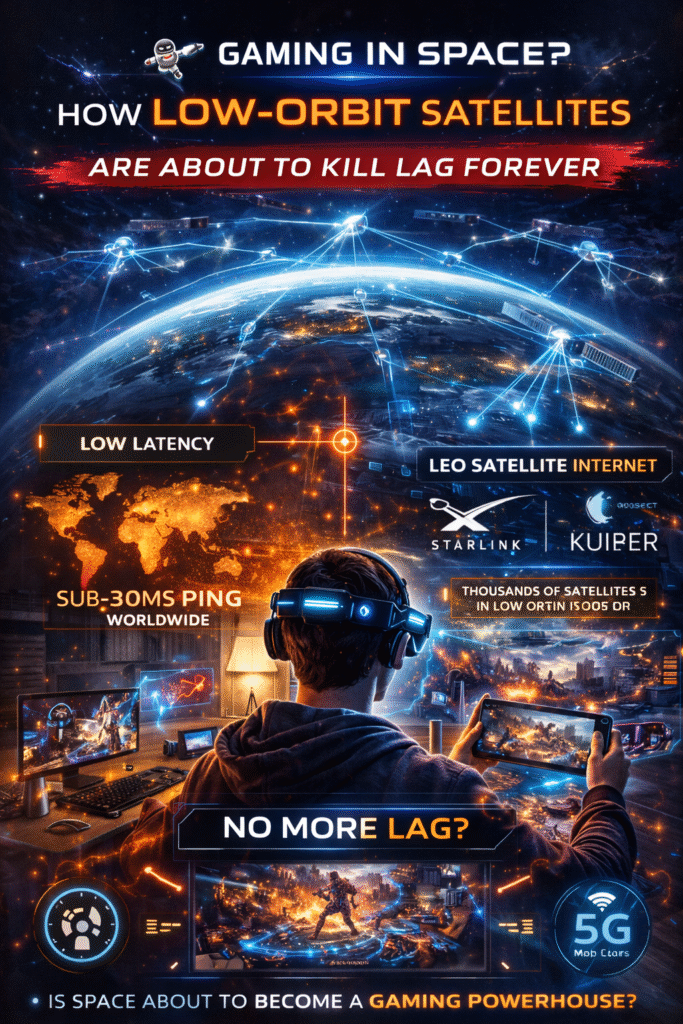
For years, one enemy has united gamers across the world:
Lag.
High ping.
Packet loss.
Sudden disconnects during ranked matches.
But what if the solution isn’t faster Wi-Fi…
What if it’s space?
Welcome to the rise of low-Earth orbit (LEO) satellite internet — and its potential to reshape competitive gaming forever.
🛰️ What Is LEO Satellite Internet?
Traditional satellite internet had one big problem:
High latency.
That’s because older satellites orbit far from Earth.
But newer systems place thousands of small satellites in low Earth orbit, drastically reducing signal travel time.
Projects like:
- Starlink
- Project Kuiper
are racing to blanket the planet with high-speed coverage.
And gamers are paying attention.
🎮 Why This Is Huge for Gaming
Low latency is everything in:
- FPS games
- Battle royales
- Esports tournaments
- Competitive mobile gaming
If satellite constellations can provide stable, sub-30ms latency globally:
Geography stops mattering.
You could live in a rural village and still compete with players in major cities.
That changes access forever.
🌍 Rural Gaming Becomes Competitive
Right now, players in:
- Remote towns
- Mountain regions
- Developing areas
often struggle with unreliable broadband.
LEO internet removes dependence on fiber infrastructure.
If it works as promised, gaming becomes equally accessible — almost anywhere with a clear sky.
⚡ The Mobile Esports Explosion
Combine:
- 5G/6G networks
- Satellite backhaul
- Cloud gaming
And you get portable competitive setups that don’t rely on wired ISPs.
This could fuel explosive growth in regions previously limited by infrastructure.
Esports may become more global than ever.
🔥 Why This Topic Can Go Viral
Because lag is relatable.
Every gamer has:
- Lost rank due to ping spikes
- Blamed the router
- Restarted Wi-Fi mid-match
- Watched their character teleport across the screen
The idea that “space internet” could fix that?
That’s headline material.
🧠 The Technical Edge
LEO satellites:
- Orbit much closer than traditional satellites
- Use laser links between satellites
- Dynamically reroute traffic
- Reduce congestion on ground infrastructure
In theory, this creates a more distributed, resilient network.
For gaming, stability is just as important as speed.
⚠️ But Is It Perfect?
There are still concerns:
- Weather interference
- Equipment costs
- Network congestion as users scale
- Regulatory limitations in some countries
And while latency is improving, it still must compete with fiber in dense urban areas.
🏆 The Competitive Future
Imagine:
- Global tournaments hosted from anywhere
- Remote training facilities without fiber
- Fully portable esports arenas
- Disaster-proof gaming infrastructure
In a world powered by satellite constellations, downtime becomes rarer.
And competitive fairness improves globally.
🔮 The Bigger Picture
Satellite-powered gaming isn’t just about lower ping.
It’s about:
- Digital equality
- Geographic freedom
- Infrastructure independence
- Always-on connectivity
Space is no longer just for rockets.
It might become the backbone of gaming.
🏁 Final Thoughts
For decades, gaming improvements focused on:
Better GPUs.
Faster CPUs.
Higher refresh rates.
But the next revolution might not happen in your PC.
It might happen above your head.
When satellites eliminate lag…
The battlefield becomes truly global.
And for the first time, skill — not location — could decide who wins.