

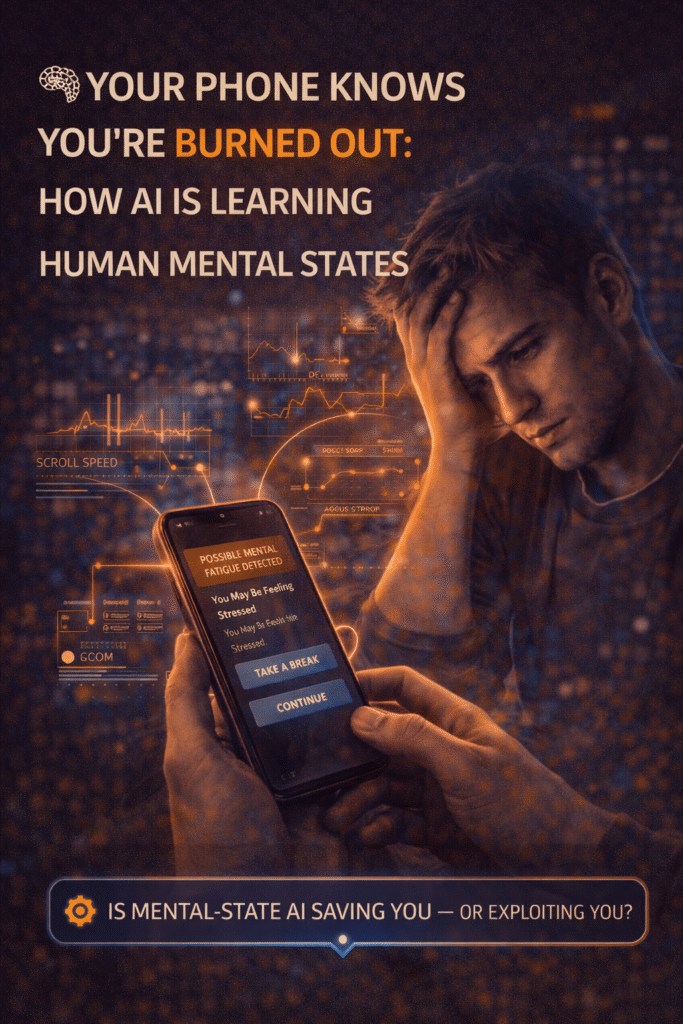
What if your phone knew you were exhausted before you did?
Not because you typed it.
Not because you searched for it.
But because it watched how you scroll, type, pause, and react.
In 2025, this is no longer theory.
AI systems are actively learning to detect human mental states — silently, constantly, and accurately.
📱 What Is Mental-State AI?
Mental-state AI analyzes behavioral signals to estimate how you’re feeling mentally and emotionally.
It doesn’t read your thoughts.
It reads your patterns.
These systems track:
typing speed
scroll behavior
pause duration
screen interaction pressure
notification response time
app switching frequency
From this, AI can detect:
stress
burnout
fatigue
boredom
focus levels
Your behavior becomes the data.
🔥 Why This Is Trending in 2025
This topic is going viral because three major shifts collided.
⚙️ AI Models Became Context-Aware
Earlier AI looked at actions.
Now it understands patterns over time.
In 2025, AI can:
spot subtle behavioral changes
detect emotional decline
learn your personal baseline
predict mental overload
This makes predictions frighteningly accurate.
📊 Big Tech Needs Engagement Optimization
Platforms don’t just want your attention.
They want to keep you functional.
If you burn out, you leave.
Mental-state AI helps platforms:
adjust content intensity
reduce notification overload
change feed pacing
optimize ad timing
Your mood directly shapes your feed.
🧑💻 Remote Work Created a New Problem
With remote work everywhere, companies lost visibility.
AI mental-state tools are now used to:
monitor employee fatigue
predict productivity drops
suggest breaks
flag burnout risks
This is both helpful — and invasive.
🎯 How This Technology Is Already Being Used
You may already be affected without realizing it.
📲 Smartphones and Operating Systems
Some systems now:
delay notifications when stress is high
reduce blue light when fatigue is detected
suggest rest instead of content
adjust screen brightness dynamically
Your phone adapts to your mental load.
🎮 Gaming and Entertainment
Games and platforms use mental-state AI to:
detect frustration
adjust difficulty
change reward timing
prevent rage quitting
The game watches how you feel — not just how you play.
🛒 Ads That Sense Your Weak Moments
This is the most controversial use.
AI can detect:
decision fatigue
emotional vulnerability
impulse-prone states
Ads may appear exactly when resistance is lowest.
This raises serious ethical alarms.
⚠️ The Privacy and Ethics Debate
This technology isn’t illegal — yet.
But big questions remain:
Should mental states be inferred without consent?
Who owns emotional data?
Can this be manipulated?
Should users be informed?
Once AI understands human vulnerability, misuse becomes easy.
🔮 What the Future Looks Like
Experts predict:
mental-state dashboards for users
AI wellness assistants
regulation on emotional data
mental fatigue ratings
content “intensity controls”
Mental health may soon become a measurable digital signal.
🏁 Final Thoughts
Your device doesn’t need your thoughts to understand you.
Your behavior tells the story.
Mental-state AI is powerful.
It can protect users — or exploit them.
The future of technology isn’t about smarter devices.
It’s about devices that understand how you feel.
And that changes everything.


