
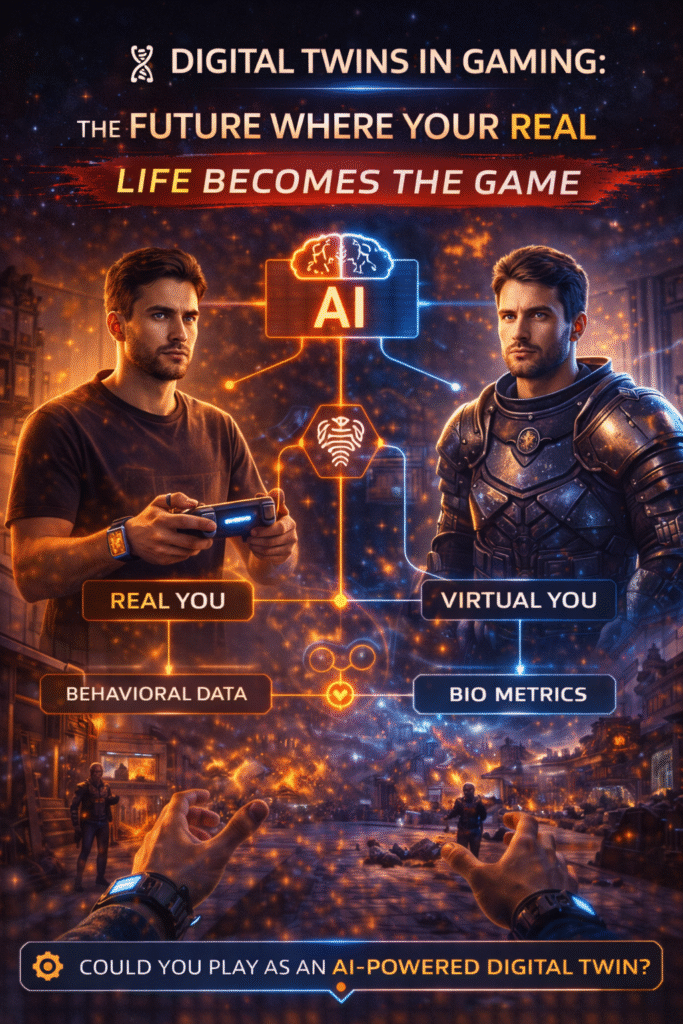
What if your in-game character wasn’t just inspired by you…
What if it was you?
Not a skin.
Not a preset avatar.
Not a custom slider build.
But a real-time digital replica powered by AI, biometrics, and behavioral data.
Welcome to the era of Digital Twins in gaming.
🧠 What Is a Digital Twin?
A digital twin is a virtual model of a real-world entity.
The concept is already used in industries like aerospace and automotive design. Companies like Siemens use digital twins to simulate machines before building them.
Now imagine applying that concept to humans in gaming.
Your movements.
Your voice.
Your decision-making patterns.
Even your stress responses.
All mirrored into a virtual environment.
🎮 How This Changes Gaming Forever
Instead of selecting “Warrior” or “Mage,” your character evolves based on:
- Your reaction speed
- Your real-world personality traits
- Your emotional responses
- Your playstyle habits
AI systems similar to those developed by OpenAI could analyze patterns over time and refine your digital twin continuously.
Every match becomes a reflection of you.
🫀 Real-Time Biometric Integration
With modern wearables:
- Smartwatches
- Fitness bands
- Heart-rate monitors
Games can already access:
- Heart rate
- Stress indicators
- Movement data
Imagine horror games increasing intensity when your pulse stabilizes.
Or competitive games adjusting AI difficulty when your focus drops.
The experience becomes reactive.
Alive.
Personal.
🌍 The Rise of Identity-Based Worlds
In multiplayer environments, digital twins could:
- Replicate your body language using camera tracking
- Mirror your voice tone and speech rhythm
- Adapt your avatar posture dynamically
Platforms experimenting with photoreal avatars, like Meta, are already pushing realism forward.
Soon, the line between physical and digital identity may blur.
🔥 Why This Topic Can Go Viral
Because it’s emotional.
Players don’t just control characters anymore.
They become them.
Viral moments could include:
- “My character panicked because I did.”
- “The boss exploited my hesitation pattern.”
- “The game predicted my strategy.”
This creates highly shareable, personal experiences.
⚖️ The Big Questions
Digital twins also raise serious concerns:
- Who owns your behavioral data?
- Can developers monetize personality profiles?
- Could predictive AI exploit player psychology?
- What happens if your digital twin outperforms you?
The technology is exciting.
But it’s powerful.
🏆 Competitive Implications
Imagine esports where:
- AI analyzes your historical behavior before tournaments
- Opponents train against simulations of your digital twin
- Teams scout players based on psychological gameplay profiles
The meta becomes deeper than mechanics.
It becomes human.
🔮 The Future Outlook
Within the next decade, we may see:
- Persistent cross-game digital identities
- AI mentors trained on your weaknesses
- VR worlds that fully mimic your physical motion
- Emotional realism built into core gameplay
Games won’t just look real.
They’ll understand you.
🎯 Final Thoughts
Gaming has evolved through graphics, physics, and online connectivity.
The next evolution may be identity.
When your digital self becomes intelligent…
When your avatar reflects your real-world behavior…
When the game adapts specifically to you…
The experience stops being just entertainment.
It becomes a mirror.
And that might be the most powerful technology shift gaming has ever seen.