

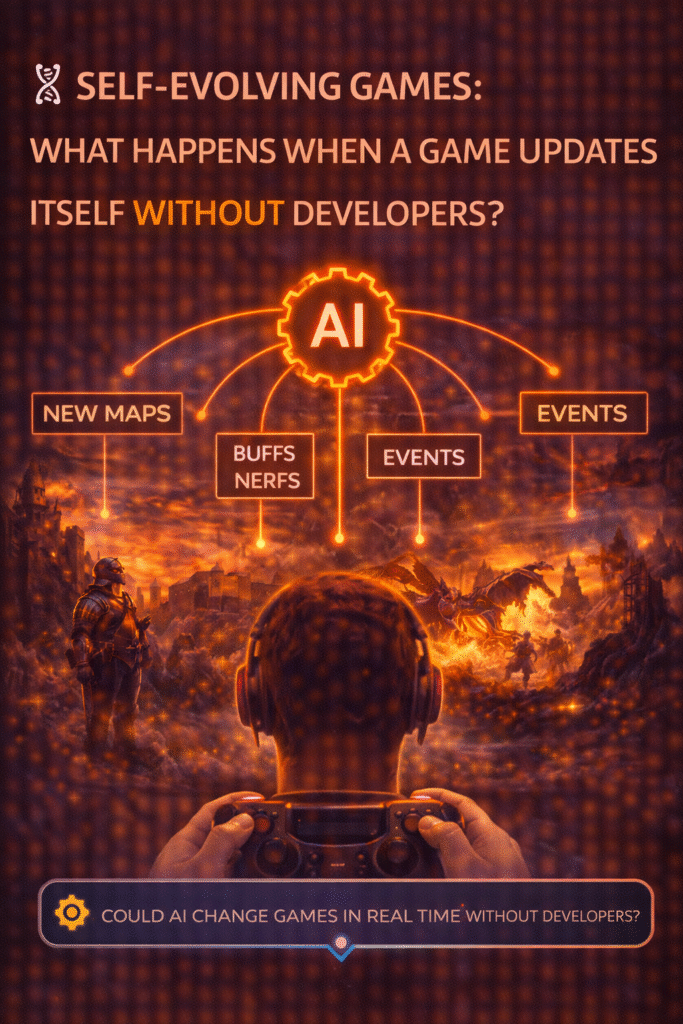
For years, games evolved through patches.
Developers made changes.
Players downloaded updates.
Meta shifted.
But what if a game could update itself?
Not once a month.
Not once a week.
But every single day.
Automatically.
Welcome to the era of self-evolving games.
⚙️ What Are Self-Evolving Games?
Self-evolving games use advanced AI systems to:
- Monitor player behavior
- Detect balance issues
- Generate new content
- Adjust difficulty
- Modify in-game economies
Without waiting for developers to manually push updates.
The game studies how it’s played — then adapts.
🎮 How This Changes Multiplayer Forever
In competitive titles, metas usually get “solved.”
Players find:
- The strongest weapon
- The most efficient strategy
- The broken mechanic
But in a self-evolving system:
The game can:
- Nerf strategies automatically
- Buff underused abilities
- Rotate mechanics dynamically
- Introduce procedural events
The meta would never stay stable.
🌍 Infinite Worlds That Don’t Need DLC
Traditional games release expansions.
Self-evolving games could generate:
- New maps based on player heat zones
- Dynamic quests from play patterns
- AI-designed characters
- Environment changes reacting to community behavior
Instead of DLC drops, the world grows organically.
No two months would look the same.
🧠 The Tech Behind It
This trend combines:
- Machine learning models
- Real-time data analytics
- Procedural generation systems
- Behavior prediction algorithms
The game becomes less like a product…
And more like a living system.
🔥 Why This Topic Is Trending
Gamers are craving:
- Endless replayability
- Dynamic content
- Unpredictable gameplay
Static games feel old faster now.
Live-service fatigue is real.
Self-evolving systems promise freshness without constant developer crunch.
⚠️ The Controversial Side
But there are risks:
- What if the AI overcorrects balance?
- Could it unintentionally create unfair advantages?
- Should players be told when the game modifies mechanics?
- Can competitive integrity survive constant evolution?
If rules change invisibly, transparency becomes critical.
Especially in esports.
🏆 Competitive Gaming in a Moving Meta
Imagine tournaments where:
- Maps evolve mid-season
- Weapon stats adapt weekly
- Strategies become obsolete overnight
It would reward adaptability over memorization.
The best players wouldn’t just master mechanics.
They’d master change.
🕹️ Single-Player Could Change Too
For solo players, AI-driven systems could:
- Detect boredom and introduce surprise events
- Increase tension when engagement drops
- Adapt story pacing dynamically
- Personalize boss difficulty
The game becomes tailored — but never repetitive.
🔮 The Long-Term Vision
In the future, games might:
- Learn from global player data
- Cross-pollinate mechanics across genres
- Develop community-shaped storylines
- Evolve differently in each region
Two players might technically own the same game…
But experience completely different versions of it.
🏁 Final Thoughts
For decades, developers controlled how games changed.
Now, games may start controlling themselves.
A self-evolving game isn’t just updated.
It grows.
It reacts.
It adapts.
The question isn’t whether technology can do this.
It’s whether players are ready for a game that refuses to stay predictable.
Because once games start evolving on their own…
There may be no going back.


