

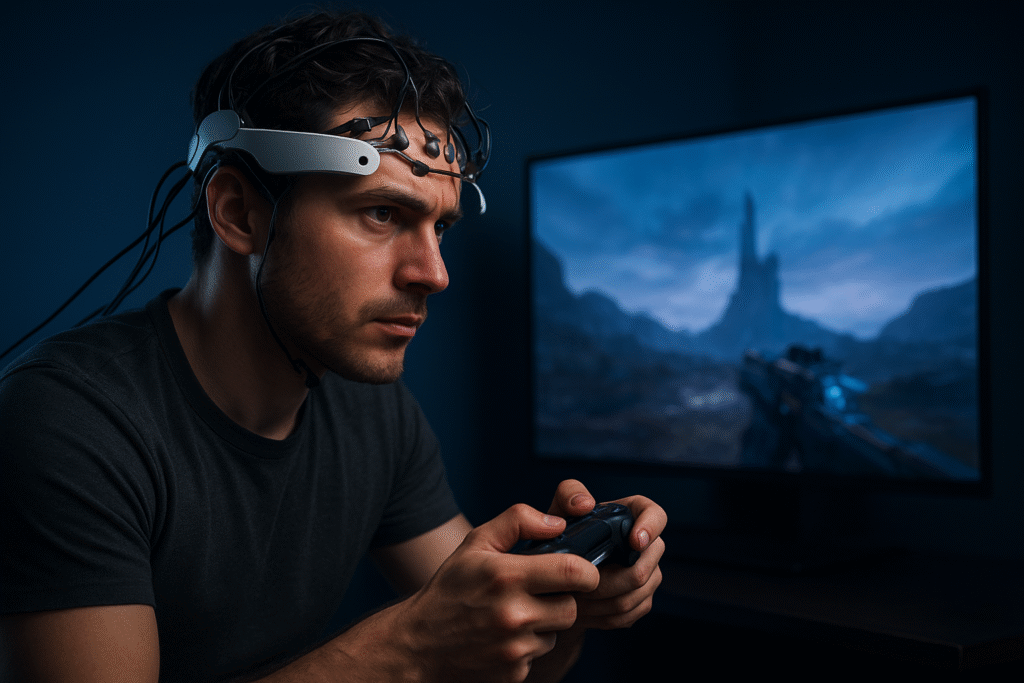
In 2025, gamers are no longer limited by controllers or keyboards. The next evolution of gaming is happening inside your head.
Neural gaming — powered by brain-computer interface (BCI) technology — is redefining how humans and machines interact.
Imagine aiming, jumping, or talking to NPCs just by thinking it.
This is no longer science fiction — it’s already happening.
What Is Neural Gaming?
Neural gaming uses BCI (Brain-Computer Interface) technology to detect your brain signals and convert them into in-game actions.
Tiny sensors or wearable headsets read electrical impulses from your brain and translate them into movement, strategy, or dialogue.
Companies like Neuralink, NextMind, and Emotiv are at the forefront of developing hardware that lets players control virtual worlds using thought patterns instead of physical inputs.
The result?
A completely hands-free, immersive experience that’s changing the way we play, create, and connect.
The Tech Behind It
Modern neural gaming works through a combination of:
- EEG Sensors (Electroencephalography): Detects neural activity from your scalp.
- AI Signal Interpretation: Uses machine learning to understand your intent in milliseconds.
- Haptic Feedback & AR Integration: Feeds real sensations back to your body for total immersion.
Games are now being designed to recognize emotions — frustration, excitement, calmness — and adjust difficulty or storylines accordingly.
For example, if your stress levels spike during a boss fight, the game might slow down slightly to keep the experience enjoyable.
PC & Console Gaming: The Next Level of Immersion
Leading gaming companies are testing BCI-compatible accessories.
PlayStation’s experimental “Project Somnus” aims to let players perform combos using focus alone, while PC gamers are using neural headsets like Emotiv EPOC X for shooter and simulation games.
Xbox is also rumored to be developing an adaptive controller add-on for neuro-inputs, letting disabled gamers play with ease.
These innovations could make gaming more inclusive than ever — removing physical barriers and letting anyone participate fully.
Mobile & VR Integration
Mobile gaming is also getting a neural upgrade.
Lightweight, wireless BCI headbands now pair with smartphones via Bluetooth, letting users control characters with minimal gestures or mental focus.
And when paired with VR headsets, the results are mind-blowing — literally.
Players can experience presence, emotion, and connection in ways never before possible.
Games in 2025 like Neura Drift and Mindfall use real-time emotional feedback to change the environment based on how the player feels — a completely personalized experience.
eSports: Mind-Controlled Competition
Neural gaming is starting to enter eSports arenas, too.
Early tournaments in Japan and South Korea feature “NeuroBattles”, where players compete using pure mental commands.
AI coaches analyze players’ brainwave data to track focus, reaction time, and decision-making speed.
It’s competitive, psychological, and futuristic — the ultimate test of mind over matter.
As this technology grows, eSports could evolve into a hybrid of mental endurance and digital reflexes.
Ethical and Creative Implications
But this new frontier also raises big questions.
- Could brain data be misused by corporations?
- Should games be allowed to read emotions?
- What happens when virtual experiences feel too real?
Developers are already discussing guidelines for privacy and ethical data use, ensuring that neural signals are kept secure and not exploited for ads or tracking.
Still, the creativity this unlocks is unmatched. Developers can now design games that respond to emotion, thought, and imagination — something no controller could ever do.
The Future of Neural Gaming
By 2030, experts predict that mind-controlled gaming will be as common as VR today.
As hardware gets smaller, cheaper, and more accurate, players could eventually plug directly into their favorite worlds without touching a button.
We may soon see multiplayer games powered by pure thought — where teamwork, emotion, and imagination are the ultimate weapons.
Final Thoughts
Gaming has always been about immersion, but neural gaming takes it to the next dimension — your mind.
It’s a blend of neuroscience, AI, and creativity that’s transforming what it means to “play.”
In the near future, gamers won’t just control the game.
They’ll become the game.


