

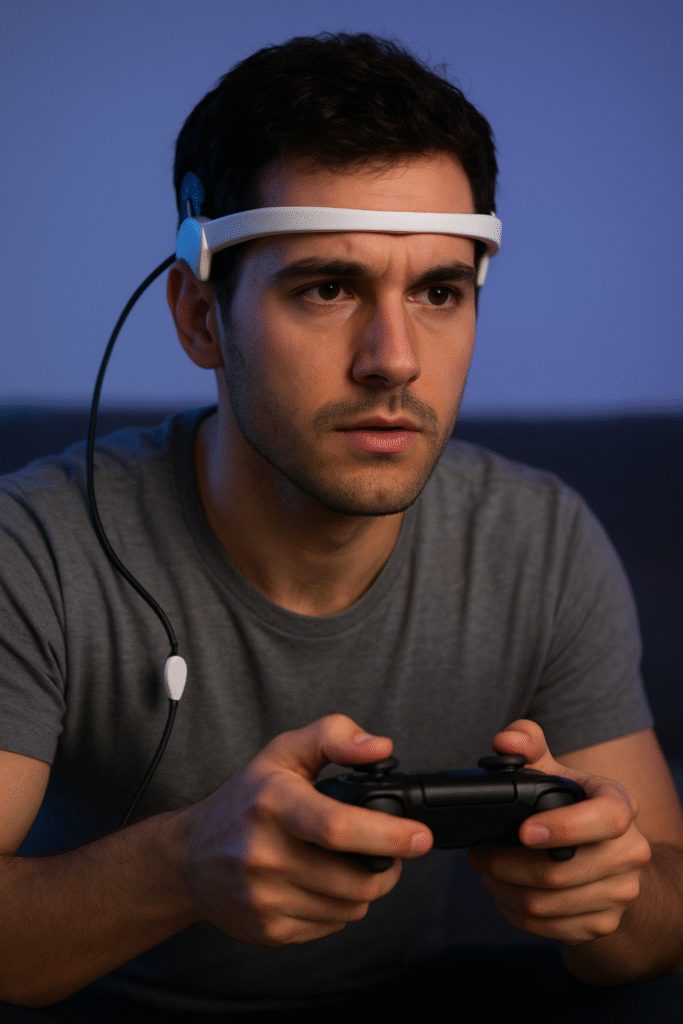
Imagine controlling a game just by thinking — no controller, no keyboard, not even a gesture.
That futuristic idea is quickly becoming reality in 2025, thanks to Brain-Computer Interfaces (BCIs) — a technology that’s blurring the line between humans and machines.
🧠 What Are Brain-Computer Interfaces?
A Brain-Computer Interface is a system that connects your brain directly to a computer. It reads the tiny electrical signals your brain produces when you think or feel, then translates them into digital commands.
In simple terms: your thoughts become your controller.
Companies like Neuralink, NextMind, and Emotiv are developing BCI headsets that can track brain activity with incredible accuracy — allowing users to move objects on screen, type messages, or play games just by focusing.
🎮 Gaming Without Hands: The New Reality
Gaming is one of the biggest testing grounds for this technology.
In early 2025, Neuralink’s latest demo showed a gamer playing DOOM Eternal using nothing but brain activity. No keyboard, no joystick — only thought patterns triggering movement and attacks.
BCIs are now so advanced they can interpret emotional states too. That means your game could automatically change difficulty when you’re stressed, calm, or focused — creating an experience that truly adapts to your mind.
Imagine a horror game that becomes scarier when your brain shows fear. That’s where we’re headed.
⚡ The Tech Behind It
Modern BCIs use a mix of:
- EEG (electroencephalography) sensors that detect brainwaves.
- AI algorithms to translate signals into real-time actions.
- Machine learning that adapts to each user’s unique brain pattern.
Some even use non-invasive headbands (no surgery needed) that sync wirelessly to your PC, console, or VR headset.
The most advanced ones — like Neuralink’s implant — can record activity from thousands of neurons simultaneously, creating millisecond-level control.
🌐 The Rise of “Neurogaming”
A new industry is forming around this concept — Neurogaming.
Developers are already experimenting with games that:
- Let you move objects or characters using concentration and focus.
- Measure excitement levels to adjust music or lighting.
- Reward calmness, focus, or creativity — turning mental control into gameplay mechanics.
For eSports players, BCIs could mean reaction times faster than any human could achieve naturally. Imagine a world where mental agility is as important as hand-eye coordination.
🧩 Beyond Gaming: The Human Upgrade
While gamers are leading the charge, the tech’s impact goes far beyond entertainment.
BCIs are helping paralyzed patients control prosthetic limbs, communicate through thought, and even regain movement.
The same breakthroughs that help patients walk again are now being refined to help gamers play better, faster, and more intuitively than ever.
We’re witnessing the birth of a cyborg generation — humans enhanced by neural technology.
⚠️ The Challenges
Of course, connecting our brains to computers isn’t without risk.
- Privacy: Who owns your neural data?
- Security: Could someone “hack” your thoughts?
- Ethics: What happens when the line between mind and machine disappears?
As the technology evolves, regulators and ethicists are racing to create rules that keep BCI development safe and fair.
Still, one thing is clear — there’s no turning back.
🚀 The Future of Gaming (and Humanity)
By 2030, experts predict that BCI-enabled gaming will be mainstream.
Imagine multiplayer shooters where players communicate silently through brain signals.
Or RPGs that read your emotions to tailor storylines.
Or even competitive leagues where mental strength replaces mechanical skill.
The controller era is ending.
The mind-control era has begun.
🧠 Final Thoughts
Brain-Computer Interfaces aren’t science fiction anymore — they’re the next great leap in both technology and humanity.
What started as a medical miracle is evolving into the ultimate gaming revolution — one that could redefine what it means to play, compete, and even think.
In 2025, gamers aren’t just players.
They’re becoming cyborg pioneers.