

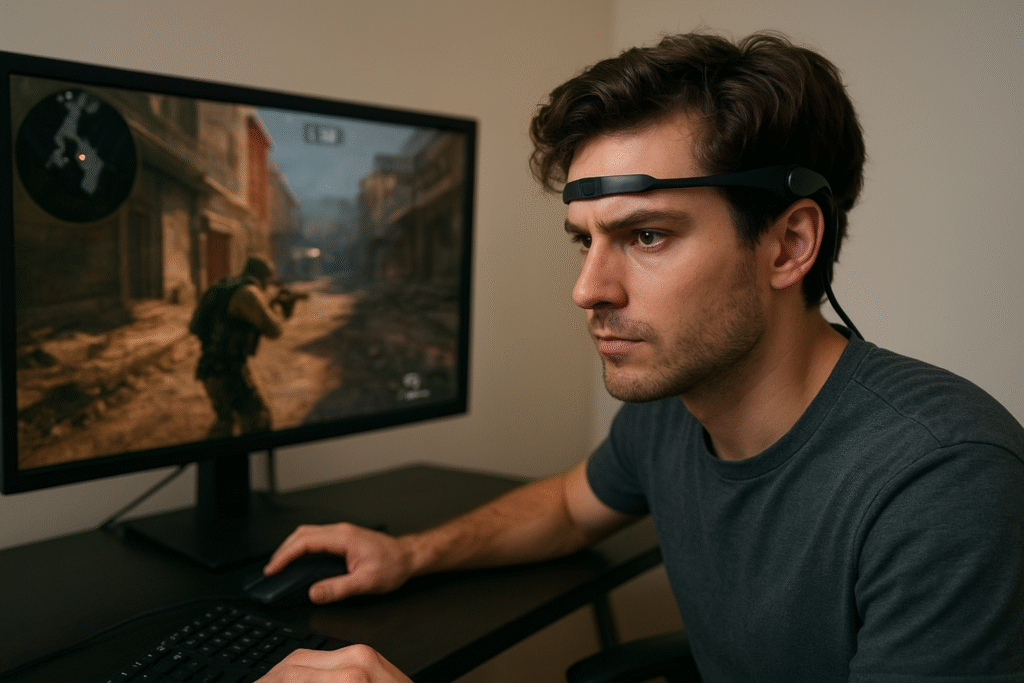
Imagine winning a match in Call of Duty without touching a controller.
Or casting spells in a fantasy game just by thinking the command.
Sounds like sci-fi?
In 2025, it’s real — and it’s redefining how humans interact with games.
Welcome to the world of Brain-Controlled Gaming, powered by neural interfaces and AI-assisted thought recognition.
🧠 What Is Brain-Controlled Gaming?
Brain-controlled gaming (BCG) uses neurotechnology — sensors that read brain signals — to let players control gameplay with their mind.
These systems use EEG (electroencephalography) or non-invasive neural sensors to pick up tiny electrical impulses from the brain.
Machine learning models then translate these impulses into commands — move, aim, shoot, jump, or even emote — inside the game.
In short: your thoughts become your controller.
⚙️ The Tech Behind It
2025 has seen massive leaps in brain-computer interfaces (BCIs). Companies like Neuralink, Emotiv, and NextMind are leading the charge.
- Neuralink’s N1 chip (FDA-approved in 2024) allows limited consumer testing in gaming environments.
- Emotiv’s MN8 headset uses non-invasive sensors — no surgery, just a wearable headband — already integrated with Unity and Unreal Engine.
- Valve’s secret project “NeuroPlay” is rumored to bring brain input compatibility to Steam VR by late 2025.
Combined with AI-driven intent prediction, these systems learn your playstyle over time — predicting what you want to do before you even press a button.
🎮 How Games Are Adapting
Developers are designing new types of gameplay built specifically for brain input:
- Reaction-based shooters where thought commands fire milliseconds faster than controller presses.
- Strategy games that read concentration levels and adjust difficulty dynamically.
- Immersive story titles where emotional responses (stress, calm, excitement) change how NPCs behave toward you.
Even traditional games like Fortnite and Valorant are experimenting with BCI-supported assist modes that detect fatigue or focus loss during long sessions.
🌍 Why Gamers Are Excited
- Accessibility Revolution – Gamers with physical disabilities can play without relying on controllers.
- Speed Advantage – Neural input is faster than finger response time — potentially changing eSports forever.
- Immersive Gameplay – Games are becoming experiences that read you — your focus, emotions, and engagement — in real time.
Players describe it as “feeling like the game reads your mind.”
🏆 Brain vs. Reflex: eSports Enters a New Era
BCG isn’t just for casual players — it’s entering competitive gaming.
eSports teams in Japan and South Korea are testing “Neuro Training Programs” to measure focus and reduce burnout.
Some events are even experimenting with hybrid tournaments, where one player uses a controller and the other uses brain input — a completely new skill battle.
Analysts predict a “Neuro League” by 2027 — an entire eSports circuit built around mental precision rather than manual dexterity.
⚠️ Challenges & Ethical Debates
As revolutionary as it sounds, brain-controlled gaming raises serious questions:
- Data privacy: Brainwave data is the most personal form of biometric information.
- Mental fatigue: Long sessions of concentration can cause cognitive overload.
- Fair competition: Will neural gaming create an uneven playing field?
Regulations are still catching up, but companies are already working on “neural firewalls” — privacy layers that prevent raw brain data from being stored or misused.
🚀 The Future of Mind-Driven Play
By 2030, experts predict hybrid systems — combining gesture, voice, and neural control — will become mainstream.
You’ll play an open-world game where:
- Your gaze selects targets,
- Your thoughts issue commands,
- Your emotion alters the story outcome.
Gaming won’t just respond to your actions — it will respond to you.
💬 Final Thoughts
Brain-controlled gaming is not just a new way to play — it’s a new way to connect mind and machine.
From improving accessibility to creating ultra-fast competitive play, this technology blurs the line between human cognition and digital experience.
In the near future, “thinking fast” might not just be a saying — it’ll be how you win.


