

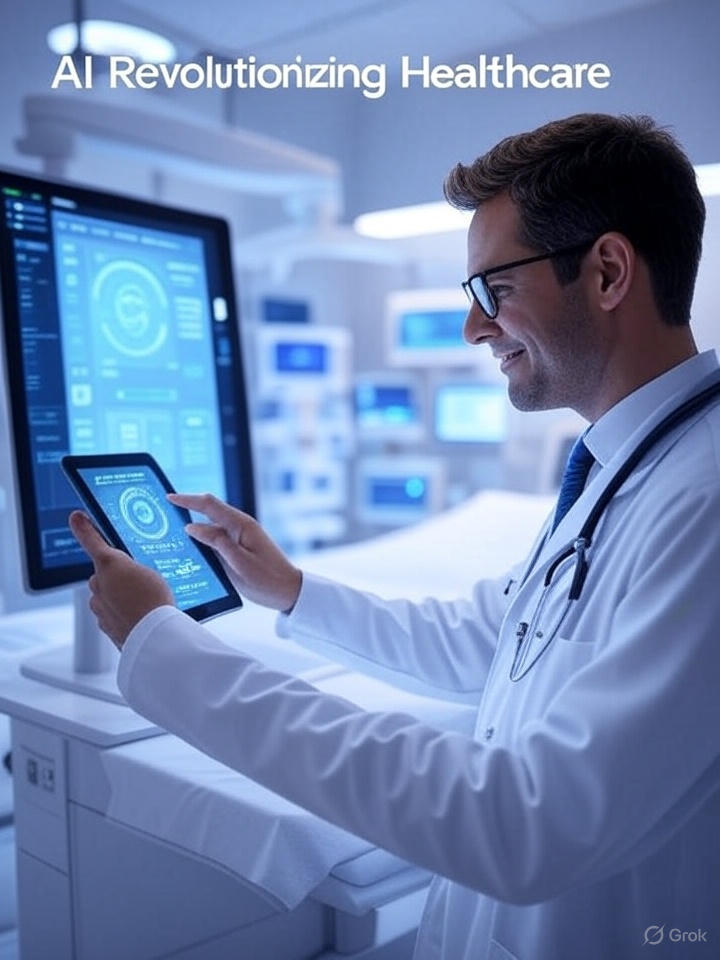
In the rapidly evolving world of technology, artificial intelligence (AI) is making profound impacts across various industries, with healthcare standing out as one of the most transformative sectors. As of 2025, AI tools are not just futuristic concepts but practical solutions that enhance diagnostics, personalize treatments, and streamline administrative tasks. This blog post explores how AI is reshaping healthcare, its key applications, benefits, challenges, and what the future holds.
The Rise of AI in Healthcare
AI’s integration into healthcare has accelerated dramatically over the past few years, driven by advancements in machine learning, big data, and computational power. According to recent reports, the global AI in healthcare market is projected to reach $187.95 billion by 2030, growing at a compound annual growth rate (CAGR) of 40.6%. This surge is fueled by the need for more efficient, accurate, and accessible medical services, especially in the wake of global health challenges like pandemics and aging populations.
AI tools in healthcare leverage algorithms to analyze vast amounts of data— from medical images and patient records to genomic sequences—far faster and often more accurately than humans alone. Tools like IBM Watson Health and Google Health AI are at the forefront, assisting in everything from early disease detection to drug discovery.
Key Applications of AI in Healthcare
AI’s versatility allows it to address multiple facets of healthcare. Here are some of the most impactful applications:
1. Diagnostics and Imaging Analysis
One of the most prominent uses of AI is in medical imaging. AI-powered tools can detect anomalies in X-rays, MRIs, and CT scans with remarkable precision. For instance, Google’s DeepMind has developed AI models that identify breast cancer in mammograms with accuracy rivaling or surpassing radiologists. Similarly, PathAI uses machine learning to assist pathologists in diagnosing diseases like cancer by analyzing tissue samples.
These tools reduce diagnostic errors, which affect up to 12 million Americans annually, and speed up the process, enabling earlier interventions.
2. Predictive Analytics and Patient Monitoring
AI excels at predicting health outcomes by analyzing patient data patterns. Wearable devices integrated with AI, such as those from Apple Health or Fitbit, monitor vital signs in real-time and alert healthcare providers to potential issues like irregular heart rhythms. In hospitals, AI systems like those from Philips predict patient deterioration, allowing for proactive care.
During the COVID-19 pandemic, AI models forecasted outbreak patterns and resource needs, demonstrating its value in public health.
3. Personalized Medicine and Treatment Plans
Gone are the days of one-size-fits-all treatments. AI analyzes genetic data, lifestyle factors, and medical history to tailor therapies. IBM Watson for Oncology, for example, recommends personalized cancer treatments by cross-referencing patient data with millions of research papers and clinical trials.
In drug discovery, AI accelerates the process from years to months. Companies like Insilico Medicine use AI to identify potential drug candidates, significantly cutting costs and time.
4. Administrative and Operational Efficiency
AI isn’t just for clinical tasks; it streamlines operations too. Natural language processing (NLP) tools transcribe doctor-patient conversations, automate billing, and manage electronic health records (EHRs). Tools like Nuance’s Dragon Medical One reduce documentation time by up to 50%, freeing clinicians for patient care.
Chatbots and virtual assistants, powered by AI like those from Babylon Health, provide initial triage and answer common queries, easing the burden on healthcare staff.
Benefits of AI in Healthcare
The adoption of AI brings numerous advantages:
- Improved Accuracy and Speed: AI minimizes human error and processes data exponentially faster.
- Cost Savings: By preventing diseases early and optimizing resources, AI can reduce healthcare expenditures by 5-10% in the U.S. alone.
- Accessibility: Telemedicine platforms enhanced by AI make quality care available in remote areas.
- Enhanced Research: AI sifts through massive datasets to uncover insights that would take humans decades.
Challenges and Ethical Considerations
Despite its promise, AI in healthcare faces hurdles:
- Data Privacy and Security: Handling sensitive patient data raises concerns under regulations like HIPAA and GDPR. Breaches could have severe consequences.
- Bias and Fairness: AI models trained on biased data can perpetuate inequalities, such as underdiagnosing conditions in underrepresented groups.
- Regulatory Approval: Ensuring AI tools are safe and effective requires rigorous FDA oversight, which can slow innovation.
- Job Displacement: While AI augments roles, it may automate routine tasks, necessitating workforce reskilling.
Addressing these requires ethical frameworks, diverse datasets, and collaborative efforts between tech companies, regulators, and healthcare providers.
The Future of AI in Healthcare
Looking ahead to 2030 and beyond, AI could lead to fully autonomous surgical robots, AI-driven preventive medicine via continuous monitoring, and even AI companions for mental health support. Emerging technologies like quantum computing will further boost AI’s capabilities in simulating complex biological processes.
As AI evolves, its integration with other innovations like blockchain for secure data sharing and 5G for real-time applications will amplify its impact. However, success hinges on responsible development to ensure equitable benefits for all.
Conclusion
AI in healthcare is not a replacement for human expertise but a powerful ally that enhances it. From diagnosing diseases with pinpoint accuracy to personalizing treatments, AI tools are transforming patient outcomes and operational efficiency. As we navigate the challenges, the potential for AI to create a healthier world is immense. Stay tuned for more insights on how emerging technologies are shaping our future—subscribe to our blog for the latest updates!
This post is for informational purposes only and not medical advice. Consult healthcare professionals for personalized guidance.


