

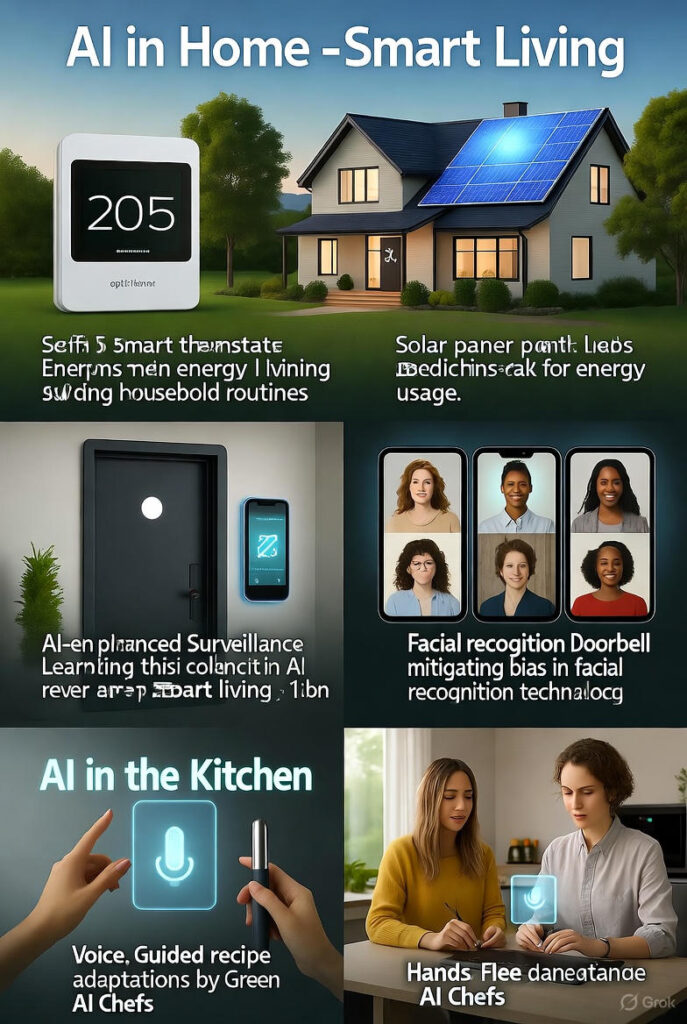
As we hit November 2025, smart homes aren’t just gadgets—they’re intelligent ecosystems that anticipate your needs, slash your bills, and safeguard your peace of mind. With the global smart home market projected to reach $200 billion this year, AI is the thread weaving convenience, efficiency, and security into everyday living. From thermostats that learn your routine to voice-guided sous-chefs, these innovations are reducing energy waste and enhancing safety. But as we embrace this tech utopia, ethical guardrails like privacy and sustainability are more crucial than ever. Drawing from CNET’s latest reviews and EU AI Act updates, this post spotlights three must-know advances in home AI, plus a forward look at balancing bliss with responsibility.
Energy-Optimizing Smart Homes: Thermostats That Think Ahead
Picture arriving to a perfectly cozy home without wasting a watt—AI thermostats are making it reality, learning your habits to optimize heating, cooling, and even solar integration for up to 25% bill cuts.
- The Smarts Behind It: Devices like Nest Learning Thermostat 4.0 or Ecobee’s AI-powered models use machine learning to analyze occupancy, weather, and usage patterns, auto-adjusting temps and syncing with solar forecasts for peak renewable draw. In 2025 pilots, quantum-AI hybrids from MIT-linked research promise even deeper efficiencies, reducing consumption by integrating real-time environmental data.
- Real Savings in Action: Gearbrain reports households seeing 20-30% drops in energy costs, with smart systems prioritizing renewables to lower grid reliance. Add voice commands via Alexa or Google Home, and it’s hands-free harmony—perfect for busy families.
- Pro Upgrade: Pair with home energy management hubs like those from EcoFlow for AI-driven battery storage, turning excess solar into off-peak power.
These aren’t set-it-and-forget-it; they’re evolve-with-you savers, making eco-living effortless.
Security Systems with Facial Recognition: Vigilant, Yet Fair
Door cams that know friend from foe in seconds—AI facial recognition is elevating home security, with 2025’s bias-mitigation tech ensuring inclusivity without false alarms.
- Proactive Protection: Systems like Ring’s Always Home Cam or Arlo Ultra 2 use edge AI for instant alerts, recognizing faces against your approved list and flagging unknowns with live feeds to your phone. EU-funded projects like MAMMOth have slashed error rates by optimizing models for diverse skin tones and lighting.
- Bias Busted: IDnow’s 2025 updates reduced algorithmic skew by 40% through targeted testing, aligning with global regs like the EU AI Act for ethical deployment. NYU Tandon’s synthetic datasets further democratize accuracy, minimizing racial/gender disparities.
- Daily Wins: Forbes notes proactive features like anomaly detection (e.g., unusual loitering) cut response times by 50%, blending seamlessly with smart locks for keyless entry.
It’s security that sees you—not stereotypes—keeping your castle safe and sound.
Kitchen AI Chefs: Hands-Free Culinary Wizards
Dinnertime dilemmas? AI recipe adapters turn your fridge into a five-star kitchen, voice-guiding adaptations for allergies or moods in a truly hands-free ritual.
- Voice-Guided Genius: Tools like Chef Voice AI or Bosch’s 2025 Cookit converter scan recipes online, adapt for your pantry/diet (e.g., vegan swaps), and narrate steps via speakers—timers, tips, and all. SideChef’s AI generators personalize with nutritional tweaks, making healthy eating intuitive.
- 2025 Flavor Boost: AI4How’s top picks include real-time inventory scans via phone cams, suggesting zero-waste meals—reducing food waste by 25% in user trials. Imagine: “Alexa, adapt this stir-fry for low-carb”—and it does, step-by-voice.
- Family Fun: AIMSYS reports 40% more home cooking among users, with AR overlays for technique demos turning novices into pros.
Cooking evolves from chore to joy, one adaptive instruction at a time.
Ethical Considerations and Future Outlook: Mindful Magic Ahead
As AI nestles into our nests, 2025 spotlights ethics—privacy peaks in surveys, literacy workshops proliferate, and green AI slashes footprints for a sustainable smart era.
- Privacy in the AI Era: With 87% of consumers demanding bans on unauthorized data sales, GDPR’s 2025 evolutions mandate AI transparency, like explicit consent for personalization—Usercentrics warns non-compliance risks fines up to 4% of revenue. Tools now feature “privacy-by-design,” anonymizing home data streams.
- AI Literacy for All Ages: Family workshops via Day of AI or MediaSmarts teach deepfake detection through games, empowering Gen Alpha to spot Sora-generated fakes—Policy Options calls it essential for consent and rights education. In 2025, 60% of schools integrate these, per AI for Education updates.
- Sustainability Through AI: Green AI could trim global emissions by 3.2-5.4 billion tonnes annually by 2035, via optimized charging (e.g., NVIDIA’s efficient models) and waste apps like Farmonaut’s trackers. MIT urges data-center renewables to counter AI’s 2-3% energy draw.
By 2030, expect “zero-trust” homes with self-healing privacy and carbon-neutral AI—sustainable, savvy living unlocked.
Your Smart Home Starter Kit
AI’s home invasion is a welcome one: Start with a thermostat upgrade for instant ROI, add a cam for peace, and spice up supper with voice AI. What’s your next smart splurge? Comment below!


