

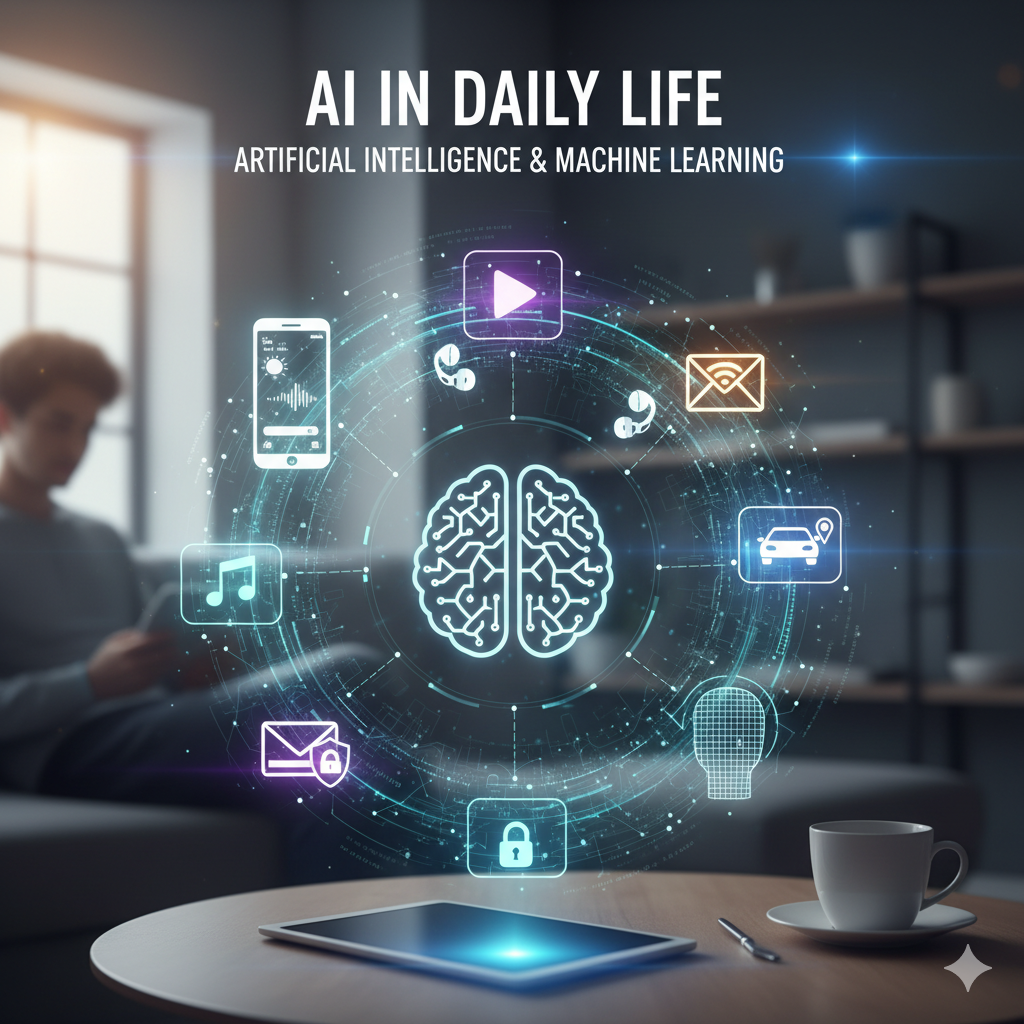
Take a moment to look around. You might not see a humanoid robot pouring your coffee, but the reality is that Artificial Intelligence (AI) and its subset, Machine Learning (ML), are deeply integrated into the fabric of your daily routine. Far from being a futuristic concept, AI is the silent engine powering much of the modern world, making your life smoother, smarter, and more personalized.
What’s the Difference? (A Quick Primer)
Before diving into the applications, let’s quickly clarify the terms:
- Artificial Intelligence (AI): The broad field of computer science dedicated to building intelligent machines capable of performing tasks that typically require human intelligence, such as learning, problem-solving, and decision-making.
- Machine Learning (ML): A specific application of AI that enables systems to automatically learn and improve from experience without being explicitly programmed. ML algorithms are trained on vast amounts of data to recognize patterns and make predictions. Think of AI as the goal (building intelligence) and ML as a key method for achieving it (learning from data).
From Alarm Clock to Lights Out: AI’s Presence
AI and ML aren’t just in Silicon Valley labs; they are actively working for you, often unnoticed, in countless ways:
1. The Smart Assistant in Your Ear
When you ask Siri, Alexa, or Google Assistant for the weather, to set a reminder, or to play a song, you’re engaging with sophisticated AI. These virtual assistants use Natural Language Processing (NLP)—a branch of AI—to interpret your voice commands, understand the context, and generate a relevant response. The more you use them, the better they get at recognizing your voice and preferences.
2. Entertainment That Knows You Better
Ever wonder how Netflix, Spotify, or YouTube instantly suggest the perfect movie, song, or video? That’s the power of Machine Learning-driven Recommendation Engines. These algorithms analyze massive amounts of data about your viewing/listening history, ratings, and even the habits of users similar to you, finding subtle patterns to predict what you’ll enjoy next. This personalization keeps you engaged and discovering new content.
3. The Smoothest Commute Possible
When you open Google Maps or Waze and get an accurate estimated time of arrival (ETA), you have AI to thank. These apps use ML to process real-time and historical traffic data, factoring in speed, accidents, and road closures to calculate the fastest route. Even if you’re not in a self-driving car, AI is optimizing your journey.
4. An Inbox Cleaner Than Ever
Your email is one of AI’s quietest victories. The incredibly effective spam filters that keep your inbox tidy are powered by ML algorithms. They constantly learn to distinguish between legitimate messages and junk mail by analyzing patterns in senders, content, and language. Similarly, features like “Smart Reply” use AI to suggest short, relevant responses, saving you time.
5. Secure Transactions and Face Unlock
Every time you pay with a credit card online, an ML system is instantly running checks in the background for fraud detection. By comparing the transaction to your normal spending patterns, the AI can flag unusual activity, protecting your money. On your smartphone, Facial Recognition for unlocking your device or authenticating a payment is a prominent use of Computer Vision (another AI field) and deep learning algorithms.
The Future is Learning
The seamless integration of AI and ML is only accelerating. From enhancing medical diagnosis to optimizing sustainable energy grids, these technologies are transforming industries and raising the bar for convenience.
While the rise of AI sparks important conversations about ethics and job evolution, it’s undeniable that our everyday lives are already being augmented for the better. The future won’t just be about inventing new AI; it will be about the continuous learning of the systems we already use, making every interaction more intuitive, efficient, and intelligent than the last.


