

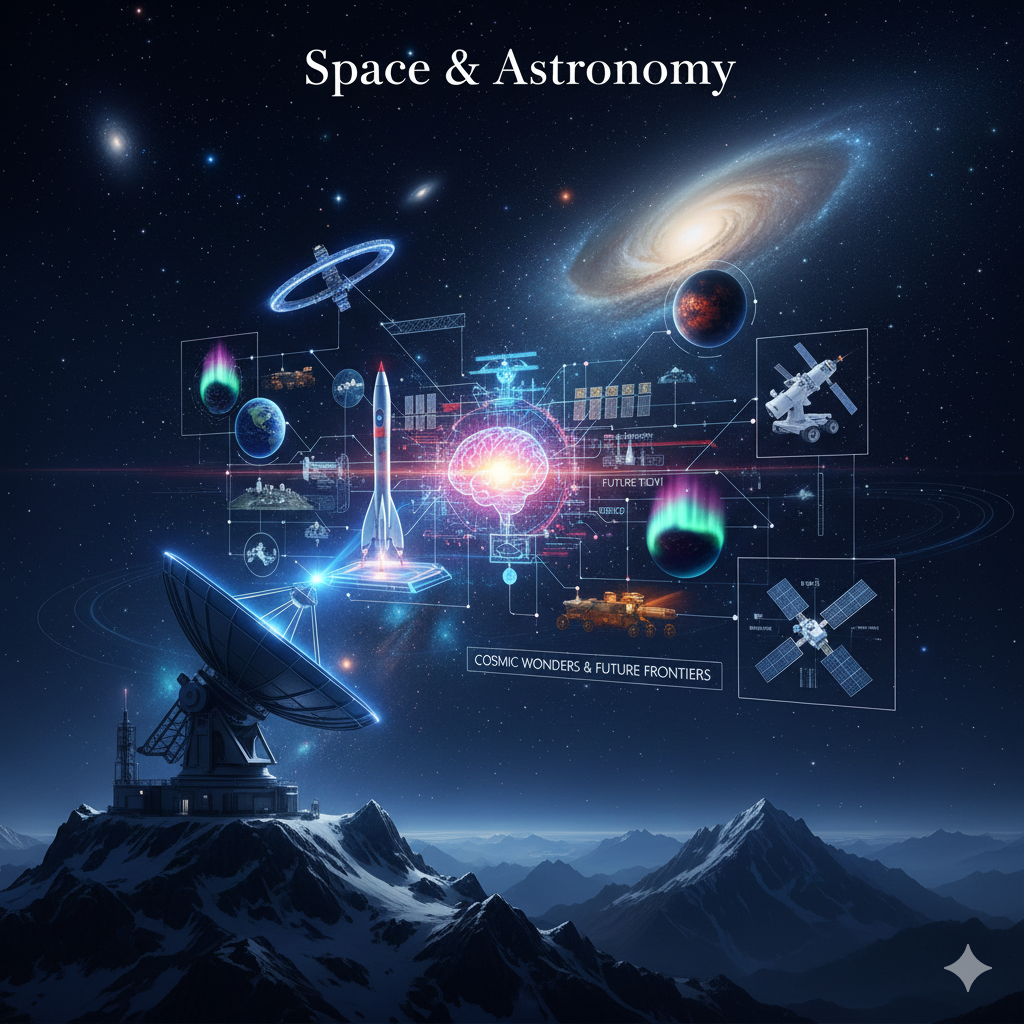
From the swirling nebulae light-years away to the humble dust motes on a distant planet, Space and Astronomy captivate humanity like few other subjects. It’s a field that not only seeks to understand the origins and mechanics of the universe but also inspires incredible feats of engineering and pushes the boundaries of future technology. Our quest to explore the cosmos drives innovation, expands our knowledge, and continuously humbles us with the sheer scale of existence.
Unveiling the Universe: The Core of Astronomy
Astronomy is the scientific study of celestial objects (such as stars, planets, galaxies, black holes), phenomena that originate outside Earth’s atmosphere (like supernovae, gamma-ray bursts), and the physical laws that govern them. It’s the oldest natural science, yet constantly reinventing itself with new discoveries.
Key areas of astronomical study include:
- Planetary Science: Studying planets, moons, asteroids, and comets within and beyond our solar system. The discovery of thousands of exoplanets has revolutionized our understanding of planetary formation and the potential for life elsewhere.
- Stellar Astronomy: Investigating the birth, life, and death of stars, from tiny red dwarfs to colossal blue giants, and the incredible processes that power them.
- Galactic Astronomy: Exploring the structure, evolution, and dynamics of galaxies, including our own Milky Way, and the mysterious role of dark matter and dark energy.
- Cosmology: The study of the universe as a whole, its origin (the Big Bang), its evolution, and its ultimate fate.
Tools of Discovery: Peering into the Deep Space
Our understanding of the universe relies on ever-improving technology:
- Telescopes: From ground-based giants like the Keck Observatory and the upcoming Extremely Large Telescope to space-based marvels like the Hubble Space Telescope and the James Webb Space Telescope (JWST), these instruments gather light and other electromagnetic radiation from distant objects, allowing us to see billions of years into the past.
- Probes and Rovers: Robotic explorers like Perseverance on Mars and the Voyager probes (now in interstellar space) provide invaluable direct data from other celestial bodies, giving us a tactile sense of other worlds.
- Particle Detectors & Gravitational Wave Observatories: Instruments like LIGO (Laser Interferometer Gravitational-Wave Observatory) listen for ripples in spacetime caused by cataclysmic cosmic events, opening a new window into the most violent phenomena in the universe.
The Future is Now: Space Exploration and Future Tech
Space exploration is the active pursuit of knowledge about space through the use of space technology. It’s where astronomy meets engineering, driving humanity to new frontiers.
- Return to the Moon (Artemis Program): NASA, in collaboration with international partners, aims to return humans to the Moon, establishing a sustainable presence as a stepping stone for future deep-space missions.
- Journey to Mars: The ultimate goal of human spaceflight is to send astronauts to Mars, studying its potential for past or present life and paving the way for eventual colonization. This requires overcoming immense engineering challenges related to radiation, propulsion, and life support.
- Commercial Space Industry: Companies like SpaceX, Blue Origin, and Virgin Galactic are dramatically changing the landscape, driving down launch costs, developing reusable rockets, and aiming for space tourism and lunar/Martian resource utilization.
- Asteroid Mining: The vast mineral wealth of asteroids represents a potential future resource for humanity, fueling space-based industries and reducing reliance on Earth’s dwindling resources.
- Advanced Propulsion: Research into technologies like ion propulsion, nuclear thermal propulsion, and even theoretical concepts like warp drives aims to drastically reduce travel times across the solar system and beyond.
- Space-Based Manufacturing: The microgravity environment of space offers unique opportunities for manufacturing materials and components that are impossible to create on Earth, leading to new industries and technological breakthroughs.
The Ultimate Frontier: Why Space Matters
Beyond the scientific discoveries and technological marvels, space and astronomy remind us of our place in the universe. They inspire us to innovate, to collaborate across borders, and to dream big. The challenges of space exploration push our technological limits, leading to spin-off innovations that benefit life on Earth. As we look up at the night sky, we are not just observing; we are envisioning our future.


