
Introduction
When you hear the word design, you might think of logos, websites, or fancy graphics. But design is much more than aesthetics—it’s about solving problems in creative and human-centered ways. This is where Design Thinking comes in.
The beauty of Design Thinking is that it’s not limited to designers. Business leaders, teachers, healthcare workers, entrepreneurs, and even students can apply it to everyday challenges. It’s a mindset as much as a process, and it helps you create solutions that are practical, innovative, and most importantly—useful to real people.
What is Design Thinking?
Design Thinking is a human-centered approach to problem solving. Instead of starting with assumptions or business goals, it starts with the users—their needs, pain points, and emotions.
It combines empathy, creativity, and logic to generate solutions that are both innovative and feasible.
At its core, Design Thinking pushes us to:
- Understand people first
- Explore multiple ideas instead of settling too quickly
- Test, learn, and refine solutions
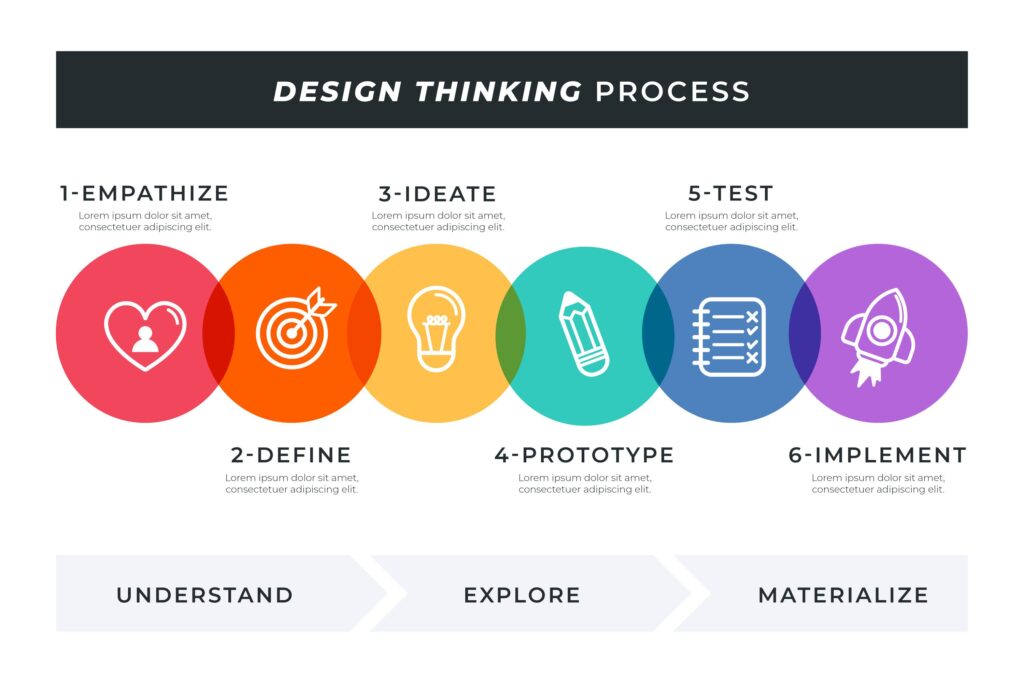
The 5 Stages of Design Thinking
Design Thinking is often described as a non-linear process—you can jump back and forth between stages. However, most frameworks follow these 5 key steps:
1. Empathize – Walk in the user’s shoes
This stage is all about listening and observing. You’re not trying to solve anything yet—just to deeply understand the user.
- Conduct interviews or surveys
- Observe behaviors (not just what people say, but what they do)
- Create empathy maps
👉 Example: A hospital team observed that patients felt anxious in waiting rooms. This insight became the seed for redesigning the entire patient experience.
2. Define – Frame the problem clearly
After collecting insights, you need to define the real problem. This means turning vague frustrations into a clear problem statement.
Bad problem framing: “We need a better website.”
Better problem framing: “How might we make online appointment booking faster and less confusing for patients?”
👉 Example: Airbnb initially thought their problem was about advertising. But after reframing, they realized it was about trust—people didn’t feel comfortable booking a stranger’s home. This insight shaped their entire platform.
3. Ideate – Generate lots of ideas
This is the fun stage—brainstorming without judgment. The goal is to go broad before narrowing down.
Methods include:
- Mind mapping
- “Crazy 8s” sketching (8 ideas in 8 minutes)
- SCAMPER technique (Substitute, Combine, Adapt, Modify, etc.)
👉 Example: Google’s design teams often use “design sprints,” where cross-functional groups brainstorm dozens of ideas before selecting the most promising ones.
4. Prototype – Build to learn, not to perfect
Prototypes don’t need to be polished—they can be sketches, paper models, or clickable mockups. The goal is to make ideas tangible so they can be tested.
👉 Example: When IDEO redesigned a shopping cart, their early prototypes were rough physical models made from everyday materials. Each prototype sparked new insights.
5. Test – Learn from real users
Share your prototypes with real users, watch how they interact, and listen to their feedback. Be ready to go back and adjust based on what you learn.
👉 Example: Netflix constantly tests its interface on small groups of users. Features like “Skip Intro” came directly from testing and user feedback.
Why Design Thinking Matters for Non-Designers
You don’t need to be a professional designer to use this process. Here’s how it helps in different fields:
- Business Leaders → Innovate services, improve customer experiences, and stay competitive.
- Teachers → Redesign lesson plans to keep students engaged.
- Healthcare Professionals → Create smoother patient journeys and reduce stress.
- Entrepreneurs → Test startup ideas quickly without wasting resources.
- Students → Solve academic or personal challenges creatively.
💡 Think of Design Thinking as a superpower for problem solving—no art skills required.
Simple Tips to Start Using Design Thinking
- Pick a small problem first – For example, “How might I make my morning routine less stressful?”
- Ask better questions – Replace “What’s wrong?” with “How might we…?”
- Sketch ideas visually – Even stick figures and doodles help clarify thoughts.
- Collaborate – Bring in people from different backgrounds for fresh ideas.
- Embrace failure – Every “bad” idea teaches you something useful.
Conclusion
Design Thinking is not just for designers—it’s a way of thinking that anyone can use to solve problems with creativity and empathy. By focusing on people first and testing ideas quickly, you can uncover innovative solutions that truly make an impact.
So, whether you’re running a business, teaching a class, or just trying to improve your day-to-day life, remember: Design Thinking is for everyone.