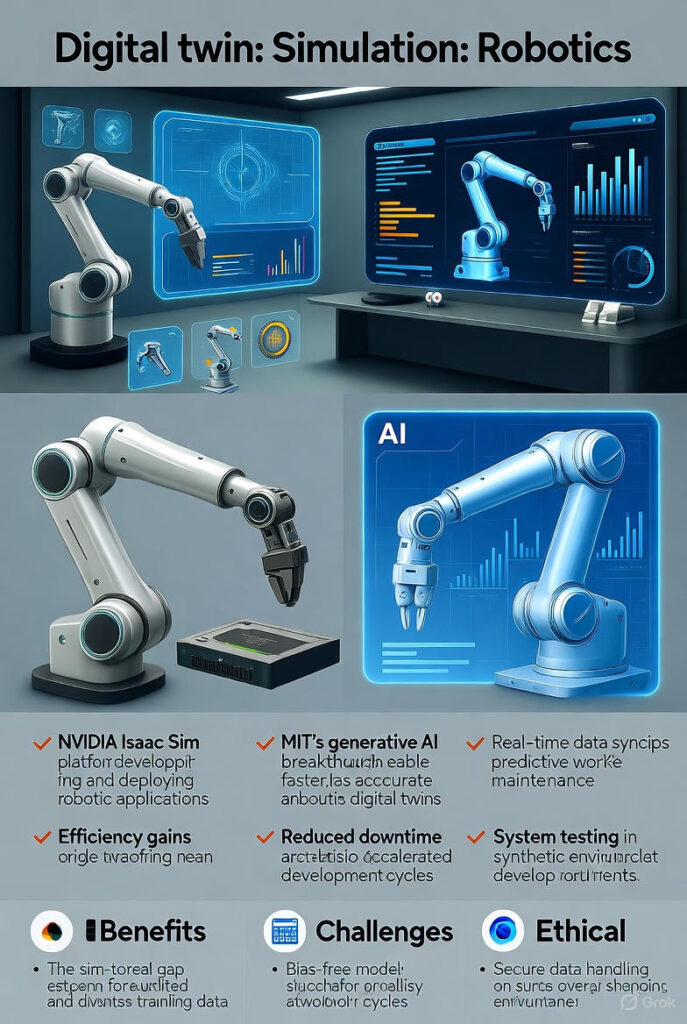
In the fast-evolving world of robotics, where physical hardware meets digital ingenuity, digital twins and synthetic simulations are the unsung heroes driving efficiency and innovation. As of November 2025, these virtual replicas—exact digital mirrors of physical robots and environments—are slashing downtime by up to 50% and accelerating training cycles from months to days. Powered by AI and cloud computing, they enable predictive maintenance, risk-free testing, and embodied learning in synthetic worlds. From manufacturing floors to surgical suites, this tech is the backbone of Industry 5.0. In this guide, we’ll unpack how digital twins work, their role in predictive upkeep, simulation for training, real-world robotics apps, and what’s next—drawing from NVIDIA’s Isaac Sim advancements and MIT’s generative AI breakthroughs.
What Are Digital Twins? The Mirror of Reality
A digital twin is a dynamic, real-time virtual model synced to its physical counterpart via IoT sensors and AI algorithms. In robotics, it replicates a robot’s mechanics, sensors, and behaviors, updating continuously with live data for hyper-accurate simulations.
- Core Components: Physics-based modeling (e.g., kinematics via Unity or Gazebo), data fusion from edge devices, and ML for anomaly detection.
- Why Robotics Loves Them: Unlike static CAD files, twins evolve—predicting wear on a cobot arm before it snaps.
- 2025 Milestone: Scalacode reports AI-enabled twins forecasting failures weeks ahead, integrating with AR for on-site diagnostics.
Think of it as a robot’s “digital soul,” living in the cloud to safeguard its body.
Predictive Maintenance: Catching Issues Before They Crash
Traditional maintenance is reactive—fixing breaks after they happen. Digital twins flip the script with proactive foresight, monitoring health in virtual space to preempt failures.
- How It Works: Sensors feed data (vibration, temperature) into the twin, where ML simulates stress tests. Algorithms like those in Zuken’s twins predict component fatigue, scheduling repairs optimally. In manufacturing, this cuts unplanned downtime by 30-50%, per Acuvate’s 2025 benchmarks.
- Robotics Edge: For industrial arms, twins simulate load scenarios, flagging joint wear early—vital for 24/7 ops like Amazon warehouses.
- Real Impact: Insia’s integrations with IoT enable scenario forecasting, reducing costs by 20% in predictive schedules.
No more surprise shutdowns—just seamless uptime.
Simulation and Training: Synthetic Worlds for Safe Skill-Building
Why risk a $100K robot on trial runs? Synthetic environments let bots “practice” in virtual realms, generating infinite data for reinforcement learning (RL) without real-world hazards.
- The Setup: Platforms like NVIDIA’s Isaac Sim create photorealistic twins of factories or labs, using generative AI to vary lighting, obstacles, or failures. MIT’s 2025 “Steerable Scene Generation” diversifies these worlds, training robots on rare events like spills or crowds.
- Training Power: RL agents iterate thousands of cycles in hours—e.g., a drone learning navigation via synthetic winds—boosting transfer to reality by 40%, per Vision Robotics EU reports.
- 2025 Boost: MAK ONE’s open API platform links simulations for multi-robot swarms, ideal for disaster response training.
It’s like flight simulators for pilots, but for bots—zero cost, zero risk.
Real-World Applications in Robotics
Digital twins shine across sectors:
- Manufacturing: Twins optimize cobot paths, predicting tool wear in Fanuc arms.
- Healthcare: Surgical robots like da Vinci use twins for procedure rehearsals, enhancing precision by 25%.
- Autonomous Vehicles: Waymo’s fleet twins simulate edge cases, cutting test miles by 90%.
| Aspect | Traditional Approach | Digital Twin/Simulation |
|---|---|---|
| Maintenance | Scheduled checks; 10-20% downtime | Predictive; <5% downtime, 30% cost savings |
| Training | Real hardware trials; high wear/cost | Synthetic iterations; 10x faster, safer |
| Testing | Limited scenarios; regulatory hurdles | Infinite variations; accelerated certification |
Benefits, Challenges, and Ethical Notes
Pros: 40% efficiency gains, safer R&D, scalable testing—Promwad’s 2025 outlook sees twins as core to performance tuning. Cons: High setup costs (data silos, compute needs), sim-to-real gaps (e.g., physics inaccuracies), and privacy risks from sensor data. Ethics: ArXiv’s review stresses bias-free models to avoid discriminatory predictions in maintenance alerts.
The Horizon: 2025 and Beyond
By late 2025, expect quantum-enhanced twins for hyper-complex sims and open-source platforms like those from Dronícola for accessible autonomy training. Workshops like UR 2025’s on synthetic data herald a future where robots “learn” faster than ever.
Digital twins aren’t just tools—they’re the bridge to intuitive, resilient robotics. Ready to twin your bot? Share your thoughts below!