
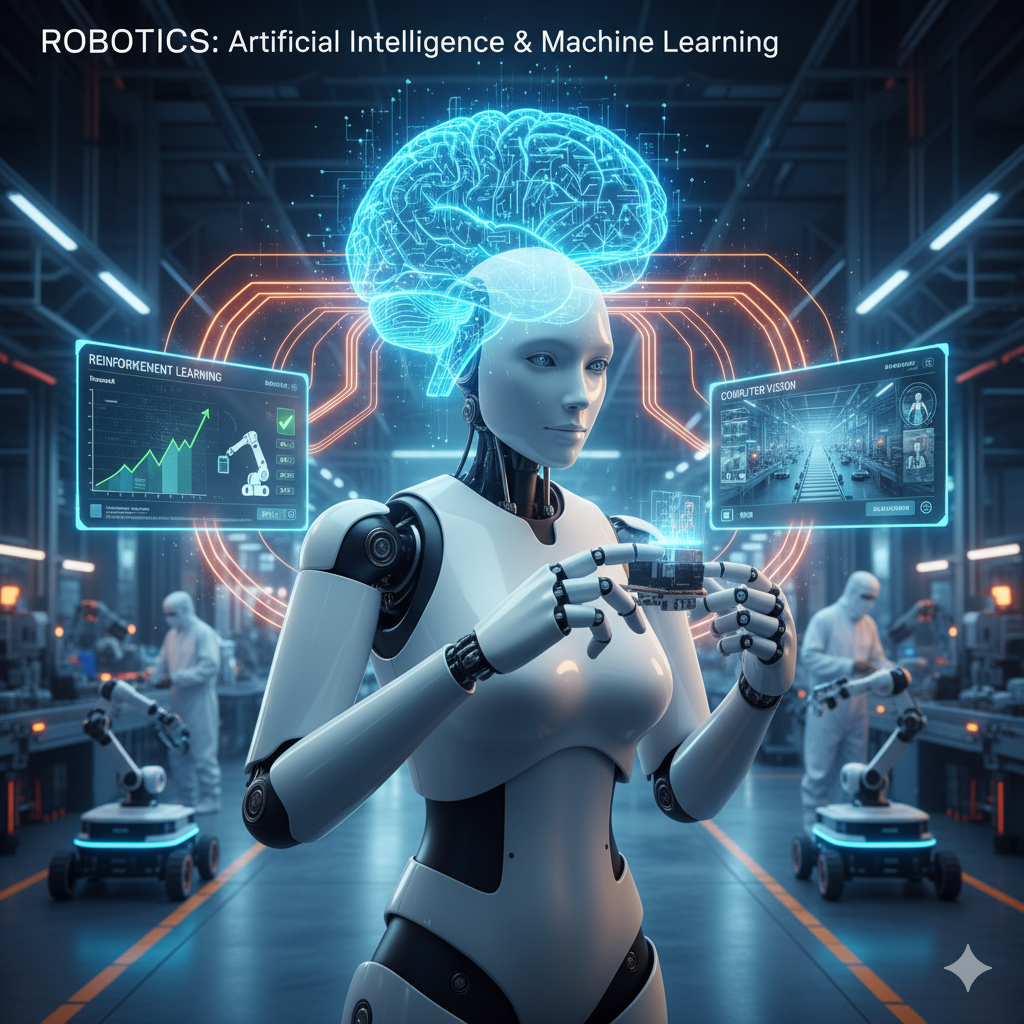
Robots aren’t just the clunky, pre-programmed automatons of yesterday. Thanks to Artificial Intelligence (AI) and its powerful subset, Machine Learning (ML), modern robots are evolving into intelligent, adaptable, and autonomous systems. This isn’t just an upgrade; it’s a fundamental shift that is turning rigid tools into smart, self-improving partners across every industry.
The Symbiotic Trio: Robotics, AI, and ML
To understand the revolution, we need to clarify the roles of this powerful trio:
- Robotics: This is the physical machine—the hardware, sensors, motors, and actuators that allow it to interact with the world. A robotic arm, for example, is the ‘body.’
- Artificial Intelligence (AI): This is the ‘brain’—the broad field that enables the machine to simulate human intelligence. It provides the high-level decision-making framework, allowing a robot to reason and solve problems.
- Machine Learning (ML): This is the ‘learning mechanism’—a crucial AI technique that lets the robot learn from data and experience without being explicitly programmed for every single situation. It’s what allows the robot to get better at its job over time.
In essence, AI gives the robot intelligence, and ML gives it the ability to learn and adapt.
How Machine Learning Brings Robots to Life
Traditional robots were limited to a set of fixed, pre-coded instructions. If a part on the assembly line moved an inch, the robot would fail. ML breaks this barrier using techniques like:
- Reinforcement Learning (RL): This is learning by trial and error. A robot tasked with picking up an object receives a ‘reward’ for a successful grasp and a ‘penalty’ if it drops the item. Over thousands of trials, the algorithm optimizes the grip pressure, speed, and angle until it masters the task with human-like dexterity.
- Computer Vision (Deep Learning): AI-powered vision systems, often utilizing deep neural networks, allow robots to “see” and interpret their surroundings. They can identify objects, distinguish between a specific product and a defect, and navigate complex, dynamic environments like a crowded warehouse or a city street.
- Natural Language Processing (NLP): This allows robots to understand and respond to human commands and queries. From service robots in hotels to collaborative robots (Cobots) on a factory floor, NLP facilitates safe, intuitive human-robot interaction.
Real-World Applications Transforming Industries
The fusion of AI and robotics is already delivering transformative solutions:
- Manufacturing & Logistics: Robots are no longer confined to repetitive welding. AI enables predictive maintenance by monitoring sensor data to identify and fix equipment before it fails. Autonomous Mobile Robots (AMRs) use ML to navigate warehouse floors, dynamically rerouting to avoid obstacles and optimize delivery paths.
- Healthcare: AI-driven surgical robots assist doctors in performing minimally invasive procedures with superhuman precision, adapting their movements based on real-time patient data. Robotic exoskeletons, powered by smart algorithms, assist in rehabilitation.
- Autonomous Vehicles (AVs): The self-driving car is arguably the most complex robot in use today. It relies entirely on AI and ML for perception (identifying pedestrians, signs, and other cars), decision-making (when to brake or turn), and path planning in an unpredictable world.
- Service Robotics: Personal assistant robots, like smart vacuum cleaners that map your home or robots that deliver food, use ML to learn household layouts and routines, enhancing convenience and efficiency.
The Future: Adaptive Intelligence and Collaboration
The road ahead is moving toward robots that are less like tools and more like partners:
- General Purpose Robots: The goal is to move beyond robots programmed for a single, narrow task. Future AI will enable humanoid robots to learn a new skill—like folding laundry or restocking a shelf—simply by watching a human demonstrate it once.
- Explainable AI (XAI): As robots become more autonomous, it’s crucial to understand why they made a certain decision. XAI will build trust and accountability in critical applications like healthcare and autonomous driving.
- Seamless Human-Robot Collaboration: The next generation of Cobots will be smarter, safer, and capable of truly anticipating human needs, sharing workspaces without cages, and dynamically adjusting their tasks based on the human’s actions.
The integration of AI and ML is turning the sci-fi dream of truly intelligent machines into an engineering reality. The future of robotics isn’t just about automation; it’s about adaptive intelligence that will revolutionize how we live, work, and interact with technology.