

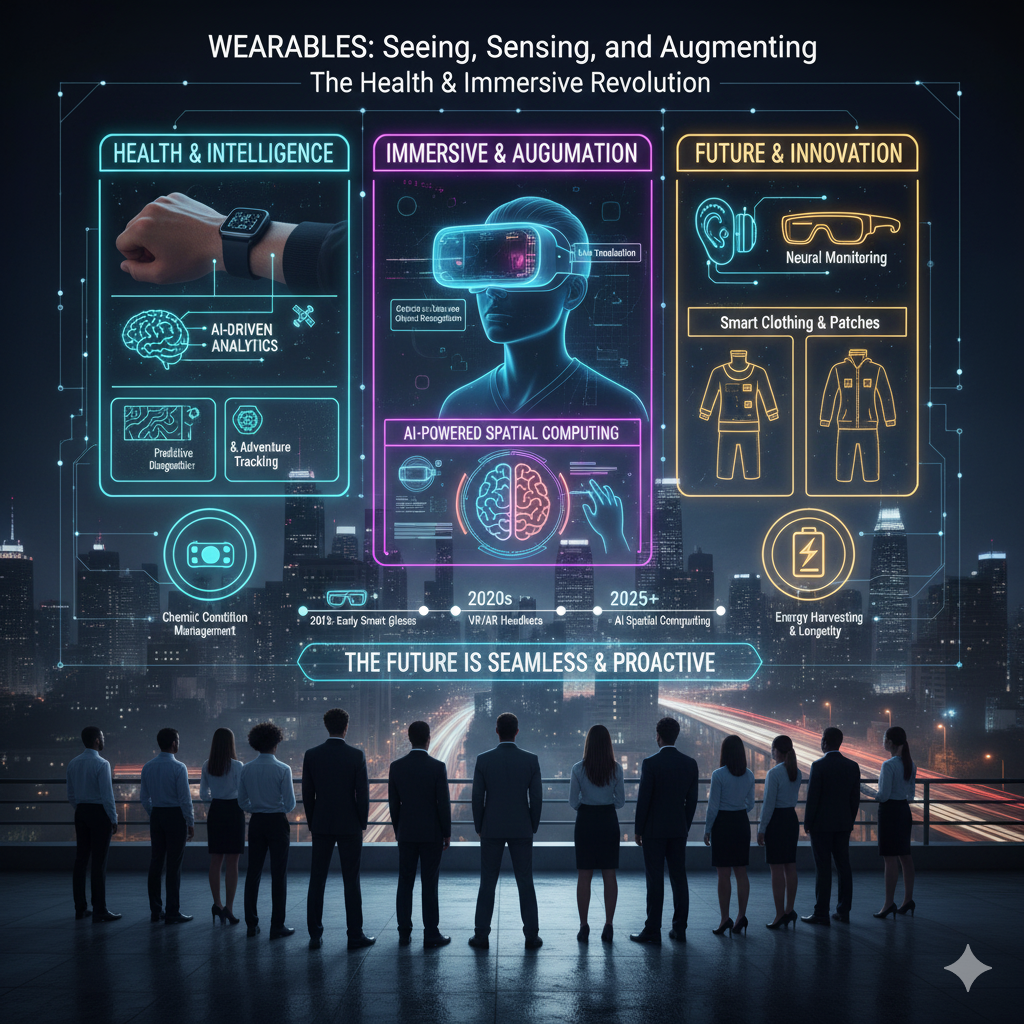
Wearable technology is evolving beyond simple step-counting and notification mirroring; it is rapidly transforming into a collection of sophisticated, often discreet, devices that act as intelligent assistants, continuous health monitors, and portals to immersive realities. The current wearable landscape is defined by the convergence of miniaturized powerful sensors, hyper-personalized Artificial Intelligence (AI), and a move toward minimalist form factors that blend seamlessly into daily life.
I. Smartwatches and Smart Rings: The Health Intelligence Core
Wrist-worn devices remain the most popular category, but their function has fundamentally shifted from a smartphone accessory to a powerful, proactive health guardian.
A. AI-Driven Health Analytics
The most significant trend is the deep integration of AI to unlock predictive health insights.
- Proactive Health Monitoring: Modern smartwatches (like the Apple Watch Series 10 and advanced Garmin models) and smart rings (like the Oura Ring 4 and the upcoming Samsung Galaxy Ring) continuously track a vast array of vital metrics: ECG, SpO2 (blood oxygen), heart rate variability (HRV), and skin temperature.
- Predictive Diagnostics: AI algorithms analyze these data streams to detect subtle anomalies in real-time. This allows devices to potentially predict health issues, such as early signs of arrhythmia or elevated stress levels, before symptoms become noticeable, encouraging users to be proactive about their health.
- Minimalist Alternatives (Smart Rings): Smart rings are growing rapidly as a key trend. They offer a sleek, low-visibility, and comfortable alternative to watches, delivering consistent and highly accurate data, particularly for sleep analysis, with a battery life that often lasts several days.
B. Advanced Form Factors and Functionality
- Outdoor and Adventure Tracking: A surge in demand for extreme durability has led to smartwatches with military-grade materials, enhanced water resistance, and multi-band GPS tracking, offering near-instant, highly accurate location and topographic mapping for hikers and adventurers.
- Chronic Condition Management: Wearables are increasingly being used for remote patient monitoring. Innovations like tracking insoles, smart socks, and advanced sensors aim to assist in managing conditions like diabetes (with non-invasive blood glucose tracking) and neurocognitive disorders (by detecting rising distress).
II. AR/VR Headsets and Smart Glasses: The Immersive Frontier
The next wave of wearables is positioned on the head, creating new channels for interaction and perception. The focus has moved from novelty to practical, contextual intelligence powered by AI.
A. The AI-Powered Spatial Computer
The evolution of head-mounted displays (HMDs) is driven entirely by AI.
- From Smart Glasses to AI Glasses: Early devices like Google Glass were primarily smart displays. Today’s devices are better described as AI glasses or spatial computers (like Apple Vision Pro or future Meta/Samsung/Google headsets). They prioritize contextual assistance over simple notifications.
- Real-Time Contextual Intelligence: AI in AR glasses uses computer vision and natural language processing (NLP) to perform essential tasks hands-free:
- Live Translation: Instantly translating conversations and text (street signs, menus) overlaid directly onto the user’s field of vision, transforming travel and international commerce.
- Object Recognition: Identifying objects in the physical world and overlaying relevant information or instructions in real-time, greatly improving efficiency in fields like industrial repair and healthcare training.
- The Tipping Point: AI is expected to be the catalyst for mass adoption of AR/VR. Generative AI allows users to create personalized virtual content or summon immersive 3D content on demand simply by speaking, eliminating reliance on developers and making the virtual world more accessible and tailored.
B. The Future of Interaction
- Spatial Audio and Communication: Advanced AR devices incorporate spatial audio, giving call participants the impression of speaking from a specific location within the user’s field of view, making communication more natural.
- Blending into the World: The form factor continues to trend toward lower visibility, with devices resembling ordinary spectacles to overcome the “social awkwardness” factor that plagued early products.
III. The Future Vision: Beyond the Wrist and Head
The wearable trend suggests that monitoring and intelligence will eventually dissolve into the background, integrating into common objects.
- Hearables (Smart Earbuds): With proximity to the brain, advanced “hearables” are being explored for applications beyond audio, potentially measuring neural activity (EEG) to quantify stress, emotional state, and sleep quality with greater accuracy.
- Smart Clothing and Patches: Sensors are being woven into clothing to monitor muscle activity, provide TENS pain relief (e.g., for menstrual cramps), or track distress in vulnerable populations. Tiny, disposable stick-on patches are also being explored as the future of non-invasive, continuous health monitoring due to their small size and cost-effectiveness.
- Energy Harvesting: A major hurdle is battery life. The future is moving toward hybrid energy systems that utilize energy harvesting—converting body heat or movement into power—to extend device runtime and drastically reduce reliance on daily charging cycles.
The wearable market is transitioning from simply tracking data to actively providing intelligent, proactive, and context-aware assistance. By becoming smaller, smarter, and less demanding of user attention, wearables are cementing their role as essential, intelligent layers over our physical and digital lives.


