

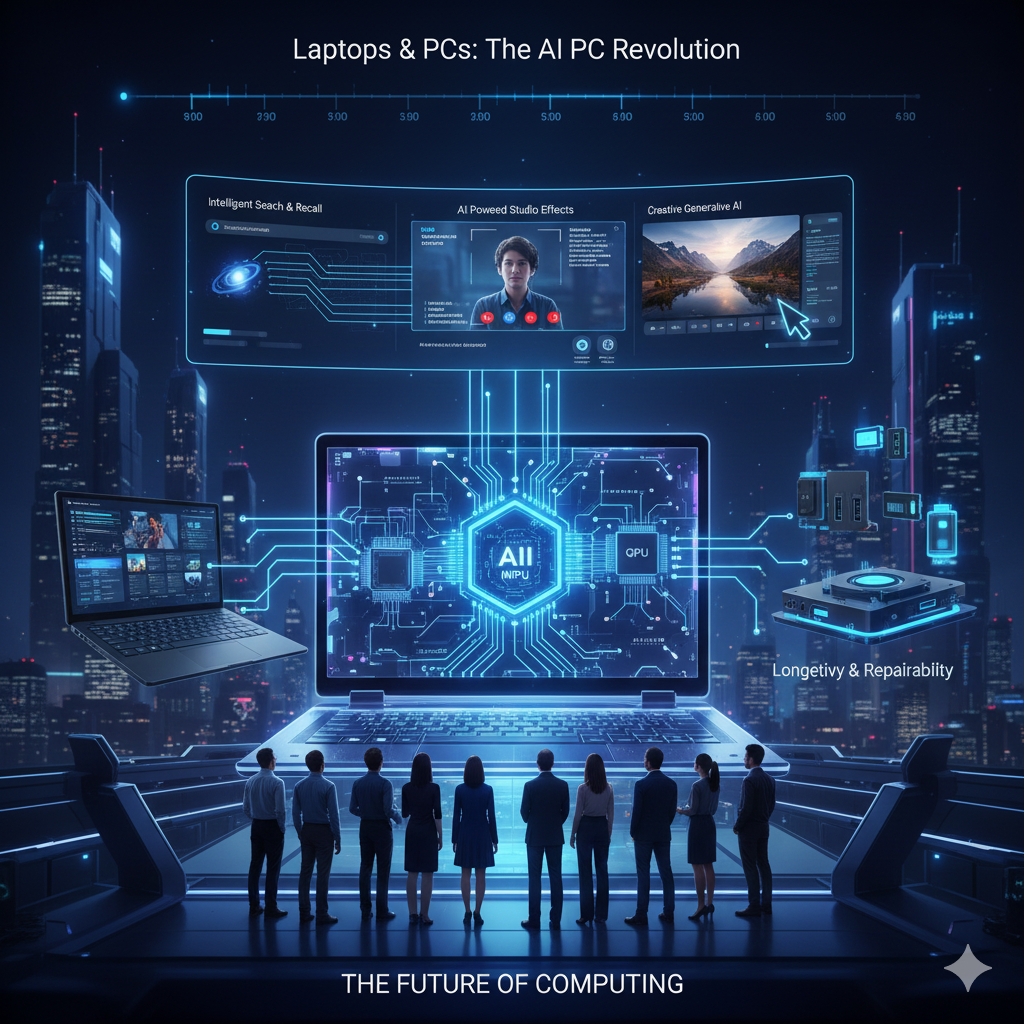
The world of Laptops and Personal Computers (PCs) is currently undergoing its most significant transformation since the arrival of the graphical interface. The defining trend is the fundamental shift from traditional computing to Intelligent Computing, driven by the pervasive integration of Artificial Intelligence (AI) directly into the device hardware and operating systems. This isn’t a mere speed bump; it’s a total re-architecture of the personal device, fundamentally changing how we work, create, and interact.
The New Standard: The AI PC and the NPU
The era of the “AI PC” is officially here. This designation is based on a critical hardware upgrade that works in tandem with the central CPU (Central Processing Unit) and GPU (Graphics Processing Unit).
The Neural Processing Unit (NPU)
The core component of the AI PC is the Neural Processing Unit (NPU).
- Function: The NPU is a dedicated processor optimized specifically to handle machine learning and AI workloads (like running large language models or image processing) with high efficiency and low power consumption.
- Impact on Performance: By offloading AI tasks from the CPU and GPU, the NPU frees up these traditional components for other work, leading to better overall performance, significantly extended battery life, and faster real-time responsiveness for AI features.
Leading processor manufacturers, including Intel (Core Ultra), AMD (Ryzen AI 300 series), and Qualcomm (Snapdragon X Elite/Plus), are all integrating NPUs with high computational power, often exceeding 40 TOPS (Trillion Operations Per Second), making them mandatory for the next generation of computing.
The Software Experience: Copilot+ PCs and Unique Features
The hardware shift is unlocked by new operating system features designed to leverage the NPU, most notably exemplified by the Microsoft Copilot+ PC initiative.
Key AI-Powered Features
Copilot+ PCs offer a suite of specialized, on-device AI functions that enhance productivity and creativity:
- Intelligent Search and Recall: Features like Recall (Microsoft’s enhanced search function) allow users to find anything they’ve ever seen or done on their PC by simply describing the context using natural language. This relies on the NPU to process and index local activity securely.
- Real-Time Studio Effects: During video calls, the NPU powers advanced Windows Studio Effects like:
- Live Captions and Translation: Providing accurate subtitles and real-time translation from over 40 languages.
- Automatic Framing and Gaze Correction: Dynamically keeping the user in the frame and adjusting eye line to maintain natural eye contact, regardless of where the user is looking on the screen.
- Creative Generative AI: Tools like Cocreator in Paint allow users to sketch and provide text prompts, with the AI instantly generating refined interpretations, accelerating creative workflows directly on the device.
- Enhanced Security: AI is being integrated deep into the PC’s security architecture (e.g., using the Microsoft Pluton security processor) to continuously monitor user behavior and predict and block sophisticated, AI-generated cyber threats in real time.
Beyond AI: The Form Factor and Sustainability Shifts
While AI is the primary catalyst, other significant trends are redefining the physical design and longevity of the PC.
The Rise of Foldable and Modular Designs
- Foldable Laptops: Devices like the ASUS Zenbook Duo and Lenovo Yoga Book 9i are pushing dual-screen and foldable form factors into the mainstream. These designs allow seamless transitions between tablet, laptop, and multi-monitor workstation modes, prioritizing versatile multitasking for hybrid professionals.
- Modular Computing and E-Waste Reduction: Driven by sustainability mandates and the need to combat the growing e-waste crisis, manufacturers like Dell are embracing modular designs. This involves building devices where components like the battery, ports (USB-C), memory, and storage can be easily accessed, repaired, or replaced by the user. This strategy aims to dramatically extend the product lifespan and reduce the cost of ownership.
Display and Connectivity
- Advanced Displays: High-end laptops now feature brilliant OLED or Mini-LED panels with high resolutions and refresh rates (up to 120Hz or 240Hz), catering to creative professionals and demanding gamers alike. The use of Tandem OLED technology is also improving brightness and panel longevity.
- Wi-Fi 7: The latest networking standard, Wi-Fi 7 (802.11be), is being integrated into high-end PCs, offering near-zero latency and theoretical speeds up to five times faster than Wi-Fi 6, which is crucial for cloud-based AI processing and high-demand applications like mixed reality and cloud gaming.
The Future of the Desktop PC
While laptops dominate sales, the desktop PC is also evolving, mainly driven by the modularity trend and the need for raw power.
- Mini-PC Systems: Traditional towers are yielding ground to highly capable mini-PC systems. These modular desktops combine a compact core unit with easily upgradable components, maximizing power in a small footprint while offering superior customization and space-saving ergonomics.
- Gaming Hardware: The desktop remains the ultimate platform for power users, with new generations of CPUs (like the AMD Ryzen 9 9950X3D) and GPUs (like the NVIDIA GeForce RTX 5070 Ti) pushing performance boundaries for 1440p and 4K gaming, relying heavily on AI upscaling technologies like DLSS to maintain smooth frame rates.
The PC is transforming into an Intelligent Personal System that anticipates needs, automates complex tasks, and offers sophisticated, real-time AI capabilities that are unavailable in the cloud. This re-architecting makes the PC not just faster, but fundamentally smarter and more personal.


