
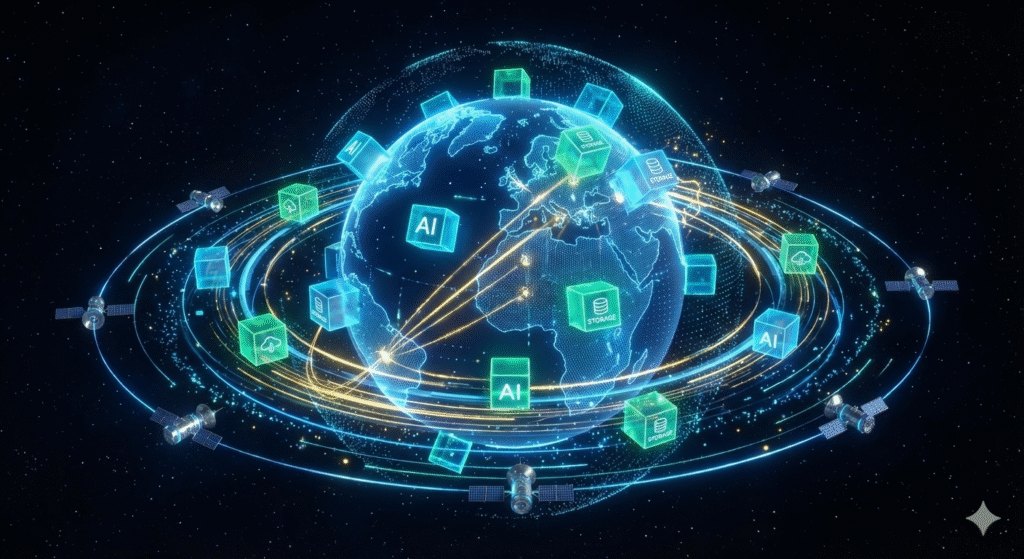
The era of “Cloud-Everything”—where businesses rushed to move every bit of data to the public cloud—has officially ended. In 2026, we have entered the age of the Strategic Cloud.
It’s no longer about if you are in the cloud, but how you are orchestrating it. The landscape has shifted from generic storage and compute to a hyper-specialized ecosystem where AI, edge devices, and industry-specific regulations dictate the architecture.
Here is the state of Cloud Computing as we navigate the first quarter of 2026.
I. The “Great Rebundling”: AI-Native Platforms
In 2024 and 2025, companies were “bolting on” AI to their existing cloud infrastructure. In 2026, the cloud is being re-architected around the model.
We are seeing a “Great Rebundling” where hyperscalers (AWS, Azure, GCP) are no longer just providing virtual machines; they are providing End-to-End AI Factories. These platforms offer integrated data lakes, vector databases, and custom silicon (like Google’s TPUs or AWS Trainium) as a single, unified service.
The 2026 Reality: You don’t “buy a server” anymore; you subscribe to an “Inference Pipeline” or a “Training Cluster” that manages its own scaling and hardware optimization.
II. Industry Clouds: The Death of Generic SaaS
The “one-size-fits-all” cloud is a relic of the past. 2026 is the year of Industry Cloud Platforms (ICPs). These are vertical clouds pre-configured with the compliance, security, and data models specific to a sector.
- Healthcare Clouds: Come with built-in HIPAA/GDPR compliance and native FHIR data connectors.
- Financial Clouds: Feature pre-integrated “Open Banking” frameworks and real-time fraud detection at the kernel level.
- Manufacturing Clouds: Designed for digital twin simulations and low-latency synchronization with factory floor robotics.
By using an ICP, businesses are reducing their “time-to-value” by up to 40% because the foundational regulatory heavy lifting is already done by the provider.
III. Multi-Cloud 2.0 and the Rise of FinOps
In 2026, Multi-Cloud is the standard, not the exception. 89% of large enterprises now use two or more hyperscalers to avoid vendor lock-in and ensure resilience.
However, this complexity has led to the “Cloud Bill Shock.” To counter this, FinOps (Cloud Financial Operations) has moved from a niche practice to a core business function. AI-driven FinOps tools now automatically move workloads between providers in real-time based on current spot pricing and carbon intensity.
2026 Cloud Maturity Table
| Feature | 2024 Approach | 2026 Standard |
| Primary Strategy | Cloud-First (Public) | Hybrid & Multi-Cloud (Sovereign) |
| Cost Management | Manual monthly audits | Real-time AI FinOps automation |
| Architecture | Monolithic Microservices | Serverless 2.0 & Edge-Native |
| Compliance | Add-on security tools | “Policy-as-Code” (Built-in) |
| Sustainability | Voluntary reporting | Mandatory Carbon-Aware Routing |
IV. The Unified Digital Layer: Cloud meets Edge
The line between “The Cloud” (distant data centers) and “The Edge” (your phone, car, or factory sensor) has blurred into a Unified Digital Layer.
With the maturity of 5G Advanced, we are seeing “Local-First” execution. The cloud now acts as the “Brain” for long-term memory and heavy model training, while the Edge acts as the “Reflexes” for instant action. If a self-driving car needs to make a split-second decision, it happens at the Edge; the data is then synced to the Cloud at night to improve the fleet’s overall intelligence.
V. Sustainable “Green” Computing
In 2026, “Green Cloud” is no longer a PR move—it’s a legal and financial necessity.
Most major providers now offer Carbon-Aware Workload Scheduling. This means your non-urgent data processing (like running a massive analytics report) will automatically wait for a window when renewable energy production (wind or solar) is at its peak in the data center’s region. Sustainable coding practices—writing efficient algorithms to reduce CPU cycles—have become a key metric for senior developers.
The Bottom Line
Cloud computing in 2026 is about Sovereignty and Efficiency. It’s about keeping your sensitive data close, your AI models fast, and your costs transparent. The winners of this era are the ones who can orchestrate these diverse platforms into a single, seamless engine for innovation.