
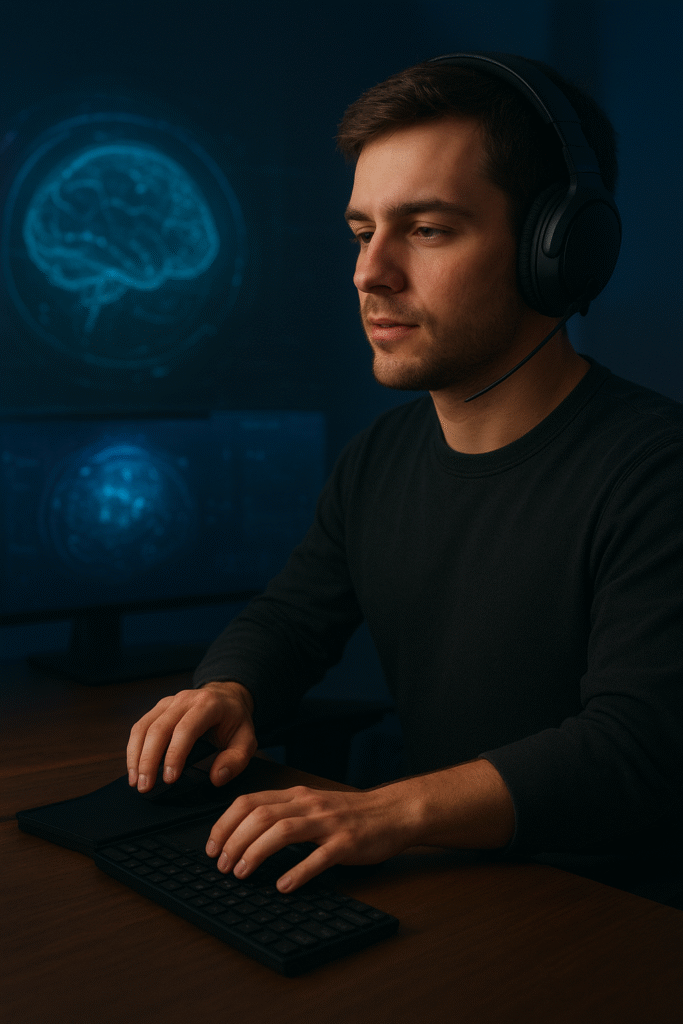
Just a few years ago, a smartwatch counting your steps felt futuristic. In 2025, that’s ancient history.
Today’s wearables don’t just track your heart rate — they understand your emotions, predict stress, enhance your focus, and even control digital devices with your thoughts.
Welcome to the dawn of the AI-augmented human.
From Smart Devices to Smart Bodies
AI wearables have evolved far beyond fitness trackers. Devices like Neuralink’s N1 implant, Meta’s EMG wristbands, and Samsung’s BioSkin patches are reshaping what it means to be “connected.”
These aren’t just accessories anymore — they’re extensions of our nervous system.
Imagine:
- Your smartwatch warns you of a panic attack before it happens.
- Your earbuds translate real-time speech in 80 languages.
- Your ring tracks your sleep, hydration, and emotional state — then uses AI to suggest what your brain needs to perform better.
It’s not sci-fi. It’s 2025.
How AI Powers the Future of Human Performance
🧠 Emotion Recognition
Modern wearables analyze tone, pulse, facial micro-expressions, and brainwave signals to detect your mood — helping you manage anxiety, burnout, or focus levels.
⚡ Neural Interfaces
Companies like Neuralink, OpenBCI, and NextMind are building brain–computer interfaces (BCIs) that translate thoughts into digital commands. Imagine typing an email or playing a game — without touching a screen.
🩺 Predictive Health Monitoring
AI models analyze data from millions of users to predict early signs of diseases like heart failure, diabetes, or even depression — weeks before symptoms appear.
🎧 Sound + Focus AI
Smart earbuds like Sony LinkBuds AI can detect cognitive fatigue and automatically play soundscapes that boost concentration.
Big Tech’s Next Battlefield: Your Body
The wearable AI race is heating up. Here’s who’s leading in 2025:
- Apple Vision Pro 2 integrates biometric data with AR, adapting visuals based on your stress or alertness.
- Meta Neural Wristband reads neural signals to let you interact with AR objects without gestures.
- Oura Ring Gen 4 uses AI to map emotional cycles, giving personalized rest and productivity suggestions.
- Google SkinSense Patch turns your skin into a display, showing health stats via micro-LEDs.
These companies aren’t just building gadgets — they’re building human operating systems.
The Blurring Line Between Human and Machine
With each new device, technology becomes less visible and more biological.
We’re moving from using tech to becoming tech.
Scientists call this trend Human-AI Symbiosis — where devices don’t just respond to us, they adapt, learn, and evolve with us.
The question isn’t “What can my phone do?” anymore.
It’s “What can I do with AI inside me?”
Ethical and Privacy Concerns
With great innovation comes serious questions:
- Who owns your biometric data?
- Can an AI predict your emotions too accurately?
- What happens if your neural device gets hacked?
Governments are racing to draft “neuro-rights” laws to protect thoughts and emotions as personal data.
The debate is just beginning — and it’s as important as the technology itself.
The Future: Merging Mind and Machine
By 2030, experts predict the rise of Cognitive Wearables — devices that don’t just track your body, but collaborate with your mind.
AI won’t just improve your performance; it will become a digital partner that grows alongside you — understanding your personality, preferences, and emotions better than anyone else.
In other words:
We’re not just connected anymore.
We’re integrated.
🚀 Final Thoughts
The wearable revolution of 2025 isn’t about fitness or fashion — it’s about evolution.
We’re entering a world where technology no longer lives in our pockets, but in our pulse.
As AI becomes part of our biology, the next upgrade might not be a new device —
It might just be you.