
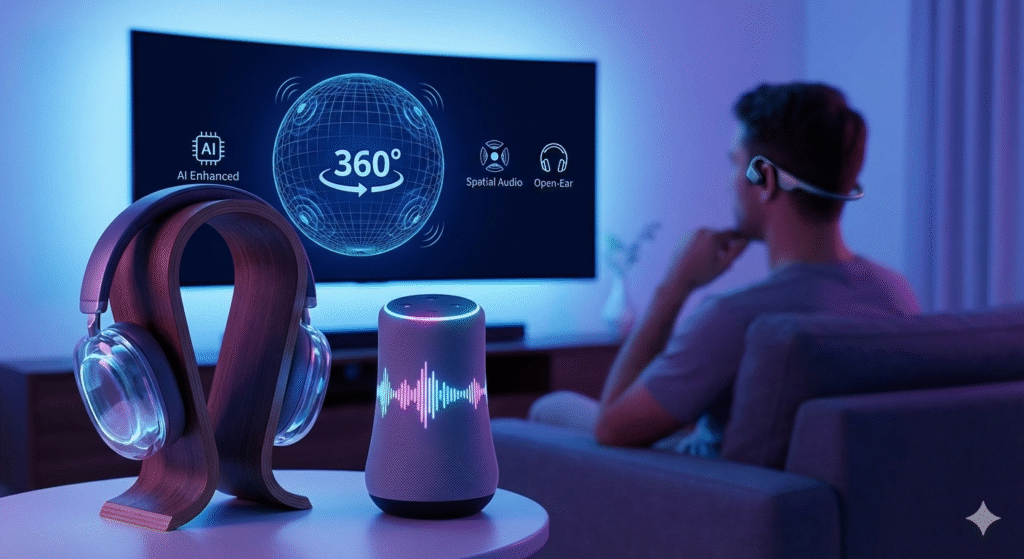
The audio landscape is undergoing a seismic shift. We are moving past the era of simple stereo playback into a world of immersive, intelligent, and increasingly open audio experiences. Driven by rapid advancements in Artificial Intelligence (AI), new connectivity standards, and a renewed focus on user comfort and awareness, the headphones and speakers of 2025 and 2026 are smarter, more personalized, and more integrated into our daily lives than ever before.
Here is a detailed look at the key trends reshaping how we listen.
1. The AI Revolution in Audio: Personalization and Clarity
Artificial Intelligence is no longer just a buzzword in audio; it’s the central nervous system of modern devices.
- Hyper-Personalized Sound Profiles: Gone are the days of generic EQ presets. AI algorithms now analyze your unique hearing capabilities, listening habits, and even the shape of your ears to create a custom sound profile. This ensures that every note is delivered exactly as your ears are best suited to perceive it, maximizing clarity and reducing listening fatigue.
- AI-Driven Active Noise Cancellation (ANC): ANC is becoming adaptive and intelligent. Instead of a static blockade of sound, AI-powered ANC continuously analyzes environmental noise—distinguishing between a humming air conditioner, traffic, or a sudden conversation—and adjusts the cancellation filters in real-time for a more natural and effective sonic shield.
- Voice Isolation and Enhancement: For communication, AI is a game-changer. Microphones equipped with AI can isolate your voice from a chaotic background (like a busy café or a windy street) with unprecedented accuracy, ensuring crystal-clear calls and voice commands even in the most challenging environments.
2. Spatial Audio becomes the New Standard
Spatial audio is transforming listening from a flat, two-dimensional experience into a fully immersive, three-dimensional soundscape.
- Beyond Stereo: Unlike traditional stereo that places sound on a left-right plane, spatial audio technologies (like Dolby Atmos, Apple Spatial Audio, and Sony 360 Reality Audio) treat sounds as individual objects that can be placed anywhere in a 360-degree sphere around you. This creates a sense of realism where sound feels like it’s coming from all directions—above, below, and behind you.
- Head Tracking Integration: The most immersive experiences now incorporate dynamic head tracking. Sensors in headphones monitor your head movements, anchoring the sound field to the real world. If you turn your head toward a sound source, it moves naturally in your ears, just as it would in real life. This is particularly revolutionary for movies and gaming, placing you directly inside the action.
3. The Rise of “Open-Ear” Listening
A major shift in form factor is occurring, moving away from sealing off the world to embracing it while listening.
- Awareness Meets Audio: Open-ear earbuds and headphones are exploding in popularity. These devices typically rest outside the ear canal, using technologies like bone conduction or directional air conduction to deliver sound. This design allows ambient noise—traffic, colleagues, nature—to coexist with your music or podcasts.
- Use Cases: This form factor is ideal for runners and cyclists who need situational awareness for safety, office workers who need to remain approachable, or anyone who finds in-ear tips uncomfortable for long sessions. The goal is a “soundtrack to your life” rather than an escape from it.
4. Connectivity and Quality: The Quest for Lossless
The pipes that deliver our audio are getting bigger and smarter, finally catching up to the demands of audiophiles.
- Bluetooth 6.0 and Beyond: The latest Bluetooth specifications are paving the way for higher data throughput and lower latency. This is crucial for delivering genuine lossless audio wirelessly, a feature that streaming services like Spotify are finally rolling out to meet consumer demand for studio-quality sound.
- Wi-Fi in Headphones: We are beginning to see high-end headphones integrate Wi-Fi connectivity. Unlike Bluetooth, Wi-Fi has the bandwidth to handle uncompressed, high-resolution audio streams directly from the cloud, bypassing the compression bottlenecks of traditional wireless connections for the ultimate listening experience.
5. Smarter, More Integrated Speakers
Home audio is moving beyond simple playback devices into intelligent hubs for the smart home.
- Context-Aware Smart Speakers: Thanks to AI, smart speakers are becoming less reactive and more proactive. They can understand complex, multi-part commands, identify different user voices to provide personalized responses, and even adjust their sound output based on the acoustics of the room they are placed in.
- Seamless Ecosystems: The focus is on creating frictionless audio experiences. You can start listening to a podcast on your smart speaker at home, and as you walk out the door, the audio seamlessly hands off to your earbuds without you pressing a button. This level of ecosystem integration is becoming a key differentiator for major brands.
In summary, the future of audio is not just about louder or bassier sound. It’s about smarter, more immersive, and contextually aware audio that adapts to you and your environment, blurring the line between the digital soundscape and the physical world.
For a look at some of the exciting products on the horizon, check out this video on upcoming speakers. Top 5 Upcoming Speakers 2026 – The Future of Sound! This video provides a glimpse into the future of home audio hardware, showcasing upcoming speaker models that incorporate many of the trends discussed, such as AI-powered tuning and advanced wireless technology.