
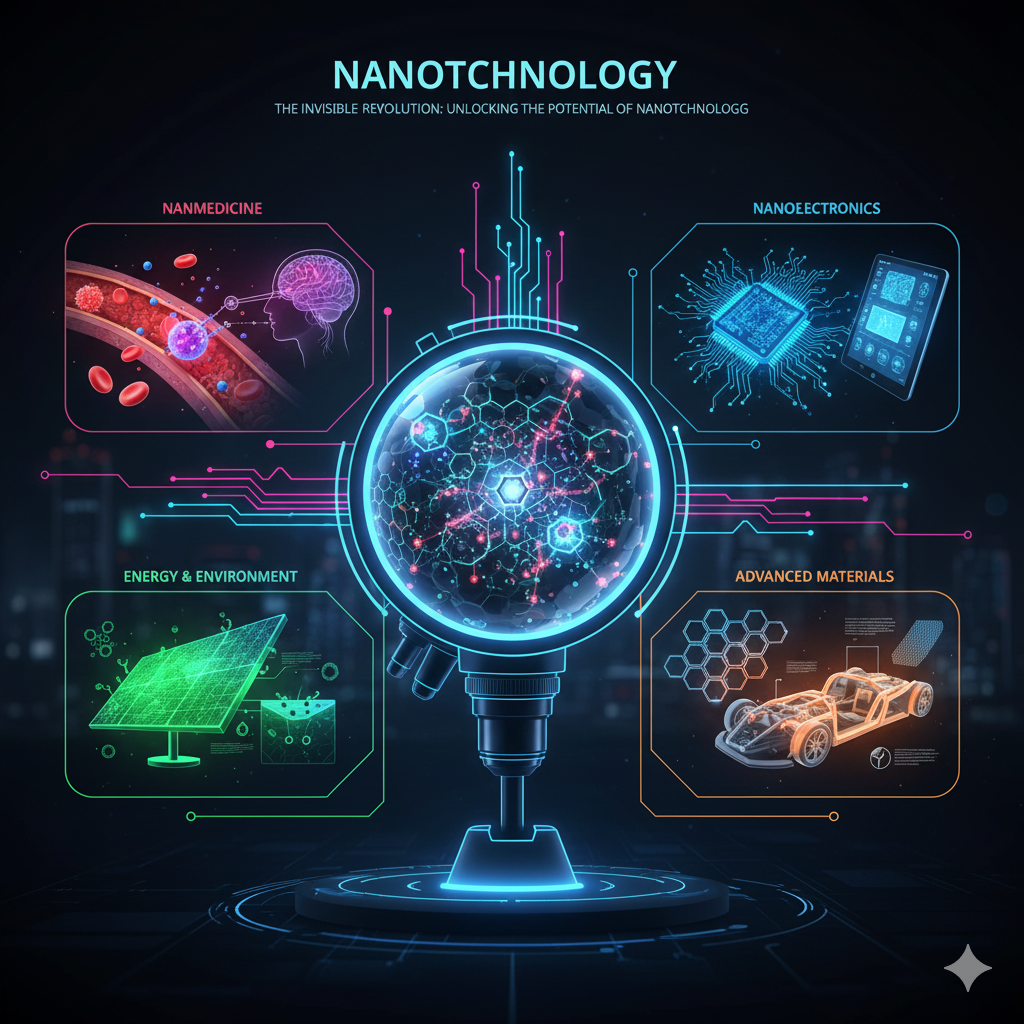
Imagine a world where doctors use tiny, programmed machines to repair cells, computer chips are thousands of times faster, and fabrics never stain. This isn’t science fiction; it’s the promise of Nanotechnology—the science of manipulating matter at the nanoscale (one to 100 nanometers).
To put this scale in perspective, a nanometer is one billionth of a meter. That’s about the width of 10 hydrogen atoms. At this minuscule level, materials exhibit unique physical, chemical, and biological properties, allowing scientists and engineers to create entirely new materials and devices with revolutionary applications.
The Science of the Small
Nanotechnology operates on two fundamental approaches:
- Top-Down: Starting with larger materials and gradually miniaturizing them down to the nanoscale. This is the common approach used today, often to manufacture tiny components for electronics.
- Bottom-Up: Building structures atom by atom or molecule by molecule through processes like self-assembly. This method, inspired by nature’s processes, holds the key to true molecular manufacturing in the future.
By controlling matter at this fundamental level, we can design materials that are lighter than aluminum but stronger than steel (like graphene), or particles that can interact specifically with biological molecules.
Applications: Nanotech is Everywhere
Nanotechnology is not just a laboratory concept; its applications are already transforming major industries:
1. Nanomedicine (Healthcare)
This is arguably the most exciting frontier, using nanoscale tools for diagnosis, treatment, and prevention:
- Targeted Drug Delivery: Nanoparticles (like liposomes or dendrimers) can be engineered to encapsulate chemotherapy drugs and release them only upon reaching cancer cells. This dramatically reduces damage to surrounding healthy tissue, improving treatment efficacy and minimizing side effects.
- Early Diagnosis: Nanosensors can detect biomarkers (molecules indicating disease) in the blood at incredibly low concentrations, allowing for the earlier detection of diseases like cancer or Alzheimer’s.
- Tissue Engineering: Nanomaterial scaffolds can be used to guide cell growth and regeneration of tissues and organs.
2. Nanoelectronics & Computing
Nanotechnology is the answer to the demand for faster, smaller, and more energy-efficient electronics:
- Next-Generation Materials: Materials like carbon nanotubes are being explored to replace silicon in microchips, potentially leading to chips that are smaller, faster, and more power-efficient.
- Flexible Displays: Graphene, a single layer of carbon atoms, offers high conductivity and flexibility, making it an ideal candidate for developing flexible touchscreens and wearable electronics.
- Memory Storage: Nanoscale structures are key to creating ultra-dense memory storage devices, capable of holding vast amounts of data in tiny spaces.
3. Energy and Environment
Nanomaterials are crucial for tackling sustainability challenges:
- Solar Cells: Nanoscale materials can be used to develop solar panels that are much more efficient at converting sunlight into electricity and are also lighter and cheaper to manufacture.
- Batteries & Fuel Cells: Nanoporous materials increase the surface area within batteries and hydrogen fuel cells, leading to greater energy density, faster charging times, and improved efficiency.
- Water Purification: Nanofiltration systems utilize specialized nanomembranes to effectively remove contaminants, heavy metals, and pathogens from water with high efficiency.
The Future: Nanorobotics and Beyond
The current generation of nanotechnology is largely based on passive nanostructures (like nanoparticles in sunscreen or coatings). The future, however, is focused on active nanosystems:
- Nanorobots: The development of self-sufficient machines operating at the nanoscale could revolutionize medicine, allowing for minimally invasive microsurgery, clearing arterial plaque, or detecting and destroying infected cells inside the body.
- Programmable Matter: The ultimate goal is to create materials whose properties can be controlled externally, offering the potential for objects to change their shape, function, or color on demand.
While ethical and safety considerations regarding the environmental and health impacts of nanomaterials remain a focus of research, the momentum of nanotechnology is undeniable. It is an investment in a future where precision at the atomic level translates into massive improvements in health, technology, and sustainability for all.