
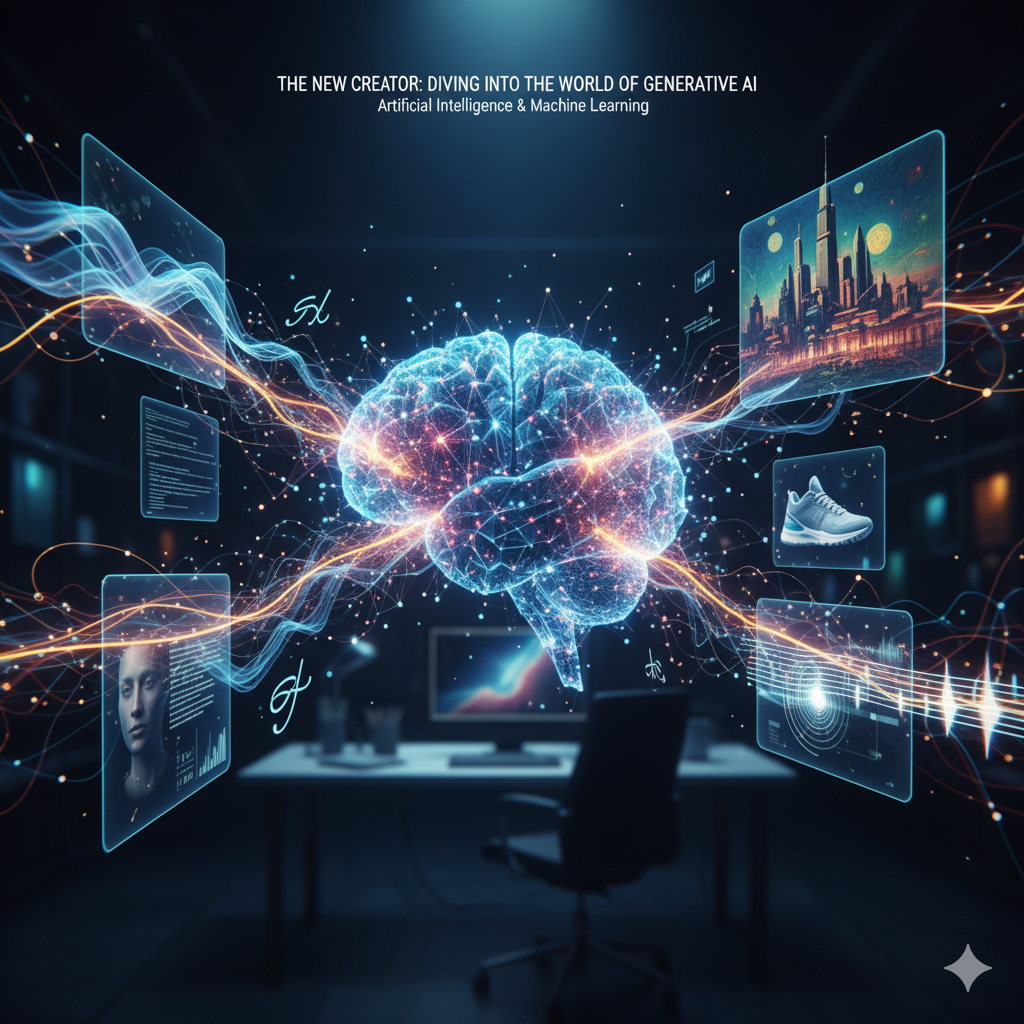
For decades, computers were the ultimate calculators—brilliant at analyzing data, following instructions, and providing specific answers. But a new era of Artificial Intelligence (AI) has arrived, one where machines don’t just process information; they create it. This is the world of Generative AI, and it is arguably the most transformative technology built upon the foundations of Machine Learning (ML).
Generative AI refers to deep learning models that can create novel, complex, and original content across various forms—from text and images to music and code—in response to a simple human prompt.
The Engine of Creation: How it Works
Generative AI doesn’t just copy. It learns the underlying patterns and structures of a massive dataset, and then uses that knowledge to produce entirely new data that shares those characteristics. This is achieved through highly advanced machine learning models:
1. The Power of Deep Learning
At the heart of Generative AI are specialized deep learning architectures, such as:
- Transformers (e.g., GPT models): These models excel at understanding context and dependencies in sequential data, making them the powerhouse behind most Large Language Models (LLMs) that generate coherent, long-form text.
- Generative Adversarial Networks (GANs): A pair of neural networks—a Generator and a Discriminator—are pitted against each other. The Generator tries to create realistic content, while the Discriminator tries to tell if the content is real or fake. This adversarial training pushes the Generator to create increasingly realistic outputs.
- Variational Autoencoders (VAEs) & Diffusion Models (e.g., DALL-E, Stable Diffusion): These models learn to encode and decode the data, effectively learning the “essence” of what they are trained on, allowing them to create stunning, high-resolution images from text descriptions.
2. Learning the World’s Patterns
The models are trained on gigantic datasets—billions of words, images, and lines of code. Through this intensive training, the model essentially develops a compressed, simplified internal representation of the real world’s information and creative styles.
3. Prompting and Generation
When a user provides a prompt (a request like “Draw a futuristic cityscape in the style of Van Gogh” or “Write a summary of the blog post above”), the model draws upon its learned internal representation to construct a novel output that fulfills the specific constraints of the prompt.
Applications: The Creative Tsunami
Generative AI has burst out of the lab and into nearly every industry, turning employees into “super-agents” who can create faster and more efficiently.
| Content Type | Generative AI Application | Real-World Impact |
| Text & Code | Large Language Models (LLMs) | Drafting emails, writing blog posts, summarizing documents, generating or debugging software code. |
| Images & Art | Image Generation Models | Creating unique digital artwork, generating photorealistic marketing visuals, designing rapid prototypes for products. |
| Audio & Music | Synthesized Voice/Music | Creating realistic voiceovers for videos, composing background music for games, synthesizing speech for virtual assistants. |
| Data | Synthetic Data Generation | Creating realistic, non-identifiable datasets for training other AI models in industries like finance or healthcare. |
The Impact: Augmentation, Not Automation
The conversation around Generative AI often revolves around job replacement, but the truer impact is augmentation.
- For the Professional: It automates repetitive, low-value tasks like drafting an initial email or writing first-pass code. This frees up human professionals to focus on higher-level strategic thinking, critical evaluation, and truly novel problem-solving.
- For the Creator: It democratizes creativity, turning a basic text description into a complex image in seconds. It acts as an infinitely patient collaborator, allowing artists, writers, and designers to rapidly prototype ideas and explore creative avenues that would take weeks manually.
However, the key to unlocking this potential is critical thinking. Studies suggest that the greatest benefit goes to those who treat AI outputs as a starting point—who review, refine, and strategically guide the AI, rather than passively accepting its output.
Generative AI is not just a technological step; it is a cultural shift. It challenges our definitions of originality and ownership and forces us to reconsider the role of the human in the creative and professional process. The future is not about if we use AI, but how we master the art of prompting, refining, and applying its incredible generative power.