
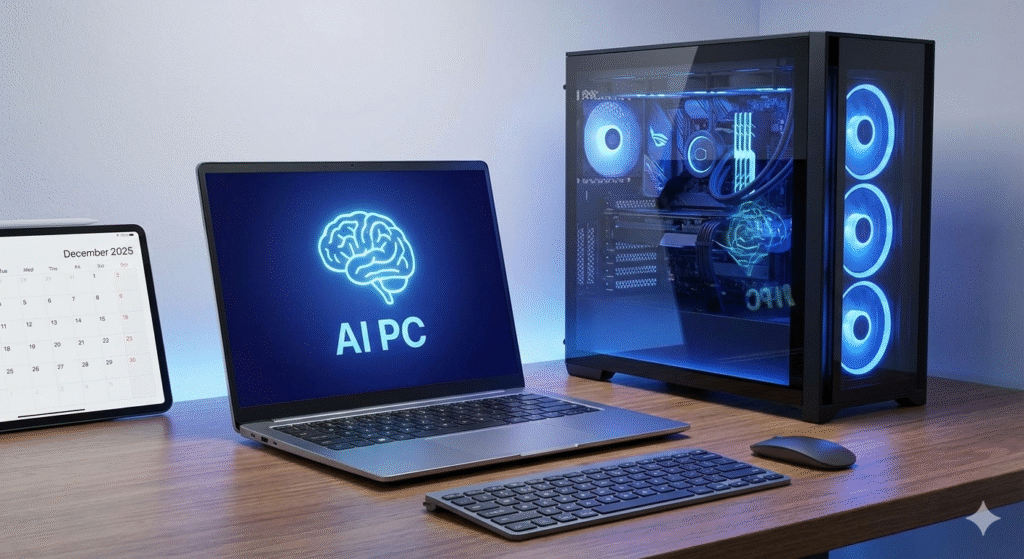
For years, the narrative was the same: “The PC is dead; mobile is the future.” Yet, here we are in late 2025, and the personal computer—both the laptop in your backpack and the rig on your desk—is experiencing its most significant evolution in two decades.
The PC isn’t dying; it’s evolving. It is transitioning from a passive tool for typing and browsing into an intelligent partner capable of generating content, anticipating needs, and lasting longer than ever before.
If you haven’t looked at the laptop market in a few years, things have changed. Here is a look at the trends defining the current landscape of Laptops and PCs.
1. The Era of the “AI PC” and the NPU
The biggest buzzword currently is the “AI PC.” But unlike many tech trends, this one involves a fundamental change to the hardware under the hood.
For decades, PCs relied on two main brains: the CPU (Central Processing Unit) for general tasks and the GPU (Graphics Processing Unit) for visuals and gaming.
Now, a third brain has become standard: the NPU (Neural Processing Unit).
Why it matters:
AI tasks—like blurring your background on a Zoom call in real-time, generating images locally on your machine without internet, or running on-device chatbots—are heavy lifting for a regular CPU. The NPU is a specialized chip designed specifically to handle this math efficiently.
The result isn’t just that your PC can “do AI.” It means it can do AI tasks without draining your battery in an hour or making your fans sound like a jet engine. We are just scratching the surface of software that utilizes NPUs, but the hardware foundation is now being laid.
2. The Battery Life Revolution: ARM vs. x86
The most practical improvement for the average user over the last two years has been the war on battery anxiety.
For a long time, Apple’s MacBooks (running on ARM-based Apple Silicon) were the only laptops that offered true, all-day performance without being plugged in. Windows laptops, powered by traditional Intel or AMD (x86) chips, struggled to keep up in efficiency.
That gap has finally closed.
The entry of powerful ARM-based chips into the Windows ecosystem (led by Qualcomm’s Snapdragon X Elite series) forced a massive shift. These laptops finally offer Windows users the “instant-on,” cool-running, 15-hour+ battery life experience previously reserved for Mac users.
In response, Intel (with their Core Ultra series) and AMD have drastically improved their own efficiency. The winner in this silicon arms race is the consumer. You no longer have to sacrifice performance to get through a workday unplugged.
3. Displays: OLED becomes the Standard
Remember the washed-out, greyish laptop screens of the 2010s? They are largely a thing of the past in the mid-to-high-end market.
OLED (Organic Light-Emitting Diode) technology, once expensive and reserved for TVs and flagship phones, has democratized. It is now common to find stunning OLED panels on mid-range laptops. These screens offer perfect blacks, incredible contrast ratios, and vibrant colors that make everything from spreadsheets to movies look infinitely better.
Furthermore, higher refresh rates (90Hz or 120Hz), previously a “gaming only” feature, are creeping into productivity laptops, making scrolling websites and moving windows feel incredibly smooth.
4. Form Factors: Refinement Over Gimmicks
While we still see prototypes of rollable screens and dual-screen behemoths at tech shows, the devices people are actually buying are refining the core experience.
- The Premium Ultrabook: The “thin and light” category has perfected the formula. Aluminum chassis, excellent keyboards, and almost zero bezels are the norm.
- The Rise of Handheld PCs: The success of the Steam Deck spawned an entire category. Powerful handheld PCs running Windows are now a legitimate segment of the PC market, bridging the gap between console convenience and PC library depth.
- Foldables are Maturing: Foldable screen laptops (one giant screen that folds in half) are getting sturdier and thinner, though they remain a niche luxury item rather than a mainstream necessity.
5. Sustainability and Repairability
A quiet but important trend is the push toward longevity. Driven by consumer demand and increasing “Right to Repair” regulations globally, manufacturers are making PCs easier to fix.
We are seeing more modular designs where batteries are not permanently glued down, and RAM and storage can be upgraded by the user. The idea of a disposable laptop that gets tossed after three years is becoming unpopular. Consumers want machines that are built to last and can be maintained over time.
The Bottom Line
The PC market in 2025/2026 is vibrant and highly competitive. The arrival of dedicated AI silicon has given the industry a new direction, while intense competition among chipmakers has solved the age-old problem of poor battery life.
Whether you need a creative powerhouse for video editing, a silent and long-lasting machine for office work, or a portable gaming rig, there has never been a better time to be a PC user.