
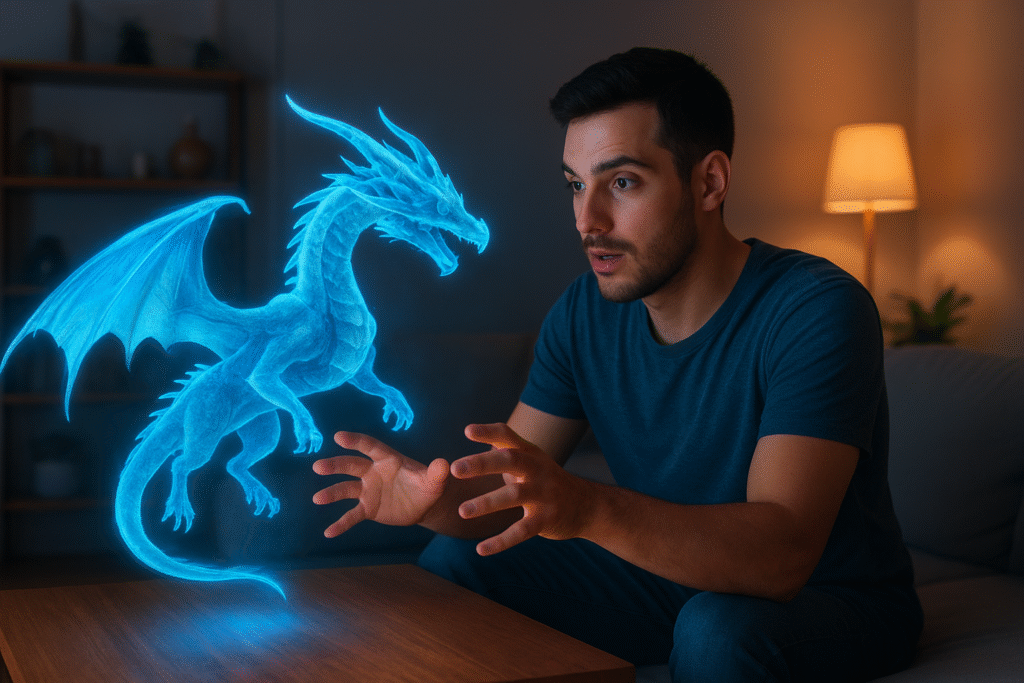
For decades, gamers have been glued to flat screens — whether it’s a 4K monitor, a VR headset, or a mobile display.
But in 2025, a new technology is changing everything: Holographic Gaming — where virtual worlds literally come alive in your physical space.
This isn’t the future. It’s happening right now.
🌈 What Is Holographic Gaming?
Holographic gaming projects three-dimensional images into real space — allowing players to see and interact with game characters, items, and worlds as if they were physically present.
Imagine summoning a digital dragon that lands on your desk, walking around it, or teaming up with a holographic partner standing beside you.
No headset. No controller. Just your environment — upgraded.
This next step in gaming blends augmented reality (AR), AI, and light-field projection to create visuals that seem to float in midair.
🔮 The Technology Powering It
Three technologies are driving the holographic revolution:
1. Spatial Light Modulators (SLMs)
They bend light waves to project 3D holograms into open air. This means you can view the same object from different angles — just like real life.
2. AI-Powered Depth Tracking
AI helps these systems understand your space — walls, furniture, and hand movements — to make holograms interact naturally.
3. 5G & Edge Computing
With lightning-fast data transmission, complex holograms can be streamed in real-time without lag, making it ideal for both multiplayer and eSports hologames.
Companies like Sony, Microsoft, and Looking Glass Factory are investing heavily in holographic displays that don’t require glasses — and early adopters are already playing with them.
🎮 Gaming Without Screens
The magic of holographic gaming is freedom.
No screen boundaries. No heavy VR headsets. Just you and your space.
Imagine:
- Playing a strategy game where your living room becomes a battlefield.
- Watching your favorite character walk around your room and respond to you.
- Hosting a co-op mission with a friend’s hologram beside you — both interacting with the same environment.
Holographic gaming is more immersive than VR and more social than traditional gaming.
It’s not about escaping reality — it’s about bringing the game into it.
💡 Why 2025 Is the Year It’s Taking Off
In 2025, several key breakthroughs have pushed holographic gaming into the mainstream:
- Meta’s Project Orion: A headset-free holographic AR platform that blends digital characters into your world.
- Microsoft’s HoloLens 3: Now supports high-fidelity multiplayer AR gaming with ultra-low latency.
- Apple Vision Pro 2: Introduced “HoloPlay” mode, where users can project AR games directly into open air using depth sensors.
- Looking Glass 65” Display: The world’s largest holographic screen — used for eSports broadcasts and game showcases.
The convergence of these technologies has turned what once felt like science fiction into a playable, social experience.
⚔️ eSports and Holographic Arenas
eSports is embracing holograms too.
Major tournaments are testing holographic projections of live players, letting audiences see competitors’ avatars fighting on-stage in real 3D.
Spectators can even walk around the battlefield, watching from any angle — turning competitive gaming into a truly interactive sport.
This hybrid entertainment model — where digital meets physical — is being called “Phygital Gaming.”
🚀 The Future: Holo-Homes and Everyday Play
By 2030, your living room could become your main gaming console.
Developers are already designing “holo-ready” games that use your surroundings dynamically — your table becomes terrain, your sofa a bunker, and your pet might even react to digital characters walking by.
Gamers could soon “buy” holographic skins and items that exist in their home space permanently — part collectible, part decoration.
⚠️ The Challenges Ahead
Like all great innovations, holographic gaming comes with hurdles:
- High cost of projection hardware.
- Energy demands of 3D rendering.
- Content creation — developers must build games that make use of physical space.
But as adoption grows and devices shrink, holograms will become as common as smartphones once were.
🌍 Final Thoughts
Holographic gaming represents more than just the next step in entertainment — it’s a shift in how we interact with digital worlds.
We’re moving from screens you look at to worlds you live inside of.
From playing games to hosting them in your own space.
2025 marks the beginning of a future where imagination and technology finally merge — and the boundaries between reality and the virtual world disappear forever.
Welcome to the era of holographic gaming — where your world becomes the game.