

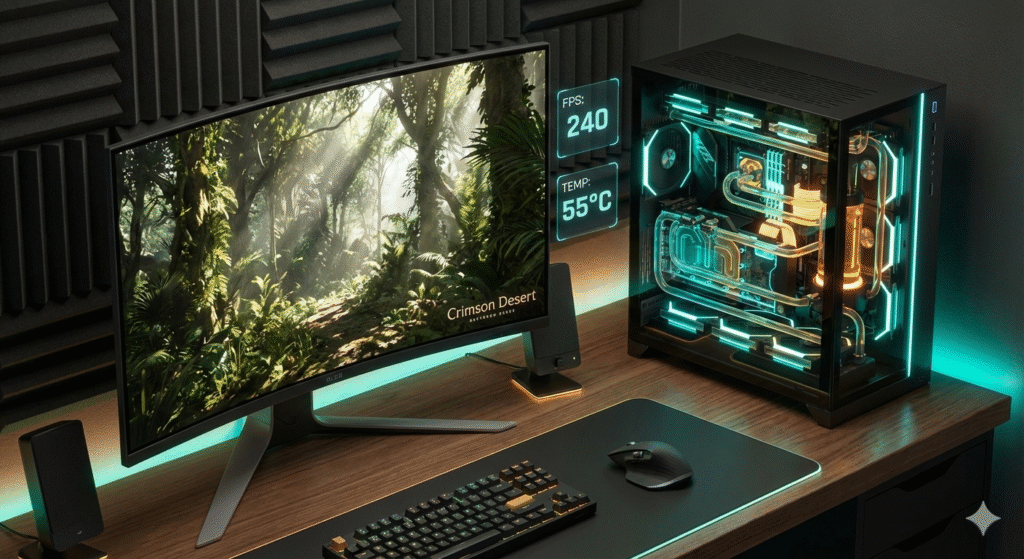
Welcome to the pinnacle of the “spec-war.” As of January 2026, the PC gaming landscape has shifted from a battle of raw teraflops to a sophisticated dance of Neural Rendering and AI-Native Architecture. We are no longer just “playing” games; we are running real-time simulations assisted by silicon brains.
If you’re looking to upgrade your rig this quarter, here is what the 2026 hardware and software meta looks like.
I. The Blackwell Era: RTX 50-Series Dominance
The launch of the NVIDIA GeForce RTX 50-series (Blackwell) has redefined the high-end enthusiast tier. With the transition to GDDR7 memory, we are seeing bandwidth speeds that make 4K gaming feel like the new 1080p.1
- Multi-Frame Generation: DLSS 4.5 has introduced “Dynamic Multi-Frame Generation,” allowing the GPU to generate up to three AI frames for every one traditionally rendered frame.2 In some titles, we are seeing a performance multiplier of $5x$ to $6x$ compared to native rendering.
- The VRAM Standard: 16GB is now considered the “entry-level” for 1440p gaming, with the RTX 5090 pushing the boundaries of 32GB to accommodate the massive datasets required for Path Tracing.
Pro Tip: If you’re building a compact rig, look for the new “Slim” dual-slot RTX 5070 and 5080 models.3 They deliver the power of previous-gen flagships in half the physical footprint.
II. CPU Wars: Zen 6 vs. Nova Lake4
On the processing front, we are witnessing a clash between AMD’s Zen 6 and Intel’s Nova Lake.5
- AMD Zen 6: Continues to lead in multi-core efficiency, making it the go-to for streamers and creators who game on the side. Its 3D V-Cache variants remain the “kings of frame times.”
- Intel Nova Lake: Intel has pivoted heavily into AI-driven performance.6 These CPUs feature dedicated NPU (Neural Processing Unit) clusters that handle background tasks—like noise cancellation, stream encoding, and AI-NPC logic—leaving the primary cores dedicated entirely to game logic.
III. The Display Renaissance: 5K and Tandem OLED
Your monitor is no longer just a panel; it’s a high-speed window. CES 2026 showcased the arrival of Tandem WOLED and Micro-LED for the mass market.7
- The 480Hz Barrier: For competitive esports, 1440p at 480Hz has become the new gold standard.
- Dual-Mode Displays: We are seeing “Chameleon” monitors that can switch between 4K at 160Hz for cinematic RPGs and FHD at 480Hz for competitive shooters with the press of a button.8
- Micro-LED: While still premium, Micro-LED offers the “holy grail” of display tech—perfect OLED-level blacks with 4,000+ nits of peak brightness and zero risk of burn-in.9
IV. 2026 Q1-Q2 Release Calendar
| Game Title | Release Date | Genre | Tech Highlight |
| StarRupture | Jan 2026 (Early Access) | Sci-Fi Survival | DLSS 4.5 Native Support |
| Nioh 3 | Feb 6, 2026 | Action RPG | Advanced AI Combat Logic |
| Resident Evil Requiem | Feb 27, 2026 | Survival Horror | Full Path Tracing Mode |
| Crimson Desert | March 19, 2026 | Open World ARPG | Photogrammetry Environments |
| Pragmata | April 24, 2026 | Sci-fi Adventure | Real-time Physics Simulation |
V. The Rise of “Agentic” NPCs
The biggest software trend in 2026 isn’t a graphical one—it’s intelligence. Large Language Models (LLMs) are now being integrated directly into game engines. NPCs (Non-Player Characters) no longer rely on pre-written scripts; they can listen to your voice input, remember your past actions, and react dynamically.10 This has turned simple fetch quests into deep, emergent stories.
The Bottom Line
PC gaming in 2026 is about immersion through intelligence. Whether it’s AI generating your frames, your CPU managing your background apps via an NPU, or an NPC having a real conversation with you, the line between “code” and “reality” has never been thinner.


