

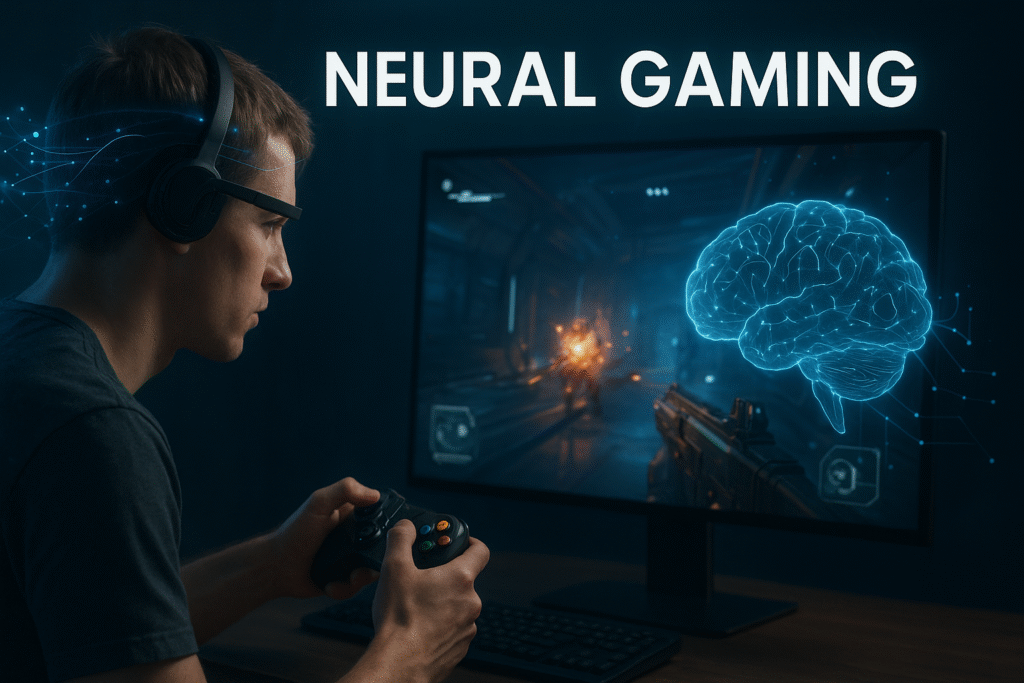
Gaming has evolved from controllers… to touchscreens… to VR…
But in 2025, the industry is entering a new era — Neural Gaming, where players control games using only their brain signals.
This is no longer science fiction.
Companies are already releasing early consumer versions of BCI headsets (Brain-Computer Interfaces) that let you perform actions just by thinking about them.
This technology is going viral — not just because it’s futuristic, but because it may redefine how humans interact with digital worlds.
🧠 What Is Neural Gaming?
Neural gaming uses a Brain-Computer Interface to capture your brain’s electrical signals through sensors.
These signals are then translated into in-game actions like:
- moving your character
- selecting weapons
- interacting with objects
- changing camera angles
- triggering abilities
No controller.
No keyboard.
No touch.
Just your mind.
⚡ Why Neural Gaming Is Trending in 2025
🔥 1. New Affordable BCI Headsets
Companies like NextMind, Neurable, Emotiv, and even gaming giants are creating headsets that:
- detect brain activity
- pair with PC, consoles, and mobile
- offer gesture-free gameplay
- support esports-like precision
They used to cost thousands.
In 2025, some models start under $300 — making them mainstream.
🎮 2. Games Built Specifically for Brain Control
Developers are launching titles designed only for neural input:
- puzzle games you solve mentally
- racing games controlled by focus levels
- shooters where aiming is guided by intention
- strategy games where “thinking ahead” literally speeds up your commands
Players say it feels “like telekinesis.”
🧑🦽 3. Massive Accessibility Breakthrough
For disabled gamers, neural gaming is becoming life-changing.
Players who cannot use traditional controllers can now:
- move characters
- participate in competitive modes
- socialize in virtual worlds
- enjoy gaming fully and independently
It’s one of the biggest inclusivity revolutions in gaming history.
⚡ 4. Esports Teams Are Testing BCI for Competitive Play
Some esports organizations are experimenting with:
- hybrid BCI + controller setups
- reflex-based mental inputs
- neuro-reaction training
Imagine a pro player firing abilities faster than any human hand could physically react.
It may create a whole new esports category:
Mind Sports.
🔍 How Neural Gaming Actually Feels
Early reviews describe it as:
- immersive
- strange
- emotional
- addictive
- life-changing
Beginners struggle at first, but then the brain “adapts,” and gameplay becomes smoother:
“It’s like the game becomes an extension of your thoughts.”
Players report moments where they forget they are using a device at all.
🔒 But Here’s the Dark Side
As with any breakthrough technology, neural gaming brings concerns.
⚠️ 1. Brain Data Privacy
Your BCI collects:
- focus patterns
- emotional reactions
- stress levels
- subconscious preferences
Who owns this data?
How is it stored?
Can companies read more than we want?
This debate is heating up globally.
⚠️ 2. Skill Gap
Players with stronger focus may perform better.
Developers must ensure fair play.
⚠️ 3. Game Addiction Could Intensify
If controlling games becomes as natural as thinking…
People may lose sense of time and reality.
Psychologists are already studying this.
🚀 The Future of Neural Gaming
Experts predict that by 2030:
- VR headsets will ship with built-in brain sensors
- some games won’t even support physical controls
- AI will merge with BCI to predict actions before you make them
- full-body haptic suits will sync with your neural output
- multiplayer “mind-link” games will allow emotional syncing with teammates
The gap between human thought and digital action is closing rapidly.
🎯 Final Thoughts
Neural gaming isn’t just a cool gadget —
It’s the next giant leap in human-computer interaction.
Whether you’re a competitive gamer, a tech enthusiast, or just curious about the future, 2025 is the year to watch this revolution unfold.
This isn’t the future of gaming —
It’s the future of how we connect with technology itself.


