

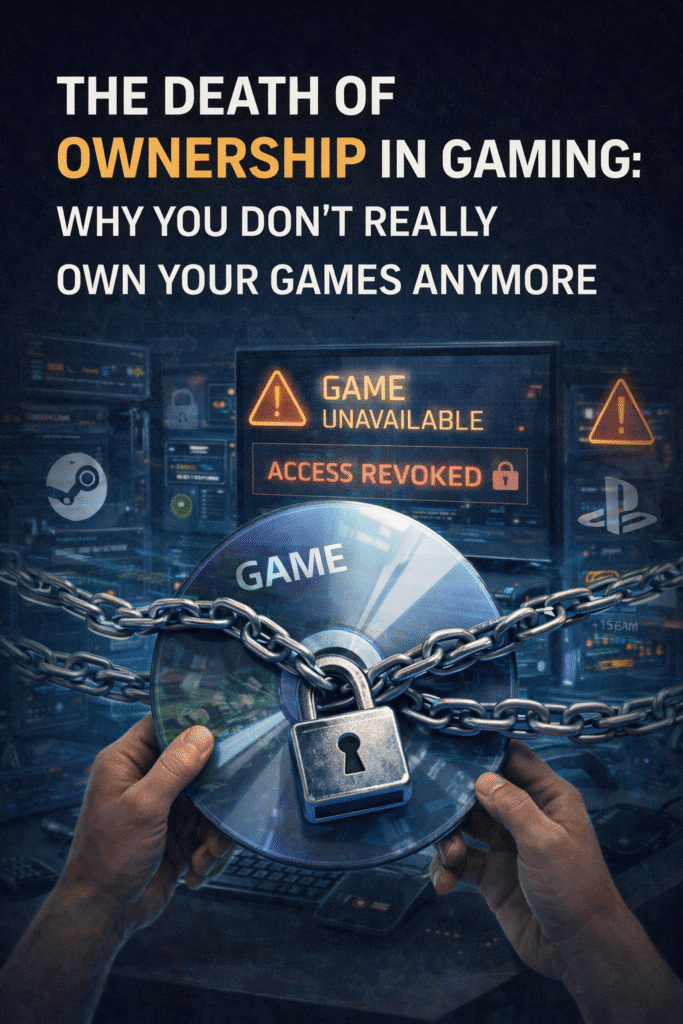
Buying a game used to mean something.
You owned the disc.
You installed the files.
You played whenever you wanted.
In 2025, that idea is disappearing fast.
Today, most gamers don’t actually own their games — even when they pay full price. And technology is the reason why.
🔐 From Discs to Licenses: A Silent Shift
Modern games are no longer products.
They are licenses.
When you buy a digital game, you’re often buying:
- permission to access content
- under specific conditions
- for an undefined amount of time
Always-online DRM, account-based authentication, and server validation mean that if access is revoked, the game is gone — even from your library.
Ownership has been replaced by conditional access.
🌐 Always-Online Technology Changed Everything
Many modern games require:
- constant server checks
- online authentication
- live content validation
Even single-player games can stop working if:
- servers shut down
- publishers remove support
- accounts are banned or restricted
This technology protects publishers — but leaves players dependent.
A game can exist on your hard drive and still be unplayable.
🎮 Subscription Services Redefined Value
Game libraries are now treated like streaming catalogs.
Subscription models offer:
- rotating game access
- limited availability
- instant removal of titles
This changes how players experience games:
- less emotional attachment
- less replay value
- more disposable experiences
When games come and go, commitment disappears.
📱 Why Mobile Gaming Normalized This Model
Mobile gaming introduced:
- server-side progression
- cloud-stored saves
- account-locked purchases
Players accepted it because mobile games were free.
Now the same system exists in premium PC and console titles — at full price.
The line between owning and renting has completely blurred.
⚠️ What Happens When Games Disappear
There are growing cases where:
- older games can’t be launched
- multiplayer modes vanish forever
- single-player content is lost
- purchased DLC becomes unusable
Preservation is becoming a serious issue.
Without physical copies or offline modes, entire games can vanish from history.
🔥 Why Gamers Are Pushing Back in 2025
This topic is trending because players feel powerless.
Common concerns include:
- losing access to paid content
- inability to play offline
- forced updates changing gameplay
- games becoming unplayable overnight
The phrase “You don’t own your games” is spreading rapidly across gaming communities.
🔮 What the Future Might Look Like
Some developers are exploring:
- offline-first designs
- DRM-free releases
- community-hosted servers
- long-term access guarantees
Gamers are becoming more vocal about digital rights — and companies are listening, slowly.
The next gaming revolution may not be technical.
It may be legal and ethical.
🏁 Final Thoughts
Gaming technology has given us incredible worlds.
But it also quietly took something away.
Ownership.
In the future, gamers may ask a new question before buying:
“Will I still be able to play this game in 10 years?”
How the industry answers that will define its legacy.