

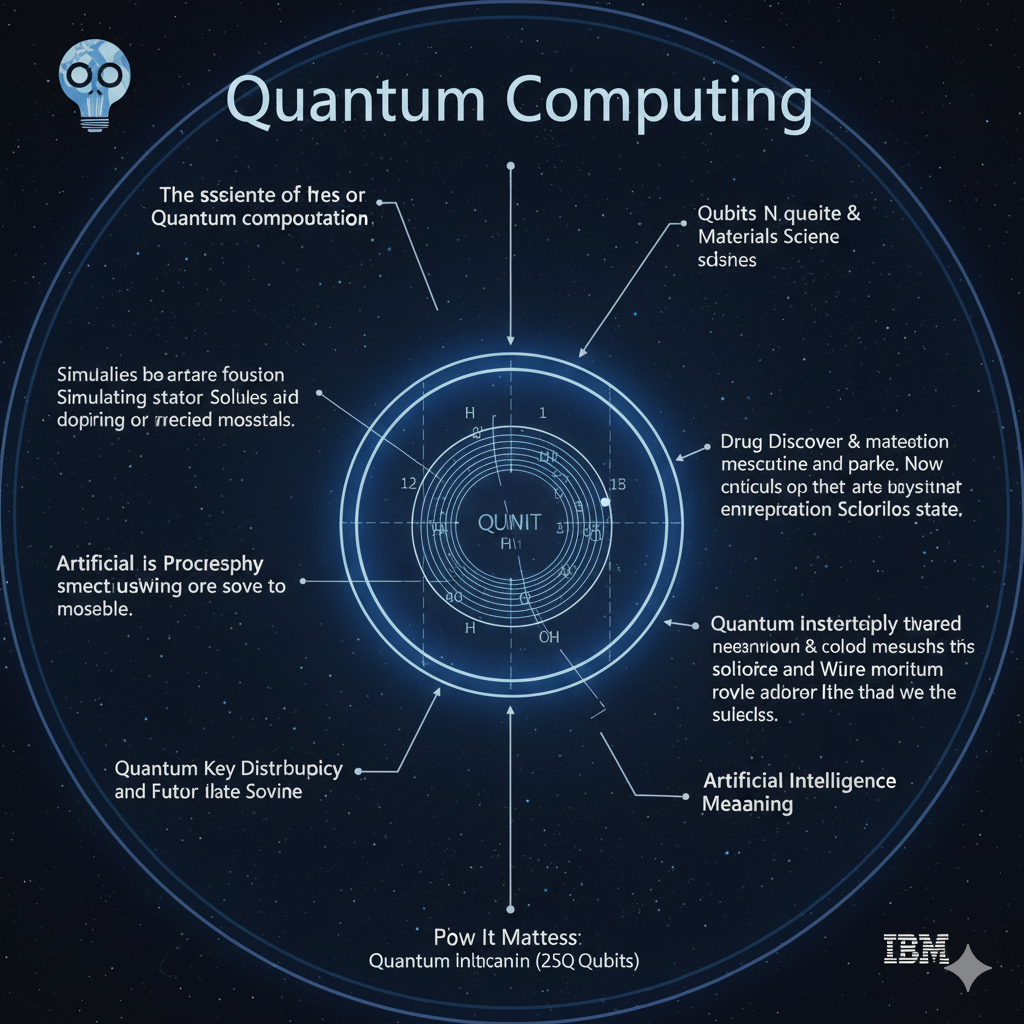
Quantum Computing is perhaps the most disruptive technology on the horizon, promising to solve problems that would take today’s most powerful classical supercomputers millions of years to crack. It is a radical new field that harnesses the bizarre, counter-intuitive laws of quantum mechanics—the physics of the atomic and subatomic world—to process information in fundamentally new ways.
While still in its early stages, the development of quantum computers is poised to revolutionize industries from medicine and materials science to finance and cybersecurity.
The Quantum Leap: Qubits vs. Bits
Classical computers, the ones we use every day, process information using bits that can represent a value of either $\mathbf{0}$ or $\mathbf{1}$ (on or off).
Quantum computers, however, use quantum bits, or qubits, which leverage two key quantum phenomena:
- Superposition: A qubit can exist in a combination of both the 0 and 1 states simultaneously until it is measured. This capability is the source of quantum parallelism, allowing a quantum computer to test millions of possibilities at once, rather than sequentially.
- Entanglement: When two or more qubits become entangled, they become intrinsically linked. The state of one entangled qubit instantaneously affects the state of the others, no matter the physical distance between them. This correlation allows quantum computers to efficiently explore a vast, multi-dimensional computational space.
Because of these properties, adding each new qubit to a quantum computer exponentially increases its processing power, unlike the linear increase seen in classical computing.
The Hardware Challenge: Taming the Quantum World
Building and maintaining quantum computers is an immense engineering feat due to the fragility of qubits:
- Decoherence: This is the loss of the qubit’s quantum state, often caused by the slightest interaction with the environment (heat, magnetic fields, or even vibrations).
- Extreme Isolation: To prevent decoherence, many types of quantum computers, like those using superconducting qubits, must be sealed, shielded from Earth’s magnetic field, and cooled to temperatures just above absolute zero (colder than deep space).
Despite these challenges, companies are making significant progress with various qubit technologies, including superconducting circuits, trapped ions, and photonic systems.
The Transformative Applications of Quantum Power
Quantum computers are not intended to replace your laptop; they are designed for specific, highly complex problems that are computationally prohibitive for classical machines. Their applications span four major areas:
1. Simulation and Materials Science
Quantum computers can naturally model other quantum systems. This allows researchers to:
- Accurately simulate molecular interactions, accelerating the discovery of new drugs and genetically customized treatments.
- Design new materials with desired properties, such as high-efficiency catalysts, room-temperature superconductors, and better batteries for electric vehicles.
2. Optimization
Quantum algorithms, such as Quantum Annealing, are superb at finding the best solution among an enormous number of possibilities:
- Optimizing global logistics and supply chains in real time.
- Improving traffic flow in smart cities and distribution networks.
- Refining complex financial models for risk assessment and portfolio optimization.
3. Artificial Intelligence (AI)
Quantum processing could provide the massive boost in computational power required for the next generation of AI:
- Executing advanced machine learning models and accelerating the training of deep learning algorithms.
- Processing and identifying patterns in extremely large or unstructured datasets.
4. Cryptography
Quantum computing presents both a threat and a solution to data security:
- The Threat: Powerful quantum algorithms (like Shor’s algorithm) could theoretically break the public-key encryption (RSA) that secures most of the internet.
- The Solution: The development of Post-Quantum Cryptography (PQC) and Quantum Key Distribution (QKD) provides new, quantum-resistant methods to secure data against future quantum attacks.
The ultimate vision is a hybrid quantum-classical computing future, where powerful classical supercomputers manage the data and control, while quantum processors tackle the specific, exponentially hard computational kernels.
You can learn more about the differences between classical and quantum systems by watching Quantum vs. Classical Computers: The Mind-Blowing Difference!. This video clearly explains the fundamental differences between the two computational models.


