

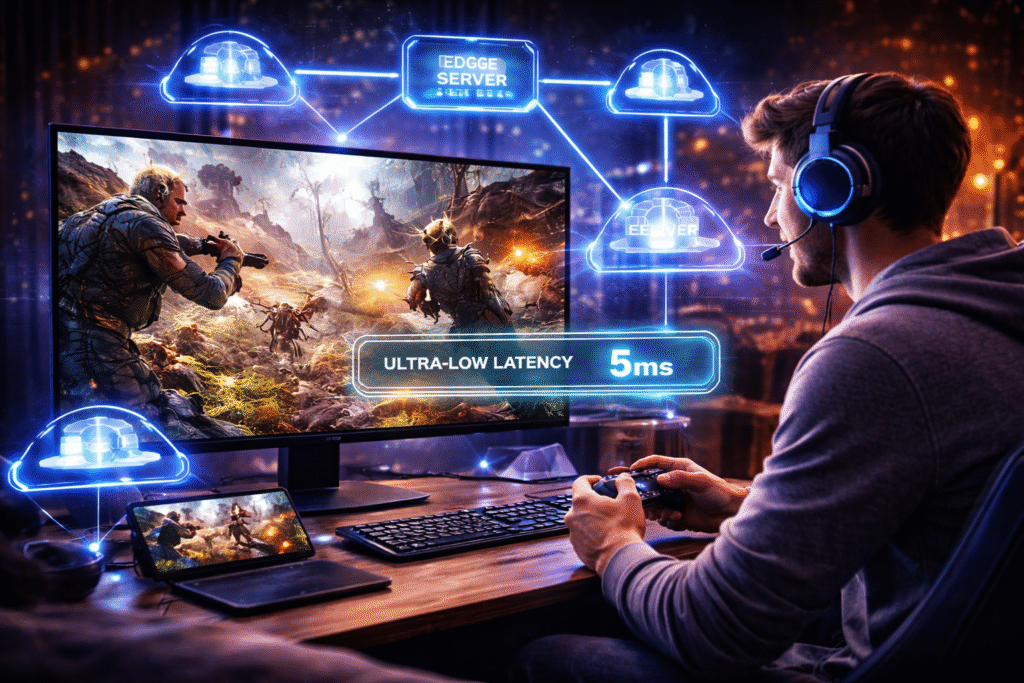
What if online games had almost zero lag?
No delays.
No sudden spikes.
No frustrating input lag during critical moments.
This is the promise of edge computing — one of the most underrated but powerful technologies that could completely transform gaming.
⚡ What Is Edge Computing in Gaming?
Edge computing means processing data closer to the player instead of relying on distant centralized servers.
Instead of sending your game data to a far-away data center, it is handled by nearby servers (edge nodes).
This results in:
- Faster response times
- Lower latency
- Smoother gameplay
- More stable connections
It brings the game physically closer to you.
💻 Impact on PC Gaming
PC gaming, especially online multiplayer, benefits massively from reduced latency.
With edge computing:
- Actions register instantly
- Competitive games feel more responsive
- Large multiplayer environments run smoother
For fast-paced games like shooters or battle royales, even milliseconds matter — and edge computing reduces that gap.
🎮 Console Gaming Gets Faster
Consoles such as:
- PlayStation 5
- Xbox Series X
rely heavily on online services.
Edge computing improves:
- Online matchmaking speed
- Multiplayer stability
- Cloud-based features
This makes console gaming more reliable, especially for online-focused titles.
📱 Mobile Gaming and Low-Latency Play
Mobile gaming stands to gain huge benefits from edge computing.
Since mobile networks can be unstable, processing data closer to the user helps:
- Reduce lag in online matches
- Improve real-time multiplayer experiences
- Enable smoother cloud gaming
With the rise of 5G, edge computing will become even more powerful on mobile devices.
🏆 Impact on eSports and Competitive Gaming
In eSports, latency can decide the outcome of a match.
Edge computing could:
- Create fairer competitive environments
- Reduce regional disadvantages
- Improve real-time synchronization
Players across different locations could compete with minimal delay differences.
⚠️ Challenges of Edge Computing
Despite its advantages, edge computing faces challenges:
- Infrastructure costs
- Limited availability in some regions
- Complex network management
- Security concerns
Building a global edge network is not easy, but progress is happening fast.
🚀 The Future of Lag-Free Gaming
Edge computing is paving the way for a future where lag becomes almost nonexistent.
Combined with technologies like cloud gaming and 5G, it could enable:
- Instant multiplayer interactions
- Real-time global competitions
- Seamless gaming across devices
Gaming will feel faster, smoother, and more responsive than ever before.
The question is no longer:
“Can your system handle the game?”
It’s becoming:
“Can the network keep up with you?” 🎮


