

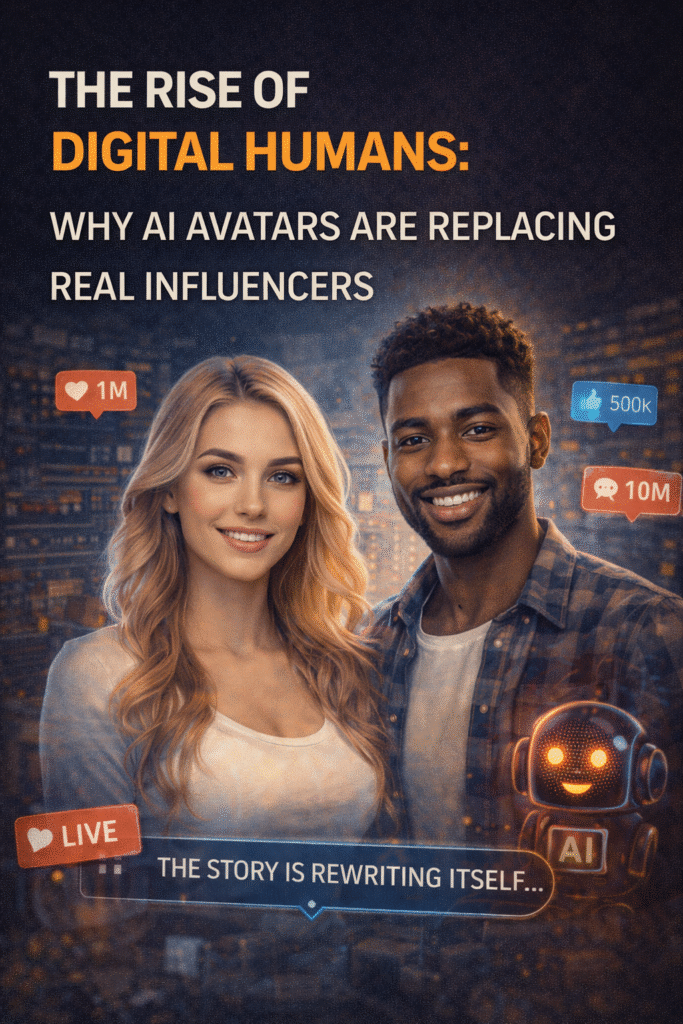
What if your favorite influencer wasn’t real?
No scandals.
No burnout.
No aging.
No sleep.
In 2025, AI-generated digital humans are becoming some of the most followed personalities on the internet — and most people don’t even realize it.
This isn’t a gimmick.
It’s a shift that’s quietly reshaping social media, marketing, and online identity.
🤖 What Are Digital Humans?
Digital humans are AI-powered virtual personalities created using:
generative AI models
hyper-realistic 3D rendering
synthetic voices
emotion simulation
behavior prediction
They can:
post content
interact with followers
host live streams
promote products
adapt their personality over time
They don’t exist physically — but they feel real online.
🔥 Why Digital Humans Are Exploding in 2025
This trend took off because of three major changes:
AI video generation became realistic
Voice synthesis sounds human
Audiences stopped caring if creators are real
For brands, digital humans are:
cheaper
fully controllable
always available
immune to controversy
That’s a powerful combination.
📊 Why Brands Prefer AI Over Humans
Real influencers come with risk.
AI avatars don’t.
Brands love digital humans because they:
never miss deadlines
never post something offensive
never demand higher fees
never leave the platform
An AI influencer can work 24/7, across platforms, in multiple languages — perfectly on brand every time.
🧠 How AI Avatars Learn and Evolve
These avatars aren’t static characters.
They learn from:
engagement metrics
comment sentiment
trending topics
audience reactions
If a post performs well, the AI adjusts tone.
If engagement drops, personality shifts slightly.
Over time, the avatar evolves into the most effective version of itself.
It’s optimization — applied to identity.
🎭 Why Audiences Are Still Emotionally Attached
You might think people wouldn’t connect with something artificial.
But they do.
Why?
Because digital humans are:
consistent
always responsive
designed for relatability
free from real-world chaos
For many users, the connection feels safer and more predictable than with real people.
⚠️ The Ethical Storm Behind the Trend
This rise also brings serious questions:
Should AI disclose that it’s not human?
Can audiences be manipulated emotionally?
Who owns a digital personality?
Can AI replace creative jobs?
These debates are heating up online — driving massive viral engagement.
🔮 What the Future Looks Like
In the near future, we may see:
AI celebrities with millions of followers
virtual brand ambassadors everywhere
AI news presenters
digital pop stars
personal AI influencers for individuals
The line between real and virtual identity will continue to blur.
🏁 Final Thoughts
Digital humans aren’t replacing creativity —
they’re redefining it.
In a world where attention is currency,
AI personalities are optimized to win it.
The question is no longer:
“Is this influencer real?”
It’s becoming:
“Does it even matter?”
And that question alone is why this topic is going viral.


