

The years 2025 and 2026 are being recorded in history books as the true beginning of the “Golden Age of Discovery.” We are no longer just looking at the stars; we are touching them. From the imminent return of humans to lunar orbit to the detection of the universe’s very first stars, the veil of the cosmos is being lifted at a staggering pace.
Today, space exploration is a high-stakes, high-reward symphony of government ambition, private-sector innovation, and groundbreaking physics.
Artemis II: The Return to the Lunar Frontier
After the success of the uncrewed Artemis I mission, the world is now holding its breath for Artemis II, currently scheduled for no earlier than February 5, 2026. This mission represents a profound shift: for the first time in over 50 years, humans will leave Earth’s orbit to venture into deep space.
- The Crew: Four pioneers—Reid Wiseman, Victor Glover, Christina Koch, and Jeremy Hansen—will board the Orion spacecraft.
- The Mission: A 10-day flight that will slingshot around the Moon. This isn’t just a “lap”; it’s a critical test of the Life Support Systems and the heat shield technology required for the eventual landing on the lunar South Pole.
- The Goal: Establishing the Lunar Gateway, a space station that will orbit the Moon and serve as a “base camp” for missions to Mars.
JWST and the “First Light” Mystery
The James Webb Space Telescope (JWST) continues to rewrite our understanding of time itself. In late 2025, astronomers announced a discovery that was once thought impossible: the potential detection of Population III stars.
What are Pop III Stars? They are the “primordial” first generation of stars formed just 200 million years after the Big Bang. Composed almost entirely of hydrogen and helium, they were massive, hot, and short-lived, forging the first heavy elements (like oxygen and carbon) that eventually made life possible.
Webb has also identified the earliest supernova ever seen, occurring when the universe was only 730 million years old. These observations are pushing our cosmological models to the brink, revealing that the early universe was far more structured and chemically complex than we ever dared to imagine.
The Interstellar Visitor: 3I/ATLAS
In July 2025, the ATLAS survey telescope in Chile detected a faint, fast-moving object. It was quickly confirmed as 3I/ATLAS, the third interstellar object ever discovered passing through our Solar System (following ‘Oumuamua and Borisov).
Unlike our local comets, 3I/ATLAS originated in a different star system entirely. Its arrival in 2025 triggered a global “armada” of observations. By studying its chemical composition, scientists are getting a direct glimpse into the building blocks of other solar systems, helping us understand if our own “recipe” for a planetary system is common or a cosmic fluke.
The Survey Revolution: Vera C. Rubin Observatory
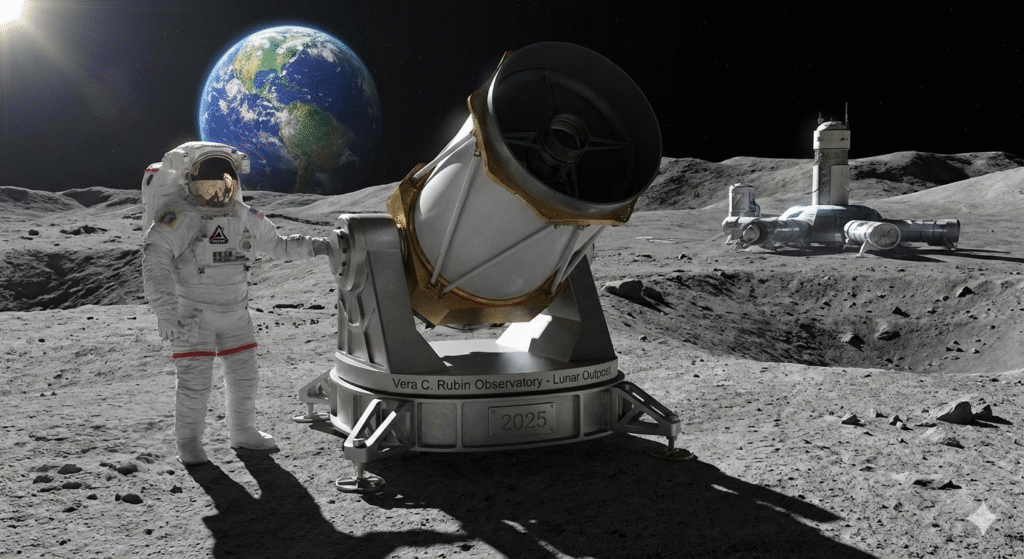
While Webb looks deep, the Vera C. Rubin Observatory in Chile looks wide. Having released its first images in June 2025, it is now beginning its primary mission: the Legacy Survey of Space and Time (LSST).
| Feature | Specification |
| Camera Size | 3,200 Megapixels (the largest digital camera ever built) |
| Data Volume | 20 Terabytes of data per night |
| Mission Goal | A 10-year “movie” of the entire southern sky |
Rubin will detect billions of new objects, from small asteroids in our own backyard to the faint ripples of Dark Matter and Dark Energy. It is essentially a planetary defense machine, capable of spotting “city-killer” asteroids years before they pose a threat.
The Privatization of the High Ground
The landscape of 2025 is defined by the “Maiden Flights” of new heavy-lift rockets. Blue Origin’s New Glenn successfully reached orbit in early 2025, providing much-needed competition in the heavy-lift market. Meanwhile, SpaceX’s Starship is undergoing regular orbital testing, focusing on the revolutionary technology of orbital refueling.
We’ve also seen the Fram2 mission, the first private crewed flight to enter a polar retrograde orbit, allowing humans to fly directly over Earth’s poles for the first time.
The Road Ahead: 2026 and Mars
As we look toward 2026, the focus shifts to the Red Planet. JAXA’s Martian Moons eXploration (MMX) mission is slated to launch, aiming to land on Phobos and return samples to Earth. Every robotic mission to Mars or its moons today is a precursor to the human footprints we hope to see there by the late 2030s.
The stars are no longer just points of light; they are destinations. Whether it’s the search for life in the organic-rich clouds of Titan or the industrialization of Low Earth Orbit, we are living in the most exciting era of astronomy since the invention of the telescope.