
If 2021 was the year of speculation and 2024 was the year of building, 2026 is the year of invisibility. We have officially moved past the “crypto-native” bubble. Today, Web3 isn’t just a niche playground for traders; it has become the silent, foundational plumbing for the global economy. Most users interacting with blockchain technology in 2026 don’t even know they are doing so. They simply see faster payments, more secure identities, and new ways to own their digital lives.
Here is the state of Blockchain and Web3 as we navigate this transformative year.
I. The RWA Revolution: Tokenizing the World
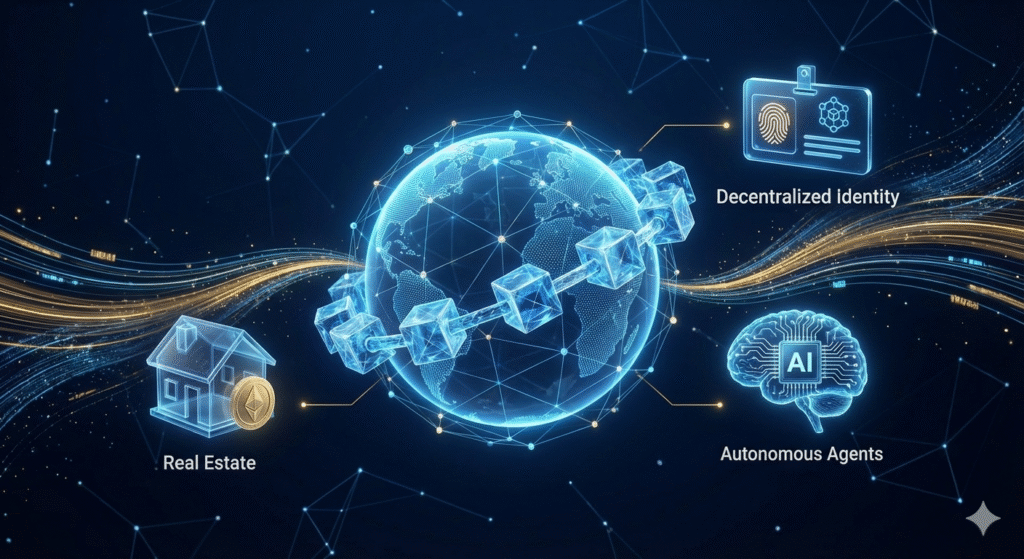
The most significant shift in 2026 is the Tokenization of Real-World Assets (RWA). We are no longer just trading “digital gold”; we are trading pieces of the physical world on-chain.
- Fractional Real Estate: In 2026, it is common to own 5% of a commercial building in Tokyo and receive daily rental yields directly to your wallet in stablecoins.
- Government Debt: Major banks have moved trillions in U.S. Treasuries and sovereign bonds onto blockchain rails. This “always-on” liquidity means settlement happens in seconds, not days.
- Green Assets: Carbon credits and ESG (Environmental, Social, and Governance) assets are now verifiable on-chain. Every “green” claim is backed by immutable data, ending the era of corporate greenwashing.
II. AI + Blockchain: The Agentic Economy
2026 is the year AI found its bank account. As AI agents become more autonomous, they need a way to pay for resources (compute power, data, APIs) without a human in the loop.
- Decentralized AI Marketplaces: Blockchain provides the trust layer where AI models are traded and executed. Smart contracts ensure that data providers are paid fairly and that model logic is transparent.
- Agentic Wallets: Your personal AI agent now manages its own “allowance” on-chain, autonomously paying for your subscriptions or micro-tasks while using Zero-Knowledge Proofs (ZKPs) to keep your private data off the ledger.
- Automated Audits: AI-driven smart contract auditors now scan code in real-time, identifying vulnerabilities before they can be exploited, making the 2026 ecosystem significantly more secure than the “Wild West” days.
III. DeSoc: Reclaiming the Social Graph
The “Great De-Platforming” concerns of the early 2020s led to the rise of Decentralized Social (DeSoc). In 2026, the power has shifted from the platform to the creator.
- Portable Identity: Your followers and content aren’t trapped on one app. Whether you are on a video platform or a micro-blogging site, you carry your “Social Graph” with you. If you leave a platform, your audience comes with you.
- Protocol-Level Monetization: Instead of waiting for an ad-revenue share, creators in 2026 are tipped and paid directly at the protocol level. Engagement is no longer a metric for the algorithm; it’s a direct value exchange.
IV. The 2026 Web3 Trend Report
| Trend | 2024 Status | 2026 Reality |
| User Experience | Complex (Seed phrases, Gas) | “Invisible” (Biometric logins, Gas-less) |
| Asset Class | Speculative Memecoins | Real-World Assets (RWA) & Debt |
| Identity | Centralized (Login with Google) | Decentralized Identity (Self-Sovereign) |
| Sustainability | Improving (Post-Merge) | Zero-Carbon (Green Consensus) |
| Regulation | Uncertain / Hostile | Harmonized Global Frameworks |
V. The Shift to Modular Sovereignty
The “Monolithic” blockchains of the past have given way to Modular Architectures. By 2026, developers “mix and match” different layers for security, execution, and data availability. This has solved the “Scalability Trilemma,” allowing for millions of transactions per second at near-zero cost.
Furthermore, with the looming threat of quantum computing, 2026 has seen the widespread adoption of Post-Quantum Cryptography in major wallet providers, ensuring your digital assets remain secure for the next century.
The Bottom Line
Web3 in 2026 is no longer a separate “internet.” It is simply the Internet of Value. It is the infrastructure that ensures that in a world of AI-generated content and digital noise, truth is verifiable, ownership is absolute, and the user is back in control.


