

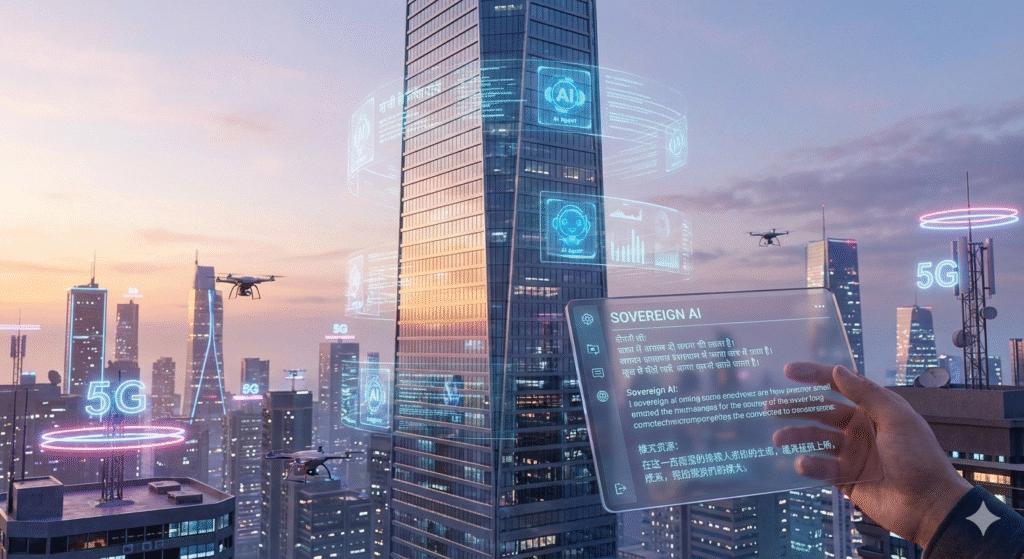
As we settle into the second month of 2026, the tech industry has officially transitioned from the “experimental” phase of AI to the “Operational Era.” The global landscape is currently defined by a fierce race for semiconductor sovereignty, the arrival of autonomous AI agents, and a hardware market grappling with a historic memory squeeze.
Here is your global briefing on the tech that is defining our year.
I. The Rise of the “Agentic” AI
In 2025, we talked to AI; in 2026, AI works for us. We have moved beyond chatbots to Agentic AI—autonomous systems capable of reasoning, planning, and executing complex workflows without constant human prompting.
- Autonomous Workflows: From booking entire multi-leg international trips to managing corporate supply chains, AI agents are now integrated directly into the OS level of Windows 12 and macOS 17.
- Search 2.0: Daily usage of AI within search engines is now 3x greater than standalone tools. The “blue link” era is fading as AI provides direct, synthesized actions rather than just information.
- The “Year of Truth”: Analysts are calling 2026 the “Year of Truth for AI,” as companies are finally being forced to prove ROI on their massive 2024–2025 infrastructure investments.
II. Hardware: The Blackwell Era & Apple’s Ambition
The hardware cycle has reached a fever pitch this February. With CES 2026 in the rearview mirror, the focus has shifted to retail availability and next-gen mobile leaps.
- NVIDIA’s Blackwell Dominance: The RTX 5090 and 5080 have successfully launched, setting a new bar for path-traced graphics. However, supply remains tight as NVIDIA prioritizes high-margin HBM (High Bandwidth Memory) chips for data centers.
- Apple’s “20-Product” Roadmap: Leaks from Cupertino suggest Apple is preparing its most aggressive year ever. We are expecting a foldable iPhone by late 2026, a new M5-powered iPad Air, and a specialized Smart Home Hub with a personalized, agentic Siri.
- Samsung’s Galaxy F70e: Launching on February 9, this device marks a shift toward “Gen Z” efficiency, featuring a massive 6,000 mAh battery and a leather-finish aesthetic aimed at the mid-range global market.
III. The Great Memory Squeeze of 2026
While processors are faster than ever, we are facing a structural global memory shortage that could last through 2027.
- The HBM Displacement: Because AI servers require massive amounts of HBM, manufacturers like Samsung and SK Hynix have reallocated capacity away from standard DDR5 and NAND.
- Price Hikes: Expect 15–20% cost increases for PCs and high-end smartphones this quarter. A “Pro” phone that had 12GB of RAM last year likely won’t see an upgrade to 16GB this year due to these costs.
- The Arizona Hub: The US-Taiwan chip deal is accelerating the “Silicon Heartland” in Arizona, with TSMC beginning construction on its fourth factory and first advanced packaging plant this month.
Tech Snapshot: 2025 vs. 2026
| Feature | 2025 (The Hype) | 2026 (The Reality) |
| AI Focus | Generating Content (LLMs) | Executing Actions (Agents) |
| Compute Location | 90% Cloud-based | 40% On-Device (NPU-driven) |
| Connectivity | 5G Maturity | 5G-Advanced & 6G Pre-Alpha |
| Energy | Grid Anxiety | Small Modular Reactors (SMRs) for Data Centers |
| Key Hardware | RTX 40-Series / iPhone 16 | RTX 50-Series / Foldable Era |
IV. Policy: Sovereign AI & The EU Act
Governments are no longer just watching; they are building.
- India’s Union Budget 2026: Presented just days ago, the budget unveiled a massive fiscal push for “Sovereign AI.” India is funding its own indigenous LLMs to reduce reliance on foreign proprietary models, focusing on linguistic diversity.
- EU AI Act Enforcement: The high-risk obligations of the EU AI Act are set to go into effect by August 2026, leading many global tech firms to overhaul their compliance frameworks this February to avoid massive fines.
The Bottom Line
Technology in 2026 is becoming more expensive but more capable. We are trading the “cheap and abundant” tech of the early 2020s for highly specialized, AI-augmented tools that are faster, more private, and—most importantly—more autonomous.


