

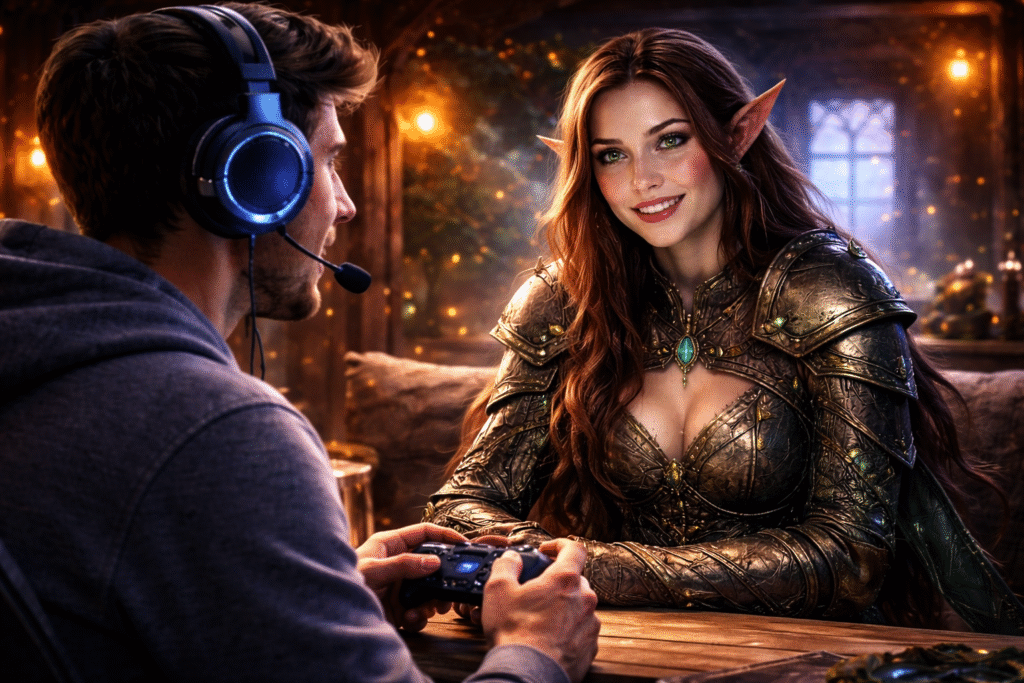
What if you couldn’t tell whether a game character was real… or virtual?
Not because of graphics alone — but because of behavior, emotions, and realism.
Welcome to the rise of digital humans — one of the most viral and futuristic trends in gaming technology today.
These are not just characters.
They are almost real people inside games.
🧠 What Are Digital Humans?
Digital humans are hyper-realistic virtual characters powered by advanced AI, motion capture, and real-time rendering.
They can:
- Show realistic facial expressions
- Speak with natural voice and emotion
- React intelligently to player actions
- Mimic real human behavior
Unlike traditional NPCs, digital humans feel alive — not scripted.
💻 PC Gaming Leads Hyper-Realism
PC gaming is pushing digital humans to the next level.
With powerful GPUs and engines like Unreal Engine, developers can create:
- Ultra-realistic skin textures
- Real-time facial animations
- Emotion-driven interactions
Technologies like MetaHuman (by Epic Games) are already enabling developers to build lifelike characters in minutes.
This is turning games into cinematic experiences.
🎮 Console Gaming Gets Cinematic
Modern consoles such as:
- PlayStation 5
- Xbox Series X
are also capable of rendering highly realistic characters.
This allows story-driven games to feel more like interactive movies, where characters express subtle emotions and react naturally.
Console gaming is becoming more immersive than ever.
📱 Mobile Gaming Joins the Evolution
Mobile devices are also stepping into the world of digital humans.
While not as powerful as PCs or consoles, mobile games are beginning to feature:
- Improved facial animations
- Voice-driven characters
- Realistic avatars
Cloud processing is helping mobile platforms deliver advanced realism without heavy hardware requirements.
🏆 Impact on eSports and Online Gaming
Digital humans could transform online gaming and eSports by introducing:
- Realistic AI teammates
- Human-like opponents for training
- Enhanced audience experiences with virtual hosts
This could blur the line between human players and AI participants.
⚠️ The “Uncanny Valley” Problem
As characters become more realistic, they also risk entering the uncanny valley — where something looks almost human but feels slightly off.
Challenges include:
- Imperfect facial expressions
- Slightly unnatural movements
- Emotional inconsistency
Developers are working to overcome this to make characters fully believable.
🚀 The Future: Games That Feel Like Reality
Digital humans are pushing gaming toward a future where virtual characters are indistinguishable from real people.
In the coming years, players may:
- Build relationships with lifelike characters
- Experience deeply emotional stories
- Interact with AI characters that remember them
Gaming will no longer feel like controlling characters.
It will feel like interacting with real beings inside a digital world.
The question is no longer:
“Is this character realistic?”
It’s becoming:
“Is this character… real?” 🎮


