

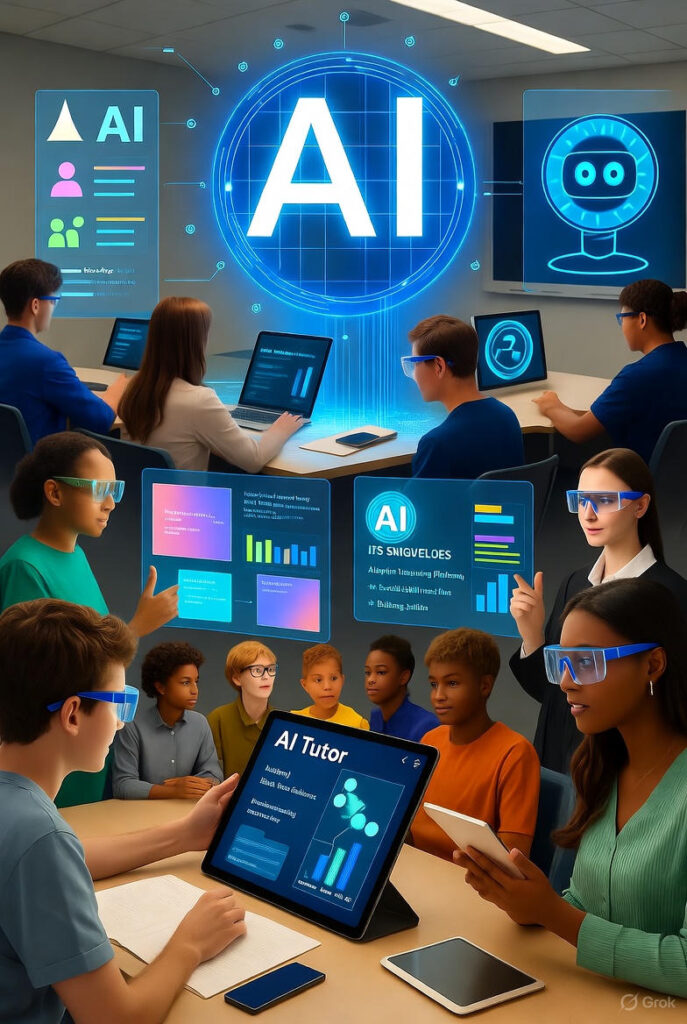
In 2025, artificial intelligence isn’t just a buzzword—it’s the quiet revolution reshaping education from K-12 classrooms to lifelong skill-building apps. With the global AI education market surging from $7.57 billion this year toward a projected $112.30 billion by 2034, AI is democratizing access to personalized, efficient learning like never before. Imagine a world where your child’s math tutor adapts in real-time to their confusion, or your evening coding session feels like a video game adventure. Drawing from the latest Stanford AI Index and UNESCO insights, this post explores AI’s transformative role in education and learning, highlighting adaptive tools, ethical helpers, and immersive builders for a smarter tomorrow.
Adaptive Tutoring Platforms: Learning Tailored to You
Gone are the days of one-size-fits-all lectures. AI-driven adaptive platforms now analyze student interactions to customize content, pacing, and difficulty—boosting engagement and outcomes by up to 30% in recent pilots.
- How It Works: Using machine learning algorithms, tools like enhanced Duolingo or Khan Academy’s AI beta track eye movements, response times, and quiz errors to tweak lessons. For instance, if a student struggles with fractions, the system pivots to visual analogies or gamified drills.
- Real-World Impact: In higher ed, platforms like Coursera’s AI tutor have seen 70% of students report better retention, per 2025 surveys. Teachers save hours on grading, freeing time for mentorship.
- 2025 Spotlight: Integration with VR for immersive history lessons, where students “walk” through ancient Rome while AI narrates based on their curiosity.
These platforms aren’t replacing educators—they’re supercharging them, making learning as unique as fingerprints.
Homework Helpers with Explainable AI: Building Critical Thinkers
Homework just got smarter (and less frustrating). Explainable AI (XAI) tools break down problems transparently, showing why an answer is correct, not just what it is—fostering deeper understanding over quick cheats.
- Key Features: Apps like Wolfram Alpha’s AI solver or Photomath 2.0 use natural language processing to dissect steps, with visuals like step-by-step graphs. XAI ensures transparency: “This quadratic formula works because…” avoids the black-box mystery.
- Benefits in Action: A 2025 APA report notes AI helpers reduce math anxiety by 25% in middle schoolers, while encouraging questions over copy-pasting. Parents love the progress dashboards that flag knowledge gaps.
- Ethical Edge: Built-in plagiarism detectors and “AI usage logs” promote honesty, aligning with U.S. Department of Education guidelines for fair AI integration.
In a post-ChatGPT era, these tools turn homework into a dialogue, not drudgery.
Lifelong Skill Builders: From Hobbies to Careers
Education doesn’t end at graduation—AI makes continuous upskilling seamless and fun, especially with microcredentials and AR overlays exploding in 2025.
- App Examples: Duolingo for languages evolves into AR cooking classes (scan ingredients for recipe tweaks), while MasterClass uses AI to suggest skill paths based on career goals. Coding platforms like Replit’s AI companion debug in real-time.
- Immersive Twist: Gamification meets VR—think Pokémon GO-style apps for language immersion or anatomy exploration, where learners “dissect” virtual frogs with haptic feedback.
- Stats to Note: OECD’s Trends Shaping Education 2025 predicts 40% of workers will use AI for daily skill-building, closing the gap on lifelong learning access.
Whether mastering guitar riffs or blockchain basics, AI turns “I wish I had time” into “I’ve got this.”
Key Trends and Tools: A 2025 Snapshot
Here’s a quick table of standout AI education innovations, based on mid-2025 updates from Cengage and beyond:
| Trend | Description | Example Tool | Impact |
|---|---|---|---|
| Personalized Learning | AI curates paths per learner style | DreamBox (K-8 math) | +35% achievement gains |
| Gamification & Immersive Tech | VR/AR for engaging simulations | Google Expeditions | 50% higher retention |
| Microcredentials | Bite-sized certs for quick skills | LinkedIn Learning AI | 2x faster career pivots |
| Teacher AI Support | Automates admin for more teaching | Gradescope | Saves 10+ hours/week |
These trends, per UNESCO, address equity gaps by scaling quality education globally.
Challenges and the Path Forward
AI’s promise isn’t without hurdles: data privacy (hello, FERPA updates), bias in algorithms (e.g., underrepresented dialects in language tools), and the digital divide. Solutions? 2025 policies emphasize ethical AI training for educators and open-source models to level the field. As Stanford’s AI Index highlights, open-weight models are narrowing access gaps, making premium tools free for under-resourced schools.
Looking ahead, expect AI “co-teachers” in every classroom by 2030, blending human empathy with machine precision.
Level Up Your Learning Journey
AI in education isn’t about machines taking over—it’s about unlocking human potential. From adaptive tutors to AR adventures, 2025 is the year learning becomes truly personal. What’s one AI tool that’s leveled up your studies? Share in the comments!


