

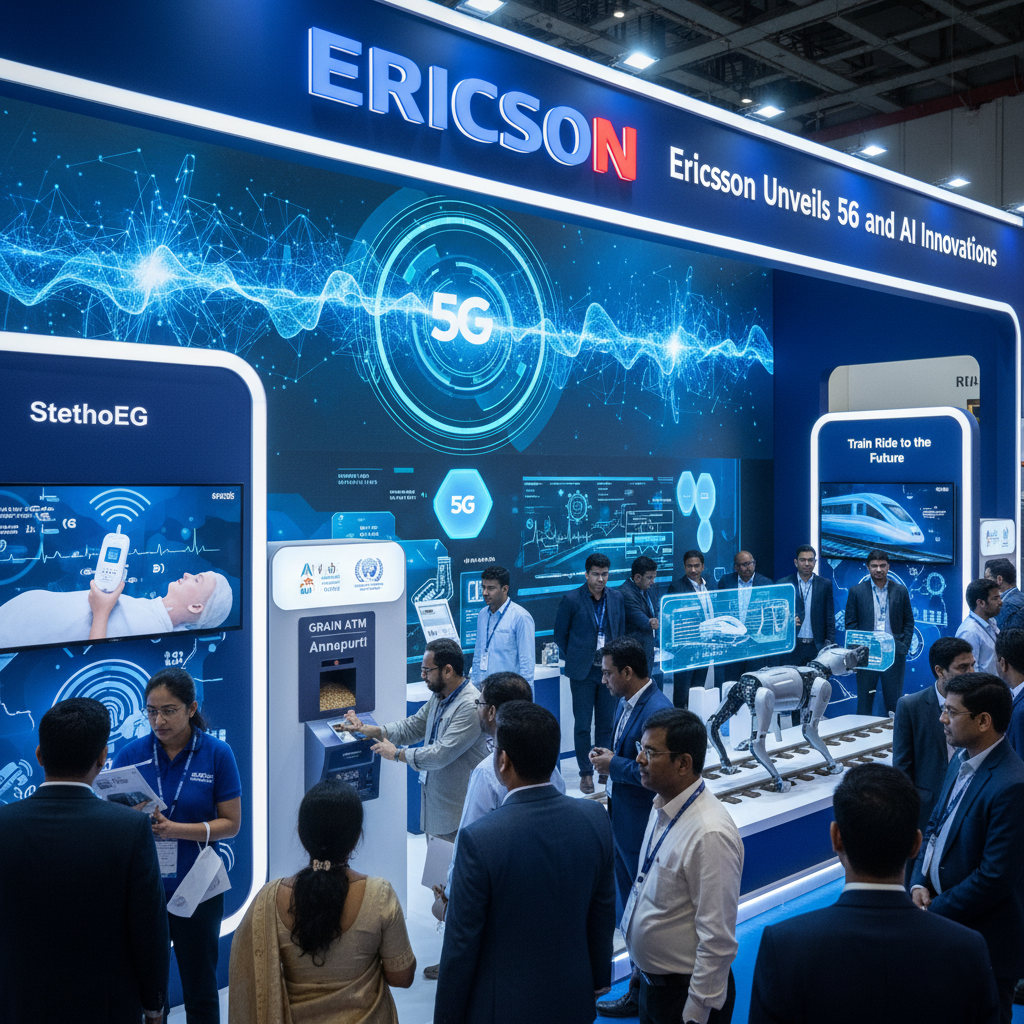
Ericsson, a global leader in telecom, used the India Mobile Congress (IMC) 2025 to underscore its commitment to India’s digital transformation. With the country now boasting over 360 million 5G subscribers and coverage reaching 80% of the population, Ericsson showcased a powerful suite of 5G and AI-powered technologies designed to accelerate inclusion and industrial progress.
The company’s exhibit featured live, practical applications that demonstrate how its technology is impacting public services and daily life:
- Grain ATM Annapurti: A partnership with the World Food Programme, this 5G-enabled, Aadhaar-based food grain dispenser is rolling out nationwide to support the ‘One Nation One Ration Card’ scheme.
- StethoECG: Developed with IIT Madras, this wireless, handheld device uses 5G to enable real-time remote ECG and diagnostics, significantly boosting rural healthcare access.
- Automated Railcar Inspection: A robotic dog leveraging private 5G and AI for automated railcar inspection, dramatically improving safety and operational efficiency.
- Fixed Wireless Access (FWA): Ericsson’s FWA solutions are successfully bridging the broadband divide, with 8.4 million subscribers—40% in rural areas—receiving fiber-like speeds wirelessly.
Investing in India’s Future
Ericsson is deeply invested in the Make in India and Digital India missions. Its R&D centers in Chennai, Bengaluru, and Gurugram are driving advancements in AI, 6G, and semiconductor design, including a recent expansion of ASIC R&D in Bengaluru. Furthermore, the company has started manufacturing passive antennas in India with VVDN Technologies.
“We are enabling next-generation networks that are foundational to the country’s ‘Digital India’ initiative,” said Nitin Bansal, Managing Director, Ericsson India.
Ericsson is also preparing the workforce through its 5G Center of Excellence in Jabalpur and the Connect to Learn initiative, ensuring Indian youth are skilled for the future.


