

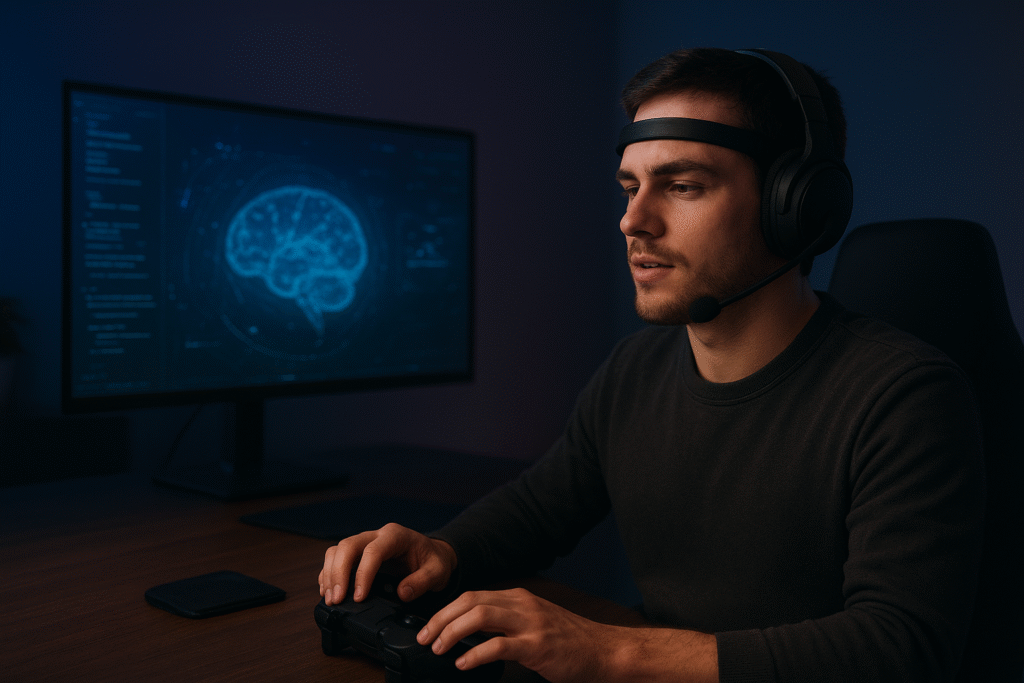
Gaming has always been about reaction — your eyes see, your hands move, and your brain processes. But in 2025, the connection between players and games is becoming literal. Thanks to breakthroughs in neural interface technology, players can now control games directly with their thoughts. What once felt like science fiction is rapidly becoming the next frontier of interactive entertainment.
What Is Neural Gaming?
Neural gaming uses Brain-Computer Interfaces (BCIs) — wearable or implantable devices that read brain signals and translate them into game commands. In simple terms, your brainwaves become your controller.
You think jump, your character jumps.
You imagine aim, and your weapon locks onto the target.
Companies like Neuralink, NextMind, and OpenBCI are pioneering consumer-grade neuro-gaming gear, and major studios are already experimenting with integrating it into mainstream titles.
PC Gaming: The Birth of Thought-Based Controls
PC gamers are often the first to adopt bleeding-edge tech, and neural control is no exception.
In 2025, several indie developers have built games that respond to emotional intensity and focus levels instead of just physical inputs.
For instance:
- In Synapse Protocol, you can push objects telekinetically by concentrating harder.
- CalmMind Arena rewards relaxed players by improving precision — showing that control is about mental balance, not just speed.
High-end gaming PCs, paired with neural sensors, are now capable of reading brain activity in real time with less than 50ms delay — opening the door for competitive neural play.
Console Gaming: Xbox and PlayStation Get Smart
Sony and Microsoft are both rumored to be exploring BCI integration for future consoles. The PlayStation 6 Neuro Edition, expected in late 2025, reportedly supports adaptive difficulty based on your cognitive load — if the system detects stress, it slightly reduces AI aggression to keep gameplay engaging rather than overwhelming.
Xbox, on the other hand, is focusing on neural accessibility, allowing players with physical disabilities to control games using mental commands. This is being celebrated as a breakthrough for inclusivity in gaming.
Mobile Gaming: Brain Sensors in Your Earbuds
Yes — neural gaming is coming to your phone, too.
Wearables like NeuroPods (brain-sensing earbuds) can detect brainwave patterns through the ear canal, making them perfect for casual or mobile games.
Games like Zen Racer and Focus Fighter measure your concentration, rewarding steady focus with speed boosts or precision bonuses.
Mobile gaming is no longer just about tapping and swiping — it’s about how you think.
eSports: The Rise of Neuro-Competitions
eSports is already experimenting with neuro-gaming tournaments, where players compete using minimal physical input. Instead of lightning-fast reflexes, it’s mental clarity, composure, and focus that define champions.
Neuro-leagues are using EEG (Electroencephalogram) headsets to track mental fatigue, reaction speed, and attention levels during matches — making performance analytics deeper than ever.
Some experts predict that within the next five years, hybrid tournaments — combining traditional control and neural commands — will redefine professional gaming.
Ethical Questions: Are Our Thoughts Safe?
As with all powerful technologies, neural gaming raises concerns.
Who owns your brain data? Could your emotional responses be tracked and monetized?
Developers are now required to follow strict neuro-privacy protocols, ensuring no personal thought data is stored or shared without consent. It’s a crucial step toward keeping innovation safe and ethical.
The Future: Gaming Without Controllers
By 2030, experts predict we’ll see fully immersive mind-only gameplay, where every action, environment, and dialogue is influenced by thought and emotion.
Imagine:
- Exploring open worlds using curiosity and imagination, not a joystick.
- NPCs that respond to your mood and attention.
- Games that literally sense your excitement and adapt in real time.
This isn’t fantasy anymore — it’s the next level of immersion.
Conclusion: When Gaming Meets the Mind
Neural technology is breaking the final barrier between gamers and games — the body itself.
What started as a dream of futuristic sci-fi is becoming reality, letting us experience games as true extensions of thought.
As 2025 unfolds, mind-controlled gaming could become the biggest shift since the invention of the controller. The question isn’t whether it will change how we play — it’s how soon you’ll be playing with your mind.


