

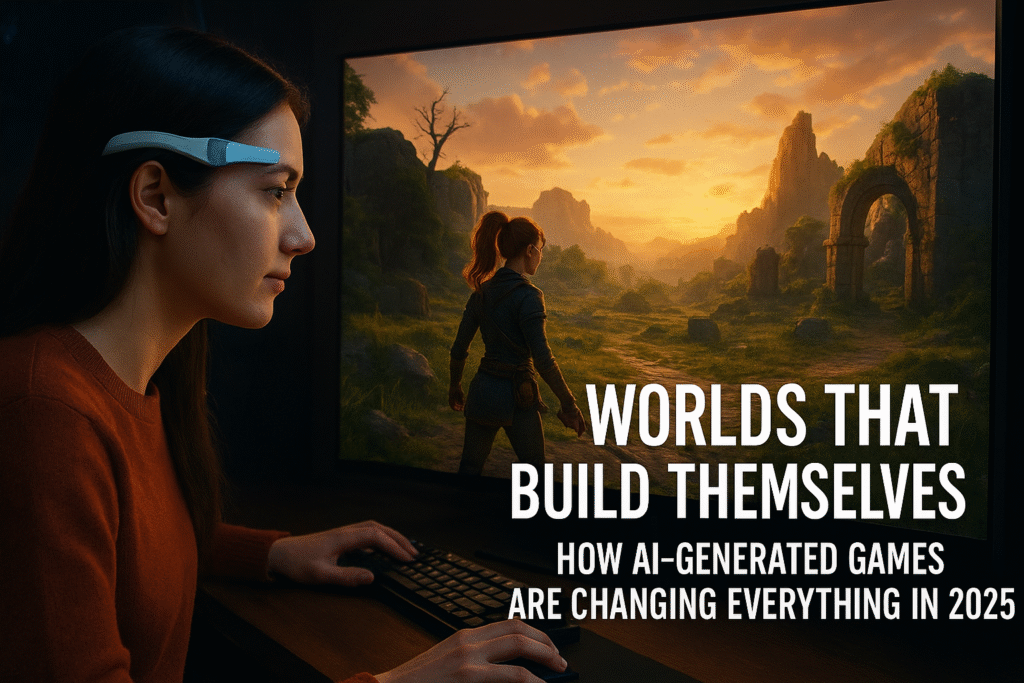
Imagine launching a game where every mission, dialogue, and world is uniquely created for you — not by human developers, but by AI.
In 2025, this isn’t a fantasy anymore. AI-generated games are here, and they’re rewriting the rules of game design forever.
From Static Games to Living Worlds
For decades, game developers spent years crafting levels, writing dialogue, and balancing storylines. But with the rise of generative AI, games are starting to create themselves in real time.
Instead of exploring a world that was built once and sold to millions, players now step into living universes that evolve differently for each person.
Every quest, NPC interaction, and environment can be unique — designed by neural networks that learn from your playstyle, emotions, and decisions.
The Power Behind It: Generative AI
AI tools like ChatGPT, Midjourney, and Unity Muse have evolved into full-scale game world engines.
These systems can now:
- Generate storylines based on your moral choices.
- Create dialogues where NPCs remember past interactions.
- Design levels that adapt to your skills and behavior.
- Even compose music that matches your emotions in the moment.
Developers no longer write every line of code — they train AIs to do it dynamically.
Games like AI Dungeon 3.0, Inworld Origins, and Ubisoft’s NEO are already using generative AI to make gaming infinitely replayable.
NPCs With Real Emotions and Memories
Gone are the days of robotic NPCs repeating the same lines.
In 2025, NPCs (non-playable characters) are powered by neural dialogue systems that give them memory, emotions, and personality evolution.
An NPC you saved in one mission might greet you differently next time — remembering your kindness or betrayal.
Some might even refuse to follow your orders if your choices go against their moral code.
It’s not just immersion — it’s relationship-building with AI.
Infinite Replay Value
Traditional games have an end. AI-generated ones don’t.
Each playthrough reshapes the world — new locations, unexpected storylines, and entirely new characters appear.
You could spend hundreds of hours in the same game, yet never experience the same moment twice.
This changes everything for open-world genres, RPGs, and sandbox games like Skyrim, Cyberpunk 2077, or No Man’s Sky.
The Player Becomes the Co-Creator
In this new era, the player isn’t just playing — they’re co-writing.
AI interprets your every move as feedback. It learns what you like — fast-paced combat, emotional dialogue, or strategic puzzles — and builds your world around it.
You become part of the creative process. Every decision, big or small, helps the AI shape the story’s next chapter.
It’s gaming that listens.
The Tech Giants Leading the Charge
Big studios and startups alike are embracing this AI revolution:
- Ubisoft NEO uses LLMs to create evolving story arcs.
- Inworld AI builds conversational NPCs with lifelike responses.
- Unity Muse and Epic’s MetaHuman AI generate realistic worlds and faces in seconds.
- OpenAI and NVIDIA are working on tools that allow small indie developers to create AAA-level AI-driven games without massive budgets.
By 2026, experts predict that over 40% of new titles will use generative AI for at least one major component — dialogue, level design, or world generation.
The Challenges Ahead
Of course, there are risks:
- Ethical concerns about AI behavior and content generation.
- Data privacy, since AI learns from player input.
- Creative control, as studios balance automation with human artistry.
But most agree that AI won’t replace developers — it will empower them to build faster, smarter, and bigger than ever before.
The Future of Play
AI-generated gaming is transforming play into something deeply personal.
No more “standard campaigns” or “preset endings.”
No more identical NPCs.
No more limits.
Every player gets a tailored adventure, every time.
The games of the future won’t just react to your choices — they’ll grow with you.
Final Thoughts
In 2025, gaming isn’t just about better graphics or faster processors. It’s about intelligent creativity — games that think, feel, and evolve.
As AI continues to merge with storytelling and world design, we’re entering a new golden age — one where players don’t just explore worlds…
They create them, live in them, and leave their mark forever.
Welcome to the era of AI-generated gaming — where imagination has no end.


