

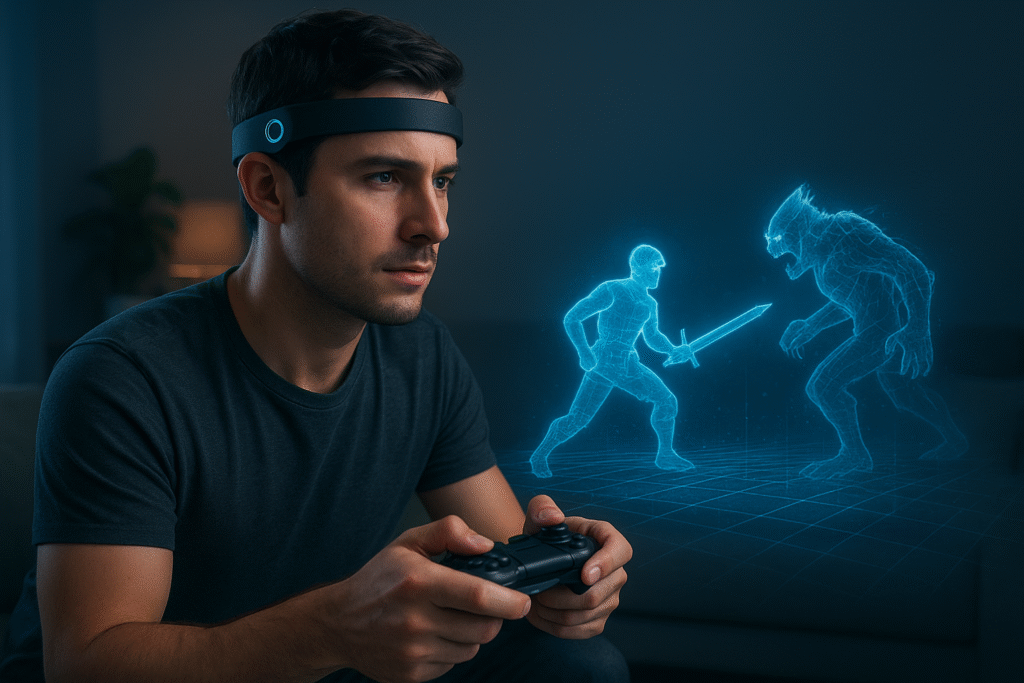
Gaming is about to leave controllers, keyboards, and even VR headsets behind.
Welcome to Neural Gaming — where your mind becomes the controller.
The fusion of Brain-Computer Interfaces (BCIs) and gaming is changing everything we know about play, reaction, and immersion. It’s not science fiction anymore — it’s the next frontier of interactive entertainment.
🧠 What Is Neural Gaming?
Neural gaming uses Brain-Computer Interface (BCI) technology — devices that translate brain signals into digital commands — allowing players to control games with their thoughts, focus, or emotions.
Instead of pressing a button to jump or shoot, your brain activity triggers the action.
Want to move an object? Just think about it.
Want to boost your power? Focus your mind.
It’s gaming that happens at the speed of thought.
⚙️ How Does It Work?
BCIs use electrodes (either wearable headbands or implanted sensors) to read your brain’s electrical signals.
AI algorithms interpret these signals and convert them into in-game commands.
For example:
- Concentrating harder might make your character sprint.
- Relaxing could slow the game down or recharge energy.
- Emotional responses like excitement or fear might alter the storyline dynamically.
This means every player’s experience becomes unique and adaptive — no two sessions are ever the same.
🎮 Why Gamers Are Excited
1. No More Controllers
Players can move, aim, or interact without any physical input. It’s ideal for hands-free, fully immersive gameplay.
2. Deeper Immersion
Neural gaming reacts to your mental state — if you’re stressed, enemies might notice; if you’re calm, stealth becomes easier. Games start responding to your emotions.
3. Accessibility Revolution
For players with disabilities, BCIs open up a new world of inclusive gaming — where anyone can play, regardless of physical ability.
4. Training the Mind
BCI gaming enhances focus and brain endurance. Some studies suggest that consistent neural gaming improves memory, decision-making, and cognitive agility.
🚀 The Tech Behind the Revolution
🧩 Major Players
Companies like Neuralink, OpenBCI, and Valve’s brain-interface team are leading the movement. Valve’s experimental projects are exploring how emotional signals could alter in-game physics and narrative outcomes.
⚡ Real-World Examples
- NextMind (by Snap Inc.): lets players use concentration to trigger game mechanics.
- Neuralink’s prototype: connects implants directly to neurons for ultra-low-latency control.
- Emotiv headsets: already being used in indie games and research simulations.
🕹️ The Future of Gaming Experience
Imagine playing a game like Elden Ring or Call of Duty, where your fear raises the stakes, or your calmness boosts stealth.
Or an open-world RPG where your thoughts literally build worlds, creating structures or powers directly from imagination.
Developers are already experimenting with AI-generated gameplay driven by brainwaves — games that learn from your mind to adjust storylines, difficulty, and even music tempo in real time.
🧩 The Challenges
- Privacy & Data: Brain data is deeply personal — who owns it?
- Safety: Long-term neural device use is still being researched.
- Affordability: Early BCI gear costs thousands of dollars, though prices are dropping fast.
Despite these challenges, early adopters and major studios are betting big. Analysts predict the neural gaming market could surpass $20 billion by 2032.
⚡ The Future Is Mind-Controlled
From mental fitness games to emotion-driven narratives, neural gaming is redefining what it means to play.
It’s no longer just you playing the game — it’s you becoming the game.
In the next few years, mind-controlled gaming could be as common as VR is today.
The line between thought and action is disappearing — and the next level of gaming isn’t on your screen… it’s in your mind.