

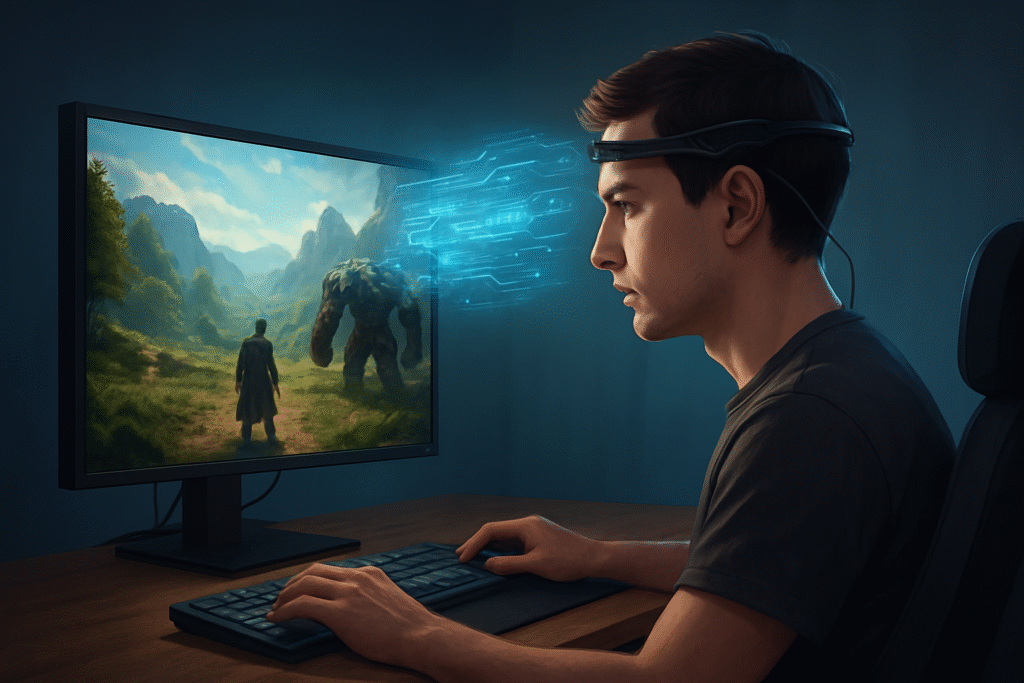
The world of gaming is changing faster than ever — and AI isn’t just behind the scenes anymore, it’s becoming part of the game itself.
In 2025, artificial intelligence has gone from being a tool to being a co-creator.
From designing vast open worlds to creating emotionally intelligent NPCs, AI is redefining how we play, create, and experience games.
🤖 From Static Worlds to Living Universes
Gone are the days when game worlds were static and predictable.
With generative AI, environments now evolve dynamically based on how you play.
Imagine this:
You enter a forest in an RPG — but instead of a fixed map, AI generates the terrain, weather, and creatures in real time, adapting to your playstyle.
- If you prefer stealth, the AI creates darker paths and quieter environments.
- If you love combat, it spawns challenging enemies that learn your attack patterns.
Games like No Man’s Sky 2.0, Elden Ring: Reforged, and Starfield AI Edition are experimenting with this concept — worlds that grow with you.
🧠 Smarter NPCs with Real Emotions
NPCs (non-playable characters) are no longer robotic.
In 2025, they think, learn, and feel using AI-driven behavioral systems.
Picture this — you insult a shopkeeper in a medieval game, and instead of a canned response, they remember it. The next time you visit, they raise prices or refuse to sell to you.
This isn’t scripted — it’s powered by large language models (LLMs) similar to ChatGPT, integrated directly into the game’s engine.
NPCs can hold natural conversations, form relationships, and even evolve personalities.
Every player gets a unique experience.
🧩 AI-Generated Storylines
Storytelling in games has entered a new era.
Traditional games followed pre-written plots. But now, AI generates storylines on the fly, based on your in-game decisions and emotions.
Games like Project Infinity and EchoVerse use emotion-sensing AI to detect player frustration or excitement, then alter the plot accordingly.
Feeling confident? The AI intensifies the difficulty.
Feeling tired? It shifts to exploration or narrative-driven scenes.
Every session becomes a one-of-a-kind story — written for you, by AI.
🕹️ How It’s Changing PC, Console, and Mobile Gaming
💻 PC Gaming
PCs, with their raw processing power, are leading the charge.
AI modding tools now let gamers create entire levels or characters just by typing a prompt.
Players can build a game world in seconds — no coding needed.
🎮 Console Gaming
PlayStation 6 and Xbox Series Z are integrating AI to optimize performance dynamically — adjusting frame rates, lighting, and sound in real-time for a smoother experience.
You’re no longer playing a fixed game — you’re playing a learning ecosystem.
📱 Mobile Gaming
On mobile, AI is optimizing gameplay for personalization.
Games now adjust difficulty, pacing, and even color tones based on your attention span and reaction time.
It’s like having a game that understands you better than you do.
🏆 The Rise of AI eSports
Competitive gaming is also being transformed.
AI is helping eSports teams analyze opponents’ playstyles, predict moves, and craft real-time strategies.
AI “coaches” are becoming as important as human ones — using predictive analytics to give players a mental edge during matches.
Some tournaments even feature AI-only matches, where machine learning models compete in self-learning simulations — drawing millions of live viewers.
🌐 The Creator Revolution: Gamers as Developers
One of the biggest shifts AI has brought to gaming is player empowerment.
Tools like Scenario, Inworld AI, and Leonardo AI let players build their own games, characters, and assets instantly.
You no longer need to be a developer — you can just describe your vision in words, and AI does the rest.
In 2025, creativity is limitless. Every gamer is a potential creator.
⚙️ The Challenges
Of course, this revolution isn’t without obstacles.
- Ethical concerns: Should AI decide what’s “fun” or “challenging”?
- Job impact: AI-driven game design may replace traditional developers and artists.
- Data privacy: AI engines learning from player behavior raises new privacy questions.
But with every breakthrough comes innovation — and the industry is learning to balance automation with creativity.
🚀 The Future: AI + Human Collaboration
The most exciting part?
AI isn’t replacing human creativity — it’s amplifying it.
Developers and players are working side-by-side with AI, crafting experiences that blend imagination with intelligence.
We’re entering an era where every game can evolve endlessly — where no two playthroughs are ever the same.
🔮 Conclusion
Artificial Intelligence has turned gaming into a living, breathing ecosystem.
It learns from you, adapts to you, and plays with you.
From smarter NPCs to evolving worlds and AI-powered storylines, the boundaries between reality and imagination are disappearing.
In 2025, gaming isn’t just entertainment — it’s intelligent co-creation.
And this is only the beginning.


